
Blood Tests for Women Over 40: Which Ones Do You Really Need?

Medically reviewed by Dr Lakshmi Vaswani, MBBS, DPB (Pathology), MBA
By Yellow Editorial · Last updated 27 October 2026

The short answer: the right blood tests in your forties are not the biggest package, they are the focused set chosen for how women actually feel at this age. A good midlife panel does two jobs: it rules out the common, treatable conditions that imitate perimenopause, and it covers basic heart and metabolic health.
Some of the symptoms of these conditions may be due to perimenopause. But more often than not, they could be signs of an underactive thyroid, low iron levels or changes in blood sugar.
A good place to start is with some basic investigations. These are generally affordable, widely available and can help your doctor identify common health problems before deciding whether more specialised tests, and in some cases hormone tests, are needed.
More tests is not the same as the right tests. What turns a report into an answer is choosing the markers for your symptoms, age and medical history, and having someone read them against your symptoms.
Why your forties are the age to test properly
Your forties can bring several changes, some of which you may notice and others that develop without obvious symptoms.
You might find that you're more tired than usual, you have brain fog and poor sleep, your weight is changing or your periods have become unpredictable. These can be signs of perimenopause, but thyroid problems, anaemia and changes in blood sugar can produce similar symptoms.
At the same time, your risk of conditions such as diabetes, high blood pressure and high cholesterol increases as you get older.
That is the real case for testing in your forties. Not to collect numbers, but to separate the treatable causes from the hormone shift, so you act on the right one instead of guessing.
The blood tests actually worth doing
There isn't one standard panel that every woman over 40 needs.
Your doctor will usually begin with a few basic tests, depending on your symptoms and health history. If something needs further investigation, additional tests can help provide a clearer picture.
Here's how that approach might look.
| Area | Tests your doctor may consider | Why they may help |
|---|---|---|
| Thyroid | TSH initially; free T4 and anti-TPO antibodies when indicated | Thyroid problems can cause tiredness, weight changes and irregular periods. TSH is usually the first test. |
| Iron stores | Complete blood count (CBC), including haemoglobin; and ferritin | A CBC can detect anaemia, with low haemoglobin levels. Ferritin checks iron stores. Low serum iron is the top cause of midlife fatigue in Indian women and falls before haemoglobin does. |
| Blood sugar | HbA1c or fasting blood glucose | Helps identify prediabetes or diabetes, which can develop without obvious symptoms. |
| Heart health | Lipid profile | Checks cholesterol and triglycerides to evaluate heart health. |
| Vitamins | Vitamin B12 or vitamin D, when indicated | May identify deficiencies when symptoms, dietary habits or other risk factors suggest them. Both deficiencies are widespread in India and cause fatigue, aches and low mood. |
| Kidney and liver health | Kidney or liver function tests, when indicated | Useful for certain medical conditions, risk factors or medicines requiring monitoring. |
What to skip, and the "full body checkup" trap
The marketing promise of a full body checkup is reassurance: test everything, miss nothing. The reality is quite the opposite.
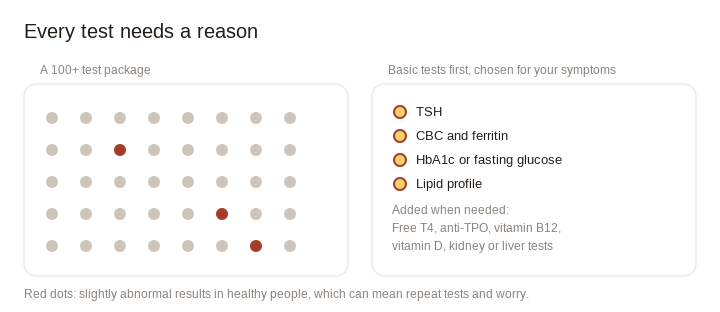
If you've ever looked at a full-body health check-up package, you'll know how overwhelming the list can be. Some include 80, 100 or even 120 tests. It can be tempting to assume that the larger the package, the more thorough the check-up. But every test needs a reason.
Large panels can also produce slightly abnormal results in otherwise healthy people. Those results may lead to repeat investigations and unnecessary worry.
A smaller set of well-chosen tests, followed by further investigations when needed, is often a sensible way to begin.
What about hormone tests?
Hormone tests are an important part of investigating certain women's health conditions. But their usefulness depends on what your doctor is trying to find out.
During perimenopause, oestrogen and follicle-stimulating hormone (FSH) levels can fluctuate considerably. A blood sample taken on one day may give a very different result from one taken a few weeks later.
This is why guidelines, including those from NICE, generally recommend identifying perimenopause from symptoms and menstrual history in otherwise healthy women aged 45 or older.
However, there are situations where hormone testing can be particularly helpful.
For example, if you're between 40 and 45 and your periods have become irregular or stopped, your doctor may recommend FSH testing to investigate early menopause, or when symptoms suggest another hormonal condition.
Our guide on hormone tests for perimenopause explains this in full, and the AMH test guide covers why that popular test cannot date your menopause either.
The India layer most perimenopause checklists miss
Western "over 40" checklists under-weigh the deficiencies that dominate here. In India these belong near the top of the list, not as afterthoughts.
Iron deficiency and anaemia
A nationwide study found that more than half of Indian women aged 15 to 49 were anaemic.
That doesn't mean every woman experiencing fatigue has low iron. But anaemia is common enough to deserve attention, particularly if you have heavy periods, feel breathless during everyday activities or are constantly exhausted.
See low iron or perimenopause.
Thyroid problems
Thyroid disorders can cause symptoms that resemble perimenopause, including fatigue, weight gain, hair thinning and irregular periods.
A study of more than 5,000 people across eight Indian cities found that nearly 1 in 6 women had hypothyroidism. Almost 22% tested positive for anti-TPO antibodies.
This test can help identify an autoimmune cause of thyroid disease, including in some people whose thyroid hormone levels are still normal.
Vitamin B12 and vitamin D deficiencies
Indian studies suggest that around 1 in 2 people may have vitamin B12 deficiency, while 6 in 10 may have vitamin D deficiency. Vitamin B12 deficiency is particularly common among vegetarians, while vitamin D deficiency can occur even if you get regular sunlight. Both can contribute to fatigue and weakness. Your doctor may recommend testing if you have symptoms or risk factors.
Blood sugar and abdominal weight gain
Nearly 4 in 10 Indian adults have excess fat around their waist, which increases the risk of diabetes and heart disease. If you've gained weight around your waist or have a family history of diabetes, an HbA1c or fasting blood glucose test can help identify problems early.
Heart health
More than 1 in 3 Indian adults have high blood pressure, often without knowing it. High cholesterol may also cause no symptoms. Regular blood pressure checks and a lipid profile, when appropriate, can help identify these risks early.
How to prepare and how to read the results
A little preparation can help ensure your results are accurate.
For a fasting blood glucose test or a lipid profile, you'll need an overnight fast of 10 to 12 hours. Water is allowed.
An HbA1c test doesn't require fasting. Neither do most routine thyroid tests, CBCs or ferritin tests, though many people do the whole draw together in the morning.
Biotin, which is found in some hair, skin and nail supplements, can affect certain thyroid laboratory tests. Tell your doctor or laboratory about any supplements and medicines you're taking.
Then the part that actually matters: do not read the report alone.
When your results arrive, try not to focus only on the numbers marked in red.
A slightly abnormal result doesn't always mean you have a disease. Equally, a result within the laboratory's normal range may need further assessment if you have persistent symptoms.
Take the symptoms you came in with and map each to what the blood supports or clears.
Your doctor can help interpret the results alongside how you're feeling and decide whether anything needs to be repeated or investigated further.
A test is only as good as the conversation it starts.
This is exactly what Yellow's blood panel is built to do. It runs the focused, symptom-led set rather than a 100-test package, puts the India-specific deficiency layer first, and returns a plain read of what is driving how you feel, interpreted against your symptoms rather than left as a page of numbers. You can see how it works at yellowforhormones.com. Yellow’s blood tests are also offered on their own, as the perimenopause panel.
Frequently Asked Questions
What blood tests should a woman over 40 get?
There isn't one standard panel. Your doctor will usually start with a few basic tests chosen for your symptoms and health history: TSH for the thyroid, a complete blood count and ferritin, HbA1c or fasting blood glucose, and a lipid profile. Free T4, anti-TPO antibodies, vitamin B12, vitamin D and kidney or liver tests are added when your symptoms or risk factors call for them.
Is a full body checkup worth it?
Not always. Some packages include 80 to 120 tests, and a larger package is not necessarily a more thorough check-up. Large panels can produce slightly abnormal results in healthy people, which may lead to repeat tests and worry. A smaller set of tests chosen for your symptoms, with further tests when needed, is often a sensible way to begin.
Do I need hormone tests over 45?
Usually not, if you have typical perimenopause symptoms such as hot flushes and changes in your periods. Your doctor can often recognise perimenopause without hormone tests, because FSH and oestrogen fluctuate and one result may not reflect what is happening. Hormone testing can be helpful in certain situations, particularly if you're younger, your symptoms are unusual or another hormonal condition is suspected.
Do I need to fast for these blood tests?
For a fasting blood glucose test or a lipid profile, yes: usually an overnight fast of 10 to 12 hours, with water allowed. HbA1c, most routine thyroid tests, a CBC and ferritin do not need fasting, though many people do the whole draw together in the morning. Confirm with the lab when booking.
Which tests matter most for Indian women over 40?
Anaemia, thyroid problems, vitamin B12 and vitamin D deficiency, high blood sugar and high blood pressure are all common in India. A complete blood count and ferritin, TSH, HbA1c or fasting glucose, and a lipid profile cover the most common of these. Your doctor may add vitamin B12 or vitamin D if your symptoms, diet or other risk factors suggest a deficiency.
How often should I get blood tests in my 40s?
There is no single rule, but a focused panel every one to two years is reasonable for most women, and sooner if you have new or persistent symptoms or an abnormal result to recheck. Low iron in particular should be retested after treatment to confirm stores have refilled. Agree a schedule with your doctor.
Further Reading
- Ministry of Health and Family Welfare, Government of India. Steps taken under Anaemia Mukt Bharat (AMB) strategy. Press Information Bureau; 2 August 2022.
- Unnikrishnan AG, Kalra S, Sahay RK, Bantwal G, John M, Tewari N. Prevalence of hypothyroidism in adults: an epidemiological study in eight cities of India. Indian J Endocrinol Metab. 2013;17(4):647-652.
- Venkatesh U, Sharma A, Ananthan VA, Subbiah P, Durga R. Micronutrient's deficiency in India: a systematic review and meta-analysis. J Nutr Sci. 2021;10:e110.
- Anjana RM, Unnikrishnan R, Deepa M, et al. Metabolic non-communicable disease health report of India: the ICMR-INDIAB national cross-sectional study (ICMR-INDIAB-17). Lancet Diabetes Endocrinol. 2023;11(7):474-489.
- National Institute for Health and Care Excellence. Menopause: identification and management. NICE guideline NG23. Published 12 November 2015, updated 7 November 2024.
- American Diabetes Association Professional Practice Committee. 2. Diagnosis and classification of diabetes: Standards of Care in Diabetes 2026. Diabetes Care. 2026;49(suppl 1):S27-S49.
- Association for Diagnostics & Laboratory Medicine. ADLM guidance document on the measurement and reporting of lipids and lipoproteins. J Appl Lab Med. 2024.