
AMH Test and Menopause: What It Can Predict and What It Cannot

Medically reviewed by Dr Lakshmi Vaswani, MBBS, DPB (Pathology), MBA
By Yellow Editorial · Last updated 20 November 2026

The short answer: an AMH (anti-Mullerian hormone) test measures how many eggs your ovaries have left, which is called your ovarian reserve. AMH levels generally fall with age and become very low after menopause. But the test cannot tell you whether you are in perimenopause or predict when your periods will stop.
Research shows that AMH can give us some clues about when menopause might happen, but the prediction for any one woman can be off by several years.
AMH is most useful during fertility treatment, where it helps doctors understand how your ovaries might respond. It can also be useful in certain cases when periods stop unusually early, particularly before 40.
If you are over 45 and experiencing hot flushes, poor sleep and changing periods, an AMH test probably won't tell you much more than you already know. In fact, guidelines do not recommend using it to diagnose perimenopause or menopause at this age.
The bottom line: an AMH test can answer some useful questions about your ovaries. Predicting exactly when menopause will happen isn't one of them.
What does an AMH test measure?
AMH is a hormone made by the small, immature follicles in your ovaries. The more eggs you have in reserve, the more AMH you make, so the blood level is used as a marker of ovarian reserve: a rough count of how much egg supply is left.
Because that supply only falls with age, AMH falls too. Levels tend to be higher in your twenties, lower through your thirties and forties, and very low or undetectable after menopause.
One practical point in its favour: AMH is stable across your cycle, so unlike FSH or oestrogen it can be drawn on any day, and you do not need to fast for it. However, certain hormonal contraceptives can temporarily lower AMH levels, so tell your doctor if you're using them.
Can an AMH test predict menopause?
Only roughly.
Research shows that women with very low AMH levels in their mid-forties tend to reach menopause sooner than women with higher levels.
But this is an average across large groups of women. It doesn't mean the test can accurately predict when menopause will happen for you.
A large review of research found that AMH can help predict menopause at a population level, but the estimates for individual women remain too uncertain to rely on.
So even with your AMH result, a doctor cannot reliably tell you whether your last period is one year away or six.
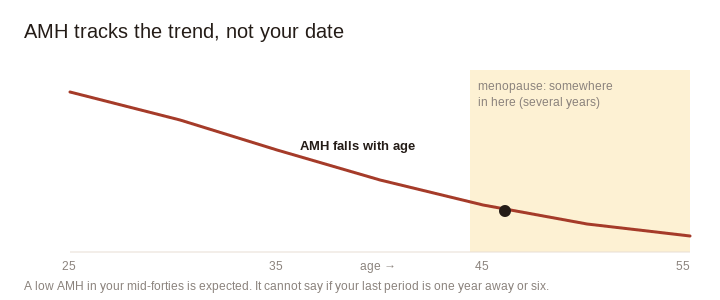
If what you want is "am I in perimenopause," the honest answer is that your symptoms and cycle changes are the better guide, not this number.
AMH is not the same as a perimenopause diagnosis
Perimenopause is diagnosed from the pattern you are living: changing cycles, hot flushes, disrupted sleep, mood shifts, brain fog. Over 45 with that pattern, guidelines say no blood test is needed to name it. Our guide to the signs of hormonal imbalance in women sets out what to look for.
AMH tells you about your remaining egg supply. It doesn't tell you whether hormonal changes are causing your symptoms.
You could have a low AMH and feel perfectly fine. Or you could have a higher AMH and still be struggling with perimenopause symptoms.
So a low AMH doesn't confirm perimenopause, and a higher result doesn't rule it out.
Your symptoms and menstrual history are far more useful than an AMH number when it comes to understanding whether you're in perimenopause.
When an AMH test is genuinely worth doing
There are clear situations where AMH earns its place:
| Situation | Why AMH helps |
|---|---|
| Planning pregnancy or fertility treatment | Helps doctors estimate how your ovaries might respond to treatment and how many eggs may be collected. It cannot predict your chances of getting pregnant naturally. |
| Periods stopped or very irregular under 40 | May help doctors investigate premature ovarian insufficiency (POI), particularly when other test results are unclear. FSH remains the main blood test used for diagnosis. See perimenopause symptoms in your late 30s |
| Suspected PCOS | AMH is often high in PCOS and adds to the picture, with other tests |
| Before certain treatments that affect the ovaries | May help doctors assess your ovarian reserve before treatments such as chemotherapy. |
What is a normal AMH level by age?
There is no single "normal" AMH level for every woman. AMH generally falls with age, so a result that is typical at 30 may be quite different from one at 45. Different laboratories may also use different units and reference ranges.
A low AMH at 46 is usually expected. The same result at 32, particularly if your periods have become irregular or stopped, may need further investigation.
It's also important to remember that a low AMH doesn't automatically mean you cannot get pregnant. The test gives an idea of your remaining egg supply, but it cannot reliably predict your chances of conceiving naturally.
This is why it's best to discuss your result with a doctor who can interpret it alongside your age, menstrual history and reason for testing. If you are not sure who to ask, see which doctor to consult for hormonal imbalance in India.
What to test instead if you feel unwell over 45
If you are over 45 and the real question is "why do I feel like this," the more useful tests are the ones that catch the conditions mistaken for perimenopause, because many of them are common in India and very treatable.
That means thyroid tests (TSH first, with free T4 and anti-TPO if needed), ferritin for iron stores, vitamin B12, vitamin D, and HbA1c with fasting glucose. Our guide on hormone tests for perimenopause covers the full picture of what blood can and cannot show.
This is also the thinking behind Yellow's blood panel. It looks at common health concerns that can overlap with perimenopause symptoms, including nutritional deficiencies and metabolic health, to help you better understand what might be contributing to how you feel. You can see how it works at yellowforhormones.com. Yellow’s blood tests are also offered on their own, as the perimenopause panel.
Frequently Asked Questions
Can an AMH test tell me if I am in perimenopause?
No. AMH measures ovarian reserve, not whether your hormones are in transition or causing symptoms. Over 45, perimenopause is diagnosed from symptoms and cycle changes, not blood. A low AMH is expected with age and does not confirm that your symptoms are perimenopausal.
At what AMH level does menopause start?
There is no specific AMH level that tells you menopause has started. AMH levels become very low or undetectable after menopause, but they cannot tell you exactly when it will happen. Women in their mid-forties with low AMH may reach menopause sooner on average, but the timing can vary by several years. This is why NICE does not recommend AMH testing to diagnose menopause.
How is AMH checked, and do I need to fast?
AMH is checked with a simple blood test. Your levels don't change much during your menstrual cycle, so you can usually have the test on any day. You don't need to fast either. But remember, while the test is easy to do, it can't tell you exactly when menopause will happen.
What is a good AMH level for a 45-year-old woman?
There is no single 'good' AMH level at 45. AMH naturally drops as you get older, so a low result in your mid-forties is quite common and doesn't necessarily mean something is wrong. The same result in a 32-year-old who has stopped getting her periods might need a closer look. Your age, symptoms and medical history all help make sense of the result.
Can I get pregnant with a low AMH?
Yes, pregnancy is still possible with low AMH. The test gives an idea of how many eggs you may have left, but it doesn't tell you about their quality. AMH is more useful for predicting how your ovaries might respond during IVF than for telling you whether you can get pregnant naturally. Your age plays a much bigger role. If you're planning a pregnancy, a fertility specialist can help you understand what your AMH result means for you.
My AMH is low and I am scared. What does it mean?
If you are in your mid-forties, a low AMH is a normal part of ageing and not a diagnosis of anything wrong. If you are under 40 with changing or absent periods, it is worth a proper work-up with a doctor rather than a reason to panic over a single number.
How much does an AMH test cost in India?
On 20 November 2026, eight labs and lab-booking sites in India listed an AMH test at ₹786 to ₹2,400. The price changes by city and with the offer running that day. AMH is one of the 22 tests in Yellow's perimenopause panel, which costs ₹4,999.
Further Reading
- National Institute for Health and Care Excellence (NICE). Menopause: identification and management (NG23), published 2015, last updated 15 April 2026, including identifying perimenopause and menopause without laboratory tests at 45 or over (recommendation 1.3.1) and the tests not to use at that age (recommendation 1.3.4).
- Depmann M, Eijkemans MJC, Broer SL, et al. Does AMH relate to timing of menopause? Results of an individual patient data meta-analysis. Journal of Clinical Endocrinology and Metabolism, 2018;103(10):3593-3600.
- Freeman EW, Sammel MD, Lin H, Gracia CR. Anti-Mullerian hormone as a predictor of time to menopause in late reproductive age women. Journal of Clinical Endocrinology and Metabolism, 2012;97(5):1673-1680.
- National Health Service (NHS UK). Menopause and perimenopause: diagnosis, reviewed 2024.
- Practice Committee of the American Society for Reproductive Medicine. Testing and interpreting measures of ovarian reserve: a committee opinion. Fertility and Sterility, 2020;114(6):1151-1157.
- Nelson SM, Davis SR, Kalantaridou S, et al. Anti-Mullerian hormone for the diagnosis and prediction of menopause: a systematic review. Human Reproduction Update, 2023;29(3):327-346.
- European Society of Human Reproduction and Embryology, American Society for Reproductive Medicine. Evidence-based guideline: premature ovarian insufficiency. 2025.
- Teede HJ, Tay CT, Laven JJE, et al. Recommendations from the 2023 international evidence-based guideline for the assessment and management of polycystic ovary syndrome. Human Reproduction, 2023;38(9):1655-1679.