
FSH and LH Test Results for Women: Normal Ranges and What They Mean

Medically reviewed by Dr Lakshmi Vaswani, MBBS, DPB (Pathology), MBA
By Yellow Editorial · Last updated 20 November 2026
The short answer: FSH (follicle-stimulating hormone) and LH (luteinising hormone) are hormones that help control your menstrual cycle and ovulation. Their levels naturally rise and fall throughout the month, so what's considered normal depends on where you are in your cycle and your age. As a guide, one university lab gives a normal FSH of about 2 to 12 IU/L early in the cycle and about 21 to 131 IU/L after menopause. FSH levels tend to rise as you approach menopause. However, a single FSH test cannot reliably confirm or rule out perimenopause because hormone levels can fluctuate considerably during this time. Your doctor will interpret your results alongside your symptoms, menstrual history and the reference ranges on your lab report.
What is the full form of FSH and LH, and what do they do?
FSH stands for follicle-stimulating hormone and LH stands for luteinising hormone. They are produced by the pituitary gland, a small gland at the base of your brain. They work together to control your menstrual cycle.
- FSH helps eggs develop inside small, fluid-filled sacs in your ovaries called follicles. As the follicles grow, they produce oestrogen.
- LH rises sharply around the middle of your cycle, triggering ovulation (the release of an egg from an ovary). After ovulation, it helps the ovary produce progesterone, a hormone that prepares the womb for a possible pregnancy.
Your ovaries and brain are constantly communicating through hormones. When the ovaries produce less oestrogen, the brain responds by releasing more FSH. This helps explain why FSH levels tend to rise as you approach menopause.
What are normal FSH and LH levels for women?
FSH and LH levels change throughout your menstrual cycle and are usually higher after menopause. Reference ranges also vary between laboratories, so the numbers below are a general guide.
| Phase | FSH (IU/L) | LH (IU/L) | What is happening |
|---|---|---|---|
| Follicular (early cycle, roughly days 1 to 13) | 2.0 to 12.0 | 2 to 15 | FSH helps eggs develop |
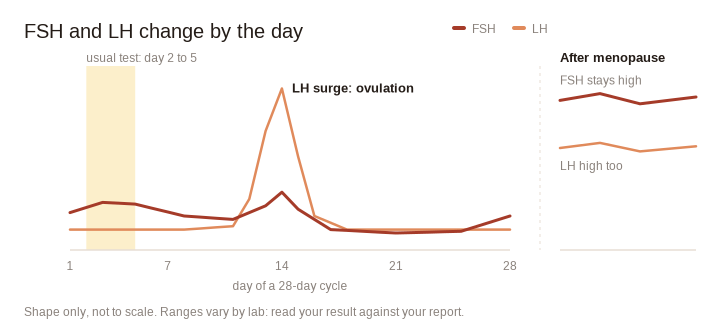
| Mid-cycle (around ovulation) | 5.0 to 24.0 | 22 to 105 | The LH surge triggers ovulation |
| Luteal (after ovulation) | 1.5 to 10.0 | 0.1 to 19 | Progesterone rises; FSH and LH fall back |
| Postmenopausal | 21.0 to 131.0 | 16 to 64 | FSH and LH levels generally remain higher |
These reference ranges are from Michigan Medicine Laboratories, University of Michigan. Your own laboratory may use slightly different ranges.
FSH and LH may be reported in IU/L or mIU/mL. Both units give the same numerical value.
Why is an FSH test done on day 2 to 5 of your cycle?
FSH is often measured between days 2 and 5 of your menstrual cycle because hormone levels are relatively stable during this time. This gives your doctor a clearer starting point, particularly when checking fertility or ovarian function.
Count the first day of your period (when full bleeding begins) as day 1. Your doctor may ask you to have the test on day 2 or 3.
Testing later in your cycle can give a different result because FSH naturally rises and falls throughout the month.
If your periods are very irregular or have stopped, your doctor may recommend testing on a different day, depending on what they're looking for.
What does a high FSH level mean?
A high FSH level usually means your ovaries are responding less to hormonal signals from the brain. This commonly happens during perimenopause and menopause.
As you approach menopause, FSH levels generally rise, although they can vary considerably from month to month. Changes in your periods, particularly longer gaps between them, can help your doctor understand where you are in the menopause transition.
If you're under 40, a high FSH level alongside irregular or absent periods may suggest premature ovarian insufficiency (POI), a condition in which the ovaries stop functioning normally earlier than expected. Your doctor will need to assess your symptoms and test results to make a diagnosis.
FSH can also rise after certain cancer treatments or ovarian surgery.
Importantly, a high FSH result doesn't necessarily mean you can no longer get pregnant.
Why can one FSH test not confirm perimenopause?
One FSH test cannot confirm perimenopause because, in those years, FSH does not climb in a straight line. It rises in bursts as the ovaries respond some months and not others, then falls back. A woman can have a menopausal-range FSH in March and a perfectly ordinary one in April.
That is not a faulty test. In perimenopause, hormone levels go up and down rather than falling steadily. So a normal FSH does not mean "it is not perimenopause", and a high one does not mean "you are in menopause now." This is why the UK's NICE guideline (NG23, last updated April 2026) advises diagnosing perimenopause and menopause from symptoms, without blood tests, in women aged 45 and over. Our guide to what hormone tests can and cannot tell you in perimenopause covers that question in full, and what to test instead.
What does a low FSH or LH level mean?
A low FSH and LH usually means the brain is sending a weaker signal to the ovaries, rather than a problem in the ovaries themselves. Common reasons include:
- Hormonal contraception. The combined pill, patch and ring work partly by suppressing FSH and LH. High-dose progestogens can do the same.
- Hypothalamic amenorrhoea. Low body weight, heavy exercise, under-eating or major stress can reduce the signal from the brain, and periods can stop.
- Pituitary problems. A pituitary that makes too little hormone (hypopituitarism), or a high prolactin level, can lower FSH and LH.
- Pregnancy also lowers FSH.
When periods have stopped and FSH and LH are low or normal rather than high, the cause is usually in the brain (the pituitary or hypothalamus), not the ovaries.
| Result pattern | What it usually suggests | Typical next question |
|---|---|---|
| High FSH, high LH, periods irregular or stopped, over 45 | Late perimenopause or menopause | Do symptoms and cycle history fit? |
| High FSH under 40, periods irregular or stopped | Possible premature ovarian insufficiency | Repeat test and specialist review |
| High FSH once, normal next time | Perimenopausal fluctuation | Read symptoms, not the single number |
| Normal FSH, high LH, irregular periods | Sometimes seen in PCOS, but not diagnostic | Androgens, ultrasound or AMH |
| Low FSH and LH, periods stopped | Hypothalamic or pituitary cause, or hormonal contraception | Weight, stress, prolactin, medicines |
| Mid-range FSH and LH on day 2 to 5, regular cycles | Usual pattern before perimenopause | Is anything else explaining symptoms? |
What does the LH to FSH ratio say about PCOS?
A high LH compared with FSH is seen in some women with polycystic ovary syndrome (PCOS), but it is not used to diagnose it. Many women with PCOS have a normal ratio, and LH changes so much through the cycle that the day of the test changes the result.
The 2023 international guideline on PCOS does not include LH or the LH to FSH ratio among its diagnostic criteria. In adults it asks for two of three features, after other causes are ruled out: signs or blood tests showing high androgens (male-type hormones), irregular or absent ovulation, and polycystic ovaries on ultrasound or a raised AMH level. A ratio flagged "suggestive of PCOS" is not a diagnosis. Our guide to hormonal imbalance tests explains which tests matter most.
How do the pill, HRT and other medicines affect FSH results?
The combined pill and high-dose progestogens suppress FSH and LH, so a result taken while you use them does not reflect what your ovaries are doing. NICE advises against using an FSH test to diagnose menopause in women using combined hormonal contraception or high-dose progestogen. Hormone therapy (HRT) also lowers FSH to a degree that varies by type and dose, which makes FSH a poor measure of menopause status while you take it.
This is not a reason to start or stop anything. It means telling whoever orders the test exactly which hormones you use, including any intrauterine system, implant, injection or HRT, so the result is read correctly.
Why is estradiol (E2) tested alongside FSH?
Estradiol, also written E2, is the main form of oestrogen made by the ovaries before menopause, and it is often tested with FSH because the two make sense as a pair. A high FSH with a low estradiol fits ovaries that are slowing. A low FSH with a low estradiol suggests the cause is in the brain, as in hypothalamic amenorrhoea.
MedlinePlus, a US government health site, gives a typical premenopausal range of 30 to 400 pg/mL, a wide band because estradiol changes so much through the cycle, and 0 to 30 pg/mL after menopause. In perimenopause estradiol can run high in some months, not just low, and NICE lists it among tests not to use to diagnose perimenopause or menopause over 45. For what low oestrogen feels like and its other causes, see our guide to low estrogen symptoms.
When is an FSH test genuinely useful?
An FSH test is useful in a few specific situations, mostly in younger women or when a practical decision depends on it.
- Under 40 with irregular or absent periods. FSH is central to diagnosing premature ovarian insufficiency. The 2024 international guideline on POI asks for irregular or absent periods for at least four months plus an FSH above 25 IU/L, and now says one raised FSH is enough with the typical picture, repeating it after 4 to 6 weeks if there is doubt. The NICE guideline asks for two raised FSH results 4 to 6 weeks apart. Your doctor will follow the guidance used locally.
- Aged 40 to 45 with symptoms and changing periods. NICE says an FSH test can be considered to help diagnose menopause in this group.
- Over 50 and deciding when to stop contraception. UK sexual health guidance allows an FSH test to help decide when contraception can stop in women over 50 who use a progestogen-only method and have no periods. It is not used while taking the combined pill.
- Fertility tests, where FSH is read with AMH and an ultrasound follicle count. Our guide to the AMH test and menopause explains what AMH adds.
Outside these, especially over 45 with typical symptoms, an FSH number rarely changes what happens next.
Where Yellow fits
An FSH result is easy to get and easy to misread: the same number means something different on day 3, day 14, at 38 and at 48. Yellow's blood panel is built around that. It reads hormone markers only where they answer a real question, and spends the rest of the panel on the conditions that most often explain how midlife women feel, from thyroid function to iron, vitamin B12 and vitamin D, then returns a plain read of what your results actually mean. You can see how it works at yellowforhormones.com. Yellow’s blood tests are also offered on their own, as the perimenopause panel.
Frequently Asked Questions
What is the full form of FSH and LH?
FSH stands for follicle-stimulating hormone and LH for luteinising hormone (luteinizing in US spelling). Both are made by the pituitary gland in the brain. FSH helps eggs develop in the ovaries, and a sharp rise in LH in the middle of the cycle triggers ovulation.
What is the normal LH range for a female?
It depends on the cycle phase. In one university lab's ranges, LH is about 2 to 15 IU/L early in the cycle, 22 to 105 at the mid-cycle surge, up to about 19 in the luteal phase, and 16 to 64 after menopause. Labs differ, so use the range printed on your report.
What FSH level indicates menopause?
No single FSH result can confirm menopause. After menopause, FSH usually stays high; one university lab gives a range of about 21 to 131 IU/L. If you are over 45, menopause is usually diagnosed after 12 months without a period, not from a blood test.
On which day should an FSH test be done?
Usually on day 2 to 5 of your cycle, counting the first day of full bleeding as day 1. That is when hormones are at a stable baseline that reference ranges are built around. If your periods are irregular or have stopped, your doctor may test on any day and read it against your history.
Can I have an FSH test while on the pill or HRT?
You can, but the result is hard to interpret. The combined pill and high-dose progestogens suppress FSH, and HRT lowers it too, so the number will not reflect your ovaries. NICE advises against using FSH to diagnose menopause in women on combined contraception. Tell whoever orders the test exactly what you take.
Does a high LH to FSH ratio mean I have PCOS?
No, not on its own. A raised ratio appears in some women with PCOS, but many have a normal one, and LH changes so much through the cycle that timing alters the result. The 2023 international PCOS guideline does not use the ratio for diagnosis; it relies on androgens, ovulation and ultrasound or AMH.
How much do FSH and LH tests cost in India?
On 20 November 2026, eight labs and lab-booking sites in India listed an FSH test at ₹187 to ₹739 and an LH test at ₹223 to ₹739. The price changes by city and with the offer running that day. Both tests are in Yellow's perimenopause panel, which has 22 tests for ₹4,999.
Further Reading
- National Institute for Health and Care Excellence (NICE). Menopause: identification and management (NG23), published 2015, last updated 15 April 2026, including when FSH testing should and should not be used and the diagnosis of premature ovarian insufficiency.
- Panay N, Anderson RA, Bennie A, Cedars M, Davies M, Ee C, et al.; ESHRE, ASRM, CRE-WHiRL and IMS Guideline Group on POI. Evidence-based guideline: premature ovarian insufficiency. Human Reproduction Open, 2024;2024(4):hoae065.
- Teede HJ, Tay CT, Laven JSE, et al.; International PCOS Network. Recommendations from the 2023 International Evidence-based Guideline for the Assessment and Management of Polycystic Ovary Syndrome. Journal of Clinical Endocrinology and Metabolism, 2023;108(10):2447-2469.
- Harlow SD, Gass M, Hall JE, Lobo R, Maki P, Rebar RW, Sherman S, Sluss PM, de Villiers TJ; STRAW+10 Collaborative Group. Executive summary of the Stages of Reproductive Aging Workshop + 10. Menopause, 2012;19(4):387-395.
- Michigan Medicine Laboratories (University of Michigan). Follicle Stimulating Hormone and Luteinizing Hormone test reference ranges, accessed October 2026.