
Low Estrogen Symptoms in Women: Signs, Tests and What Actually Helps
By Yellow Editorial · Last updated 12 October 2026
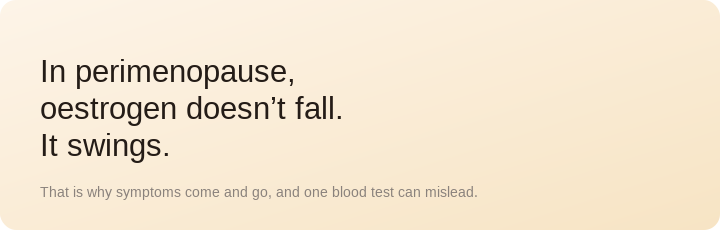
The short answer: the most common signs of low oestrogen (estrogen) are hot flushes (hot flashes), night sweats, vaginal dryness or painful sex, broken sleep, low mood or anxiety, brain fog, joint aches, and irregular periods that eventually stop. For most women over 40 the cause is perimenopause, and here is the part few people explain: in perimenopause oestrogen is not steadily low. It swings, sometimes higher than ever, sometimes very low, often in the same month. That is why symptoms come and go, and why a single estradiol blood test is usually unhelpful; the UK's NICE guideline (NG23) advises diagnosing perimenopause in women over 45 from symptoms, not blood tests. Food and supplements cannot replace the oestrogen your ovaries stop making, but there are effective treatments, hormonal and non-hormonal, worth an informed conversation with your doctor. In India, this conversation often needs to start earlier than you think: the average age of menopause here is about 46 (Ahuja, 2016), around five years earlier than in the West.
What does oestrogen do in a woman's body?
Oestrogen is best known for running the menstrual cycle, but it works far beyond the uterus. There are oestrogen receptors in the brain, blood vessels, bones, skin, joints, bladder and vaginal tissue. When oestrogen falls, all of these notice.
That is why low oestrogen does not feel like one symptom. It feels like a whole-body change: temperature control goes haywire, sleep fragments, mood shifts, skin and vaginal tissue thin and dry, joints ache, and bone starts to be lost faster. Women often describe it as "I do not recognise myself," which is a very accurate description of a hormone that touches so many systems at once.
What are the symptoms of low oestrogen?
The symptoms cluster into a few groups. Most women have some, not all.
| Area | Common symptoms of low oestrogen |
|---|---|
| Temperature | Hot flushes, night sweats, feeling suddenly flushed or clammy |
| Sleep | Waking at 2 or 3am, trouble getting back to sleep, often from night sweats |
| Mood and mind | Anxiety, irritability, low mood, brain fog, poor concentration, forgetting words |
| Vagina and bladder | Dryness, itching, burning, painful sex, needing to urinate often, repeat UTIs |
| Periods | Irregular, skipped, then stopped periods |
| Body | Joint and muscle aches, dry skin, thinning hair, lower libido |
| Silent changes | Faster bone loss, less favourable cholesterol |
The vaginal and urinary symptoms deserve a special mention because they are the most under-discussed. Doctors call them genitourinary syndrome of menopause (GSM). Unlike hot flushes, which usually ease over the years, GSM tends to get worse without treatment, and many women never mention it because they assume it is simply ageing. It is common, and it is very treatable.
If low mood has become persistent hopelessness, please do not wait for an appointment about hormones. In India you can call Tele-MANAS, the government's free mental health line, on 14416, any time.
Why do perimenopause symptoms come and go?
Because perimenopause is not a smooth decline in oestrogen. It is a rollercoaster. As the ovaries become less predictable, some cycles produce surges of oestrogen higher than in your thirties, and others produce very little. Progesterone, which depends on ovulation, falls more steadily.
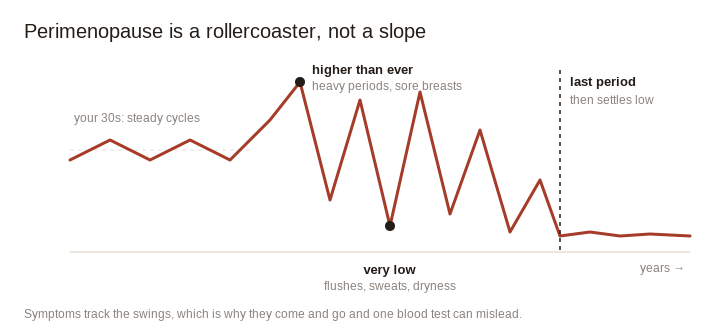
So the same woman can have both "high oestrogen" and "low oestrogen" symptoms within weeks of each other:
| High oestrogen phases | Low oestrogen phases |
|---|---|
| Heavy or flooding periods | Hot flushes and night sweats |
| Sore, swollen breasts | Vaginal dryness |
| Bloating, fluid retention | Broken sleep |
| Migraines, irritability | Low mood, brain fog |
This is also why searches for "how to reduce estrogen" and "how to increase estrogen" so often come from the same age group. Most women in their forties are not stuck at one end; they are moving between both. Heavy periods during the high phases have their own consequences, including iron loss, which our guide to the ferritin test covers.
What causes low oestrogen in women under 40?
After 45, perimenopause is by far the most likely cause. Before 40, low oestrogen always deserves a proper investigation, because the causes are different and some need specific care:
- Premature ovarian insufficiency (POI): the ovaries stop working normally before 40. It is more common than once thought, and it matters because years of low oestrogen affect bones and heart health. - Hypothalamic amenorrhoea: periods stop because the brain dials down the reproductive hormones in response to low body weight, under-eating, intense exercise or severe stress. - Surgery or treatment: removal of both ovaries, chemotherapy or pelvic radiotherapy. - Breastfeeding: oestrogen is naturally low while breastfeeding. - Certain medicines: for example, those used to treat endometriosis, fibroids or breast cancer. - Pituitary conditions, including a raised prolactin, which can switch off the cycle.
Is there a blood test for low oestrogen?
There is, but over 45 it rarely helps. An estradiol (E2) test measures oestrogen on the day of the blood draw. In perimenopause, levels swing so widely from week to week that one reading can look "normal," "high" or "menopausal" purely by chance. That is why NICE advises against using blood tests to diagnose perimenopause or menopause in women over 45 with typical symptoms. Our guide to hormone tests for perimenopause explains this in detail.
Testing is more useful in a few situations:
- Under 40, when POI is suspected, FSH is measured, usually twice, some weeks apart. - Between 40 and 45, with symptoms, FSH may be considered. - When periods stop for other reasons, estradiol, FSH, LH and prolactin help find the cause.
Just as important are the tests that rule out mimics. An underactive thyroid, low iron, and low vitamin B12 or vitamin D can all produce the fatigue, low mood and brain fog blamed on oestrogen. For that set, see hormonal imbalance symptoms and what to test.
How can I increase oestrogen naturally? Do foods help?
Honestly: not by much. No food, herb or supplement can replace the oestrogen your ovaries stop making in perimenopause. It is better to know that than to spend months and money on a promise.
Some foods, such as soy, tofu, flaxseed and chickpeas, contain phytoestrogens, plant compounds that act like very weak oestrogen. A Cochrane review (Lethaby et al., 2013) found no conclusive evidence that phytoestrogen foods or supplements reduce hot flushes, though some soy extracts may have a small effect for some women. They are perfectly healthy foods to eat, especially for vegetarians, but they are not a treatment.
What does make a real difference to how you feel during low-oestrogen years:
- Strength training and enough protein, which protect the muscle and bone that oestrogen used to help maintain. - Calcium and vitamin D, through food, sunlight or supplements if you are low, because bone loss speeds up around menopause. - A cooler bedroom, layered clothing and less alcohol, which reduce the trigger for night sweats. - Regaining a healthy weight, if low weight or under-eating has stopped your periods; in hypothalamic amenorrhoea, this can restore oestrogen. - A non-hormonal vaginal moisturiser and lubricant, for dryness and comfort during sex.
What treatments are there for low oestrogen symptoms?
These are the main options to discuss with a doctor. This is not a recommendation to take or avoid any of them.
| Option | What it is | Mainly helps with |
|---|---|---|
| Menopausal hormone therapy (HRT/MHT) | Oestrogen, usually with progestogen if you have a uterus, as tablets, patches or gel | Hot flushes, night sweats, sleep, mood, bone protection |
| Vaginal oestrogen | Low-dose cream, tablet or ring used locally | Dryness, painful sex, urinary symptoms, repeat UTIs |
| Non-hormonal prescription medicines | Some antidepressants and other medicines that reduce hot flushes | Hot flushes, for women who cannot or prefer not to use hormones |
| Cognitive behavioural therapy (CBT) | A structured talking therapy | Hot flush distress, sleep, low mood |
| Moisturisers and lubricants | Non-hormonal vaginal products | Dryness and comfort |
Two points are often misunderstood. First, low-dose vaginal oestrogen works locally and very little reaches the bloodstream, so The Menopause Society regards it as a different decision from whole-body HRT. Second, for women with POI, NICE advises hormone treatment until at least the natural age of menopause, unless there is a medical reason not to; for early menopause between 40 and 44, the balance of benefit and risk is worked out individually. The right choice depends on your age, symptoms, medical history and preferences, which is why it is a conversation, not a prescription from the internet.
Where Yellow fits
Low oestrogen is real, but it is also the explanation women are given most often without anyone checking what else might be going on. Yellow's membership helps you separate the two: understanding your symptoms and their pattern, checking the treatable mimics in your blood, and going into your doctor's appointment with clear questions about the options above. You can see how it works at yellowforhormones.com.
Frequently Asked Questions
What are the first signs of low estrogen?
For most women over 40, the first signs are changes in periods (shorter, longer or skipped cycles), hot flushes or night sweats, waking in the early hours, and new anxiety or irritability. Vaginal dryness and joint aches often follow. These usually reflect perimenopause, where oestrogen swings rather than falling steadily.
Can low estrogen cause anxiety and brain fog?
Yes. Oestrogen affects brain chemistry, sleep and temperature control, so falling or swinging levels can cause anxiety, low mood, irritability, poor concentration and forgetting words. Low iron, thyroid problems and poor sleep can cause the same, so they are worth ruling out with a doctor.
How do I know if my estrogen is low?
Mostly from your symptoms and their pattern, especially over 45. A blood test for estradiol is unreliable in perimenopause because levels change week to week. Under 40, or if periods stop for no clear reason, blood tests including FSH, estradiol and prolactin are useful to find the cause.
What foods increase estrogen in females?
Soy, tofu, flaxseed and chickpeas contain phytoestrogens, weak plant oestrogens. They are healthy foods, but a Cochrane review found no conclusive evidence they relieve hot flushes, and no food can replace the oestrogen the ovaries stop making. Strength training, protein, calcium and vitamin D do more for how you feel.
Can you have high and low estrogen symptoms at the same time?
Yes, especially in perimenopause. Oestrogen swings between unusually high and very low levels, sometimes within weeks. You may have heavy periods and sore breasts in one phase, then hot flushes and dryness in another. This is why symptoms come and go and a single blood test can mislead.
Is vaginal estrogen safe?
Low-dose vaginal oestrogen acts mainly on local tissue, and very little reaches the bloodstream. The Menopause Society considers it an effective treatment for vaginal dryness, painful sex and urinary symptoms, and a separate decision from whole-body HRT. Discuss your own history, especially any breast cancer history, with your doctor.
Further Reading
- National Institute for Health and Care Excellence (NICE). Menopause: identification and management (NG23), published 2015, last updated 15 April 2026.
- Ahuja M. Age of menopause and determinants of menopause age: A PAN India survey by IMS. Journal of Mid-life Health, 2016;7(3):126-131.
- Lethaby A, Marjoribanks J, Kronenberg F, Roberts H, Eden J, Brown J. Phytoestrogens for menopausal vasomotor symptoms. Cochrane Database of Systematic Reviews, 2013;(12):CD001395.
- The North American Menopause Society. The 2020 genitourinary syndrome of menopause position statement. Menopause, 2020;27(9):976-992.
- European Society of Human Reproduction and Embryology (ESHRE), ASRM, CRE-WHiRL and IMS. Evidence-based guideline: premature ovarian insufficiency. Human Reproduction Open, 2024.