
Low Iron or Perimenopause? Why a Ferritin Test May Be Worth Asking About

Medically reviewed by Dr Lakshmi Vaswani, MBBS, DPB (Pathology), MBA
By Yellow Editorial · Last updated 20 November 2026
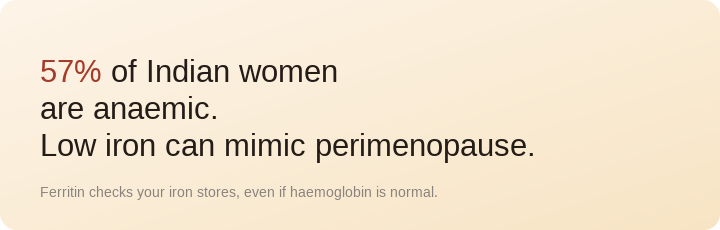
The short answer: the fatigue, hair fall, breathlessness and brain fog that women in their forties blame on hormones are very often low iron instead, and a normal haemoglobin result doesn't always rule it out. A ferritin test checks your iron stores.
In India, the National Family Health Survey (NFHS-5, 2019-21) found that 57% of women aged 15 to 49 have anaemia. Not all anaemia is caused by low iron, which is why further tests, including ferritin, may be needed to identify the cause.
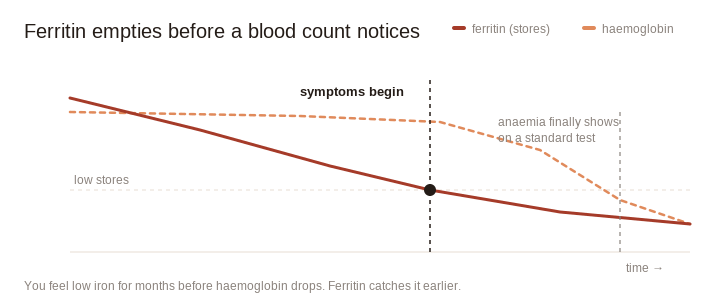
Ferritin measures your iron stores, the reserve tank your body draws on before anaemia develops.
Heavy or frequent periods during perimenopause can increase iron loss further. So if you're constantly exhausted but your haemoglobin report is normal, a ferritin test may be worth discussing with your doctor.
What is a ferritin test?
Ferritin is the protein that stores iron in your body. The ferritin level in your blood is the best everyday marker of how much iron you have in reserve.
Ferritin represents your iron reserves (the fuel tank), while haemoglobin represents the iron actively being used to carry oxygen in your blood (the fuel in the engine).
Because your body prioritises keeping the engine running, your haemoglobin levels can look completely normal on a standard blood test even while your ferritin levels are low.
That is why ferritin is so useful. It falls first. By the time your haemoglobin drops and a report finally says "anaemia," your stores have often been low for months or years, and you have been feeling it the whole time. A ferritin test catches the problem in that earlier window, which is exactly when it is easiest to fix.
Can low iron feel like perimenopause?
Yes, some of the symptoms overlap. Fatigue, poor concentration and hair shedding can occur with iron deficiency as well as during perimenopause. More severe iron deficiency, particularly when anaemia develops, can also cause breathlessness and a racing heart.
| What you feel | Could be linked to perimenopause | Could also be linked to low iron or anaemia |
|---|---|---|
| Exhausted no matter how you sleep | Yes | Yes |
| Brain fog, poor concentration | Yes | Yes |
| Hair thinning or shedding | Yes | Yes |
| Breathless on stairs, racing heart | Yes | Yes |
| Restless legs at night | Sometimes | Yes |
| Feeling cold, pale, low mood | Sometimes | Yes, particularly with anaemia |
Because the lists overlap, you cannot tell them apart by feel. The only way to separate "iron" from "hormones" is to measure iron properly. And often it is both at once: perimenopausal heavy periods cause the iron loss, so fixing the iron is part of fixing the picture.
Why Indian women are especially at risk
Two things stack up in India. First, the baseline: NFHS-5 (2019-21) found 57% of women aged 15 to 49 are anaemic, one of the highest rates in the world, driven by diet, menstrual loss and pregnancy history. Many women arrive in their forties with stores already low.
Second, in some women, perimenopause makes periods heavier and more frequent for a while before they stop. Heavier bleeding means more iron lost each month, on top of an already depleted baseline. A largely vegetarian diet, common across India, adds to the gap because the iron in plants is harder for the body to absorb than the iron in meat.
So for an Indian woman in her forties, low iron is one of the first things that should be ruled out.
What ferritin level is too low?
A ferritin below 15 ng/mL means your iron stores are very low, and 15 to 29 ng/mL may be low. The number on your report matters, but so does the context.
| Ferritin level | What it may mean |
|---|---|
| Below 15 ng/mL | Your iron stores are very low. This strongly suggests iron deficiency. |
| 15 to 29 ng/mL | Your iron stores may be low, even if your haemoglobin is normal. |
| 30 ng/mL or higher | Your iron stores may be adequate, but this does not always rule out iron deficiency, particularly if inflammation is present. |
Source: WHO guideline on use of ferritin concentrations to assess iron status.
First, normal haemoglobin doesn't necessarily mean your iron stores are normal. Haemoglobin tells you whether you have anaemia. Ferritin helps show how much iron you have in reserve.
Second, ferritin can rise during infection or inflammation. A result may look normal or even high when iron stores are actually low. Your doctor may need to look at other blood tests, such as transferrin saturation or markers of inflammation, to understand the result.
This is why ferritin is best interpreted alongside your blood count, symptoms and medical history rather than as a number on its own.
Getting tested, and what to do with a low result
Ferritin does not need fasting and can be done any day, though it is best not drawn during an active infection. Ask specifically for "ferritin" plus a full blood count (CBC).
If your ferritin is low, the next question is why.
Heavy menstrual bleeding is one possible explanation. Low dietary iron intake, problems absorbing iron and blood loss from elsewhere in the body are other possibilities.
Your doctor may recommend further investigations depending on your symptoms, menstrual history and other test results.
Pay attention to changes in your bleeding. Periods can become heavier during perimenopause, but very heavy bleeding, bleeding between periods or bleeding after menopause should not automatically be put down to hormones. These changes need medical assessment. Fibroids are a common cause of heavy bleeding in the forties; our guide to bulky uterus and fibroids explains what a scan report means, and blood clots during your period covers when heavy bleeding needs a check.
Where this fits in the bigger picture
Iron deficiency is one possible explanation for symptoms that resemble perimenopause. Thyroid disorders and some vitamin deficiencies can also cause similar problems. Our guide on hormone tests for perimenopause walks through the whole set, and if your energy and weight symptoms point at the thyroid, thyroid or perimenopause helps you tell them apart.
This is the thinking behind Yellow's blood panel. It puts ferritin and the India-specific deficiency layer first, checks the treatable mimics, and returns a plain read of what is actually driving your fatigue rather than a page of numbers. You can see how it works at yellowforhormones.com. Yellow’s blood tests are also offered on their own, as the perimenopause panel.
Frequently Asked Questions
Can low iron cause symptoms that feel like perimenopause?
Yes. Low iron causes fatigue, brain fog, hair fall, breathlessness, a racing heart and low mood, the same symptoms blamed on hormones. Because the lists overlap, the only way to tell them apart is to measure iron with a ferritin test. Often it is both, as perimenopausal heavy periods cause the iron loss.
What is the difference between a ferritin test and a haemoglobin test?
Haemoglobin measures the iron working in your blood right now; ferritin measures your stored iron reserve. Ferritin falls first, so you can have a normal haemoglobin and still have low stores causing symptoms. That is why a ferritin test catches iron deficiency earlier than a standard blood count.
Do I need to fast for a ferritin test?
No, fasting is not required and it can be done on any day. The one caution is that ferritin rises with infection or inflammation, so it is best not tested while you are acutely unwell, as the result can look falsely normal.
Why is my haemoglobin normal but I still feel exhausted?
Because haemoglobin is the last thing to drop. Your iron stores (ferritin) can be low for months before haemoglobin falls, and that low-store state alone causes fatigue, fog and hair fall. Ask for a ferritin test, not just a haemoglobin, to see the fuller picture.
Should Indian women over 40 get a ferritin test?
It is worth discussing with your doctor, particularly if you are tired all the time or your periods are heavy. With 57% of Indian women anaemic and perimenopausal periods increasing iron loss, low iron is a common and fixable cause of midlife fatigue. Ask for ferritin by name along with a full blood count.
My ferritin is low. How do I fix it?
Usually with dietary iron, oral iron supplements and treating the cause of the loss, such as heavy periods. Stores refill slowly over months, so retesting afterwards confirms it worked. Do not self-prescribe high-dose iron without testing, since excess iron is also harmful; test first and treat to a target with a doctor.
How much does a ferritin test cost in India?
On 20 November 2026, eight labs and lab-booking sites in India listed a ferritin test at ₹280 to ₹1,069. The price changes by city and with the offer running that day. Ferritin and a full blood count are both in Yellow's perimenopause panel, which has 22 tests for ₹4,999.
Further Reading
- Ministry of Health and Family Welfare, Government of India. National Family Health Survey (NFHS-5), 2019-21: anaemia prevalence among women aged 15-49 (57.0%).
- World Health Organization. WHO guideline on use of ferritin concentrations to assess iron status in individuals and populations. World Health Organization; 2020.
- Snook J, Bhala N, Beales ILP, et al. British Society of Gastroenterology guidelines for the management of iron deficiency anaemia in adults. Gut. 2021;70(11):2030-2051.
- Vaucher P, Druais PL, Waldvogel S, Favrat B. Effect of iron supplementation on fatigue in nonanemic menstruating women with low ferritin: a randomized controlled trial. CMAJ. 2012;184(11):1247-1254.
- National Institutes of Health, Office of Dietary Supplements. Iron: fact sheet for health professionals. Accessed 26 October 2026.
- National Library of Medicine. Ferritin blood test. MedlinePlus. Accessed 26 October 2026.
- American College of Obstetricians and Gynecologists. Abnormal uterine bleeding. ACOG.