
Blood Clots During Your Period in Your 40s: What Is Normal and What Is Not
By Yellow Editorial · Last updated 10 October 2026
The short answer: yes, small jelly-like blood clots during your period are usually normal, especially on the heaviest days. They form when blood collects in the uterus faster than the body can keep it liquid. What matters is size and pattern. The NHS lists clots larger than about 2.5 cm (roughly the size of a 10p coin) as one sign of heavy periods, along with changing a pad every 1 to 2 hours and periods lasting more than 7 days. In your 40s, periods often get heavier or more frequent because perimenopause brings cycles where you do not ovulate, and conditions like fibroids, polyps and adenomyosis become more common. Heavy bleeding is also one of the main reasons Indian women run low on iron. Large or frequent clots, flooding, dizziness, or bleeding between periods, after sex or after menopause all deserve a proper check with a doctor.
Are blood clots during your period normal?
Small clots are a normal part of many periods. Your body normally keeps period blood liquid, but on heavy days, when blood pools before it leaves, some of it thickens into the dark red, jelly-like clumps most women recognise.
So a few small clots on day one or two, in a period that otherwise feels manageable, are usually nothing to worry about.
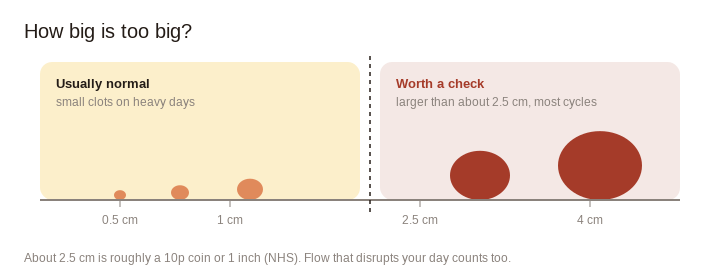
The NHS describes heavy periods as including any of these: needing to change your pad or tampon every 1 to 2 hours, passing clots larger than about 2.5 cm, bleeding through to your clothes or bedding, needing to use two types of period product together, periods lasting more than 7 days, or avoiding daily activities because of your period.
How big is too big for a period clot?
The working threshold is about 2.5 cm across, roughly the size of a 10p coin in the NHS guidance, or about an inch. Clots smaller than this, now and then, are common. Clots this size or larger, especially if they appear every cycle, point towards heavy menstrual bleeding.
Size is not the only measure. NICE, whose definition FIGO has adopted, defines heavy menstrual bleeding as blood loss that interferes with your physical, social, emotional or material quality of life. If you plan your day around your period, avoid travel, double up on pads, or wake at night to change, that counts, whatever the clots look like.
| Usually normal | Worth booking a check | Needs prompt medical attention |
|---|---|---|
| A few small clots on the heaviest day or two | Clots larger than about 2.5 cm, most cycles | Soaking a pad every hour for several hours |
| Changing a pad less often than every 2 hours | Changing every 1 to 2 hours, or using two products together | Feeling faint, very breathless or a racing heart |
| Periods lasting up to 7 days | Periods lasting more than 7 days | Any bleeding a year or more after your last period |
| Cycles roughly every 24 to 38 days | Cycles regularly shorter than 24 days | Heavy bleeding with severe pain or fever |
| Some cycle-to-cycle change in your 40s | Bleeding between periods or after sex | Bleeding so heavy you cannot leave the house |
Why are my periods heavier with more clots in my 40s?
The most common reason is perimenopause itself. In the years before menopause, ovulation becomes unreliable. In a cycle where you do not ovulate, the ovary does not make the usual surge of progesterone that keeps the lining in check. Oestrogen (estrogen) keeps building the lining, which then sheds heavily and unpredictably. That is why bleeding in your 40s can swing between light and very heavy, and why clots often appear where there were none before.
FIGO's 2018 classification calls this ovulatory dysfunction (AUB-O) and notes that predictable cycles every 24 to 38 days usually come with ovulation, while bleeding from ovulatory disorders is typically irregular in timing and flow. The NHS describes the same pattern from the patient side: in perimenopause, periods may come more or less often and get heavier or lighter.
The NHS rule of thumb: if your bleeding has changed and you are bleeding more, not less, than before, see a doctor. Perimenopause should be the conclusion after other causes are considered, not an assumption.
What else can cause heavy periods and clots?
Doctors use FIGO's PALM-COEIN system to sort the causes of abnormal bleeding. The first four letters are structural causes a scan or hysteroscopy can see. The last five are not.
| Cause | What it means | Clues |
|---|---|---|
| Polyps | Small growths of the lining, usually benign | Bleeding between periods, after sex |
| Adenomyosis | Lining tissue growing into the muscle wall | Heavy, painful periods; bulky, tender uterus |
| Leiomyoma (fibroids) | Non-cancerous muscle growths | Heavy periods, pressure, frequent urination |
| Malignancy and hyperplasia | Thickened or, rarely, cancerous lining | Irregular or intermenstrual bleeding, bleeding after menopause |
| Coagulopathy | A bleeding disorder such as von Willebrand disease | Heavy periods since your teens, easy bruising, gum bleeding |
| Ovulatory dysfunction | Cycles without ovulation, common in perimenopause; thyroid problems can contribute | Irregular timing, unpredictable heavy bleeds |
| Endometrial | A problem with how the lining controls bleeding | Heavy but regular periods with no other cause found |
| Iatrogenic | Caused by a medicine or device | Blood thinners, some hormonal medicines |
| Not otherwise classified | Rarer causes | Found on further tests |
Fibroids are the headline cause in women over 40. Our guide to a bulky uterus and fibroids explains why a fibroid that bulges into the cavity matters more for bleeding than a larger one on the outside.
An underactive thyroid lists irregular or heavy periods among its symptoms, and its tiredness overlaps with perimenopause. NICE advises thyroid testing for heavy bleeding only when there are other signs of thyroid disease, so mention any you have. Our guide on thyroid or perimenopause helps you sort the overlap.
Endometrial hyperplasia and womb cancer are uncommon causes, but they are the reason irregular bleeding in your 40s is never simply waved away. NICE lists persistent bleeding between periods, persistent irregular bleeding, infrequent heavy bleeding in women who are obese or have PCOS, taking tamoxifen, and treatment that has not worked as reasons to look more closely at the lining. Our guide to endometrial thickness explains the lining measurement on your scan report.
Is getting a period twice a month normal in perimenopause?
It can happen, but it still deserves a look. Older reports use the word "polymenorrhagia" for frequent, heavy periods, and "menorrhagia" for heavy periods. FIGO abandoned these terms in favour of plain descriptions: frequent, heavy, prolonged, irregular. By FIGO's standard, periods coming more often than every 24 days are frequent.
Short cycles are common in early perimenopause. But two bleeds a month can also be bleeding between periods from a polyp, a fibroid or a lining change, and the two can look the same to you. A simple diary of start dates, heaviness and any spotting in between helps your doctor tell them apart.
When should I see a doctor about heavy periods?
See a doctor if heavy periods are affecting your life, have gone on for some time, come with severe pain, or if you bleed between periods or after sex. Those are the NHS's own triggers, and they apply in India too.
Seek care the same day if you are soaking through a pad every hour for several hours, passing very large clots repeatedly, or feeling dizzy, faint, very breathless, or aware of your heart racing. Those can be signs of significant blood loss or anaemia.
Bleeding after menopause is different. If you have had no period for 12 months and then bleed, even once and even if it is only spotting, the NHS says it needs to be checked. Most causes are benign, but this is the one bleeding pattern no one should wait on.
Many women in India put off this appointment. Periods are still talked about in lowered voices, and heavy bleeding is often treated as something to put up with. But it is common, treatable, and exactly what gynaecologists see every day.
What tests should I expect for heavy bleeding?
Expect a history, an examination and a blood count, then a scan or hysteroscopy only if the picture calls for it. NICE recommends a full blood count for every woman with heavy menstrual bleeding, alongside any treatment. It advises against routine female hormone tests, because hormone levels in perimenopause swing too much to explain bleeding.
If fibroids, adenomyosis or a mass are suspected, a pelvic or transvaginal ultrasound is the usual next step. If your history suggests a polyp, a fibroid inside the cavity or a lining problem, NICE recommends outpatient hysteroscopy, a small camera passed through the cervix, with a biopsy if you are at higher risk. Testing for a bleeding disorder is considered if you have had heavy periods since your teens and a personal or family history that suggests one.
Ask for your actual numbers. A haemoglobin result can look acceptable while your iron stores are already low, which is why a ferritin result is worth discussing too. Our guide to the ferritin test explains why.
Why do heavy periods matter so much for Indian women?
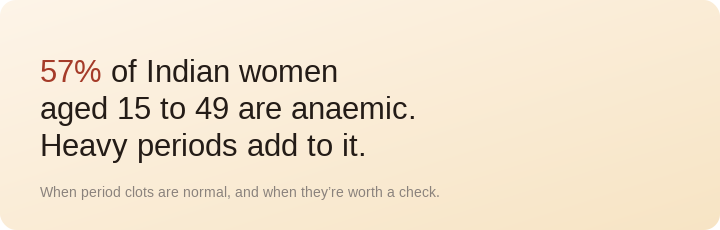
Because so many Indian women are already short of iron before heavy bleeding starts. India's National Family Health Survey (NFHS-5, 2019 to 2021) found that 57% of women aged 15 to 49 are anaemic. Heavy periods are one of the most common causes of iron deficiency anaemia, and every heavy cycle draws down iron stores further.
Diet adds to the gap. Iron from plant foods such as dal, greens and millets is absorbed less well than iron from meat, fish and eggs, so women eating a mostly vegetarian diet have less margin. The tiredness, breathlessness, headaches and hair fall of low iron are easy to blame on hormones or age, which is how anaemia gets missed in women in their 40s.
Can home remedies stop heavy bleeding or clots?
No home remedy has good evidence for stopping heavy bleeding or clots, and searching for one can delay the check that finds the cause. Iron-rich food and rest help you cope, but they do not treat fibroids, polyps or a thickened lining.
Effective options exist, and NICE groups them for doctors to discuss with you. They include a hormonal coil (LNG-IUS), non-hormonal tablets taken only during the period (tranexamic acid, or anti-inflammatory painkillers), hormonal tablets, and, where a specific cause is found, procedures such as hysteroscopic removal of a polyp or fibroid. Which suits you depends on the cause and your preferences. These are options to talk through with a gynaecologist, not to start on your own.
Questions worth taking to your appointment:
- Is my bleeding heavy enough to need tests, and which ones? - What were my haemoglobin and ferritin results, and do I need iron? - Is there a structural cause, such as a fibroid or polyp, and where is it? - Do I need a closer look at the lining, given my age and pattern? - What are the non-surgical options, and how long before each one helps?
Where Yellow fits
Heavy periods in your 40s often get dismissed as "just perimenopause" before anyone has checked your iron, your scan or your thyroid. Yellow's membership is built to help you change that: understanding what your blood count, ferritin and scan results mean, keeping a clear record of your bleeding pattern, and going into your gynaecologist appointment knowing what to ask. You can see how it works at yellowforhormones.com.
Frequently Asked Questions
Are jelly-like blood clots during a period normal?
Usually, yes. Small jelly-like clots on the heaviest days are common and form when blood pools in the uterus before it leaves. They are worth a doctor's check if they are larger than about 2.5 cm, happen most cycles, or come with very heavy flow, dizziness or tiredness.
What size of period clot is a concern?
The NHS uses about 2.5 cm, roughly the size of a 10p coin, as one sign of heavy periods. Clots that size or bigger, especially every cycle, suggest heavy menstrual bleeding that is worth discussing with a gynaecologist, along with a blood count to check for anaemia.
Why are my periods suddenly heavier in my 40s?
Often because of perimenopause. Cycles without ovulation leave oestrogen unopposed by progesterone, so the lining builds up and sheds heavily. Fibroids, polyps and adenomyosis also become more common after 40. Because the causes overlap, a change to heavier bleeding should be checked rather than assumed to be hormonal.
What is polymenorrhagia?
It is an older term for periods that are both frequent and heavy. FIGO, the international gynaecology federation, has abandoned it and similar terms such as menorrhagia in favour of plain descriptions. By FIGO's standard, cycles shorter than 24 days are frequent, and bleeding that affects your quality of life is heavy.
Can heavy periods cause anaemia?
Yes. Heavy periods are one of the most common causes of iron deficiency anaemia. In India, NFHS-5 found that 57% of women aged 15 to 49 are anaemic, so many women start with low reserves. Signs include tiredness, breathlessness, headaches and palpitations. A blood count and ferritin test show where you stand.
Is bleeding after menopause ever normal?
No bleeding after menopause should be ignored. If you have gone 12 months without a period and then bleed, even a single episode of spotting, the NHS advises getting it checked. Most causes, such as polyps or a thin lining, are benign, but a doctor needs to rule out a lining problem.
Further Reading
- National Institute for Health and Care Excellence (NICE). Heavy menstrual bleeding: assessment and management (NG88), last updated 2026.
- Munro MG, Critchley HOD, Fraser IS; FIGO Menstrual Disorders Committee. The two FIGO systems for normal and abnormal uterine bleeding symptoms and classification of causes of abnormal uterine bleeding in the reproductive years: 2018 revisions. International Journal of Gynecology and Obstetrics, 2018;143(3):393-408.
- National Health Service (NHS UK). Heavy periods.
- National Health Service (NHS UK). Menopause: symptoms.
- Ministry of Health and Family Welfare, Government of India. National Family Health Survey (NFHS-5), 2019-21: anaemia prevalence among women aged 15-49 (57.0%).