
Thyroid or Perimenopause? How to Tell When the Symptoms Overlap

Medically reviewed by Dr Lakshmi Vaswani, MBBS, DPB (Pathology), MBA
By Yellow Editorial · Last updated 27 October 2026
The short answer: an underactive thyroid gland and perimenopause cause almost the same list of symptoms, so it is genuinely hard to tell these two conditions apart.
Both can leave you exhausted, foggy, struggling with your weight and wondering why your periods have suddenly become unpredictable. Feeling cold all the time or being constipated may point more towards your thyroid, while hot flushes and night sweats are more typical of perimenopause. But the symptoms overlap enough that you can't always tell the difference yourself. What makes it worse is that sometimes, both may be affecting you at the same time.
How can you tell which one it is when the symptoms overlap so much? Blood tests can help, along with checks for other common conditions affecting Indian women, like anaemia or low iron. The important thing is to find out what's behind your symptoms.
Get the right tests, and you stop guessing.
Why low thyroid hormones and perimenopause feel so similar
Your thyroid is a small gland in your neck that helps control how your body uses energy. When it doesn't produce enough thyroid hormone, your metabolism can slow down. You may feel tired, gain weight, become constipated or find it difficult to concentrate.
Perimenopause brings a different set of hormonal changes. Oestrogen and progesterone levels start fluctuating, affecting your periods, sleep, mood and body temperature.
Different hormones, but many of the same symptoms.
So when a woman in her forties says she's exhausted, putting on weight, struggling to concentrate and finding her periods increasingly unpredictable, either condition could be contributing.
The symptoms that overlap
Most of the classic complaints belong to both lists. Here is where they meet and where they differ.
| Symptom | Underactive thyroid | Perimenopause |
|---|---|---|
| Fatigue and low energy | Common | Common |
| Weight gain or difficulty losing weight | Possible | Common |
| Brain fog and poor concentration | Possible | Common |
| Low mood | Possible | Common |
| Irregular periods | Possible | Common |
| Heavy periods | Possible | Possible |
| Dry skin and thinning hair | Common | Possible |
| Feeling cold all the time | Typical | Less typical |
| Constipation | Typical | Less typical |
| Hot flushes and night sweats | Not typical | Typical |
| Anxiety or heart racing | Not typical; can occur with an overactive thyroid | Possible |
Feeling cold even when everyone else is comfortable, along with constipation and dry skin, may make an underactive thyroid more likely. Hot flushes, night sweats and changing periods point more towards perimenopause.
One more thing worth knowing: very heavy bleeding, bleeding between periods or bleeding after menopause should always be discussed with a doctor rather than being put down to hormonal changes.
Can the pattern of symptoms help tell them apart?
Sometimes it can.
An underactive thyroid often causes symptoms that develop gradually. You might notice that you're becoming more tired, feeling colder than usual or struggling with constipation.
Perimenopause can feel less predictable. You might have a few difficult weeks of poor sleep, mood changes or night sweats, followed by a period when things seem better. This is why keeping track of your symptoms can be useful.
You don't need an elaborate app or a daily spreadsheet. Even a few notes about your periods, sleep, energy levels and hot flushes can help you spot changes and explain them to your doctor.
Just remember that there's no single symptom pattern that reliably separates thyroid problems from perimenopause. That's where blood tests can help.
Why "your thyroid hormone level is normal" does not always end the story
A lot of women are told their thyroid is fine and sent home still feeling terrible. There are a few things worth knowing before you accept that.
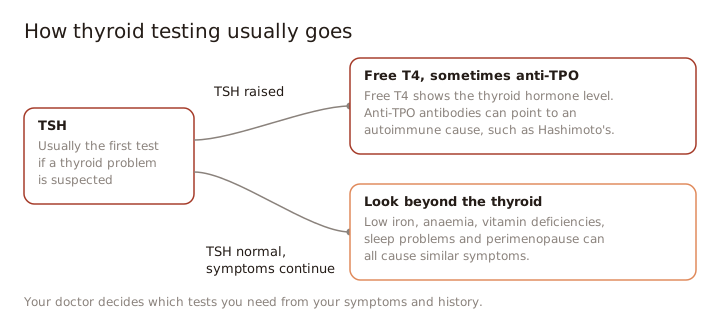
For most women, the first test that is done for the thyroid is TSH, or thyroid-stimulating hormone. It's usually a reliable way to check whether the gland is underactive.
If TSH is high, your doctor may check free T4, which measures one of the hormones produced by your thyroid.
Sometimes, another test called anti-TPO antibodies is useful. These antibodies can indicate an autoimmune thyroid condition, such as Hashimoto's disease.
There's also something called subclinical hypothyroidism. This is when TSH is raised but free T4 is still normal. Some people have symptoms, while others feel perfectly well. Whether treatment is needed depends on several factors, including the TSH level and whether it remains raised over a few months.
If your TSH is normal and your symptoms persist, the next step may be to look beyond your thyroid. Low iron, anaemia, vitamin deficiencies, sleep problems and perimenopause itself can all leave you feeling much the same way.
Why this matters more in India
When you're in your forties and your periods start changing, perimenopause is often the first explanation that comes to mind. And it may well be the right one. But thyroid problems can show up around the same time, with many of the same symptoms.
Heavy periods can also be a sign of thyroid trouble. Around 1 in 3 women (33%) with an underactive thyroid reported unusually heavy bleeding during their periods, compared with just 6% of women without thyroid problems.
More than 1 in 4 women (27.3%) who had reached menopause in an Indian community were found to have an underactive thyroid.
That's why the Indian Menopause Society's 2026 guidelines specifically highlight thyroid problems as something doctors should look out for in midlife women. An underactive thyroid can make symptoms such as fatigue, low mood and memory problems worse, or make them harder to explain.
The guidelines recommend checking thyroid function as part of a midlife health assessment, particularly when symptoms suggest a thyroid problem.
So if you're feeling exhausted, struggling with your weight or noticing changes in your periods, it's worth discussing your thyroid with your doctor.
Why getting the diagnosis right makes a difference
If your thyroid is underactive, there's a specific treatment for that. Most women with confirmed hypothyroidism are prescribed levothyroxine, a tablet that replaces the thyroid hormone their body isn't producing enough of. Treatment often improves symptoms.
Perimenopause is different. There's no single treatment that suits everyone. Some women need help with sleep or hot flushes. Others may be more troubled by heavy periods, mood changes or vaginal dryness. Menopausal hormone therapy may be an option depending on symptoms, medical history and personal preferences.
And if you're dealing with both an underactive thyroid and perimenopause, each may need attention. That's why it helps to know what you're actually dealing with before deciding what to do next.
What to actually do about it
You don't necessarily need a huge hormone panel or a long list of blood tests.
A few well-chosen tests, based on your symptoms, can often tell your doctor much more.
Here's what they may consider.
| Test | What it helps check | When it may be useful |
|---|---|---|
| TSH | Whether your thyroid is working normally | Usually the first test if a thyroid problem is suspected |
| Free T4 | The level of thyroid hormone in your blood | Usually when TSH is abnormal, or in certain other situations |
| Anti-TPO antibodies | Whether thyroid autoimmunity may be present | Sometimes useful when TSH is raised |
| Complete blood count (CBC) | Anaemia | Tiredness, weakness or heavy periods |
| Ferritin | Your body's iron stores | Heavy periods or suspected iron deficiency |
| Vitamin B12 | B12 deficiency | Unexplained anaemia, tingling or numbness, or dietary risk factors |
| Vitamin D | Vitamin D deficiency | Bone pain, muscle weakness or other risk factors |
| HbA1c or fasting glucose | Diabetes or prediabetes | Symptoms or risk factors for high blood sugar |
If your TSH is normal, you may not need free T4 or thyroid antibodies. And although vitamin D testing can be useful in certain situations, it isn't routinely necessary for every woman with fatigue.
Low iron is the other great mimic of perimenopause, so it is worth reading low iron or perimenopause alongside this, and which blood tests are actually worth doing over 40 for the full set.
During perimenopause, hormone levels can change quite dramatically from one day to another. An FSH or oestrogen result taken today might look very different a few weeks later.
That's why women over 45 with typical perimenopausal symptoms usually don't need hormone blood tests to confirm what's happening. Doctors can often make the diagnosis from symptoms and changes in the menstrual cycle. Between 40 and 45, FSH testing may sometimes be helpful, particularly when periods are changing and the diagnosis isn't clear.
If you're under 40 and menopause is suspected, hormone testing and further assessment become more important. A single FSH result isn't enough to confirm premature menopause. Hormonal contraception can also affect the results, so it's important to tell your doctor if you're taking it.
Our guide on what a hormone test can and cannot tell you explains why.
This is the approach Yellow built its blood panel around. Instead of the hormone screen or the 100-test full-body dump, it checks the markers most likely to explain how a midlife woman actually feels, and returns a plain read of what is driving your symptoms rather than a wall of numbers. You can see it at yellowforhormones.com.
The goal is simple. Stop guessing whether it is your thyroid or your hormones, find out which, or whether it is both, and walk into your doctor's appointment with the right evidence.
Frequently Asked Questions
Is it my thyroid or perimenopause?
It can be either, and sometimes both, because the symptoms overlap. Feeling cold all the time and constipation may point more towards your thyroid, while hot flushes and night sweats are more typical of perimenopause, but symptoms alone can't always tell them apart. TSH is usually the first blood test if a thyroid problem is suspected.
Can you have thyroid problems and perimenopause at the same time?
Yes. Thyroid problems can show up around the same time as perimenopause, with many of the same symptoms. If you're dealing with both, each may need attention, so it helps to consider both rather than assume one explains everything.
My thyroid test was normal but I still feel awful. Why?
TSH is usually a reliable first check of whether your thyroid is underactive, and if it is normal you may not need free T4 or thyroid antibody tests. If your symptoms persist, other causes are worth looking at: low iron, anaemia, vitamin deficiencies, sleep problems and perimenopause itself can all leave you feeling much the same way. Your doctor can help decide which tests are relevant.
Which symptoms point more to thyroid than to perimenopause?
Feeling cold all the time, constipation and dry skin may make an underactive thyroid more likely. Hot flushes, night sweats and changing periods point more towards perimenopause. No single symptom or pattern reliably separates the two, which is where blood tests can help.
Can perimenopause cause a thyroid problem, or the other way around?
Perimenopause doesn't directly cause an underactive thyroid. But thyroid conditions and perimenopause can happen around the same time, and their symptoms can overlap. That's why it's worth considering both when new symptoms appear in midlife.
What tests should I ask for in India?
If a thyroid problem is suspected, TSH is usually the first test. Depending on your symptoms, your doctor may also check your blood count, iron stores, vitamin B12 or blood sugar. Free T4 and thyroid antibody tests may be useful in certain situations. You don't need every test on the list, and your doctor can help decide which ones are relevant to you.
Further Reading
- Ahuja M. Age of menopause and determinants of menopause age: a PAN India survey by IMS. J Midlife Health. 2016;7(3):126-131.
- Meeta M, Anuradha M, Ashraf AB, et al. Clinical practice guidelines for menopause: an executive summary and recommendations: Indian Menopause Society 2026. J Midlife Health. 2026;17(suppl 1):S12-S116.
- National Institute for Health and Care Excellence. Thyroid disease: assessment and management. NICE guideline NG145.
- National Institute for Health and Care Excellence. Menopause: identification and management. NICE guideline NG23.
- National Institute for Health and Care Excellence. Heavy menstrual bleeding: assessment and management. NICE guideline NG88.
- American Thyroid Association. Hypothyroidism.
- Sharma P, Verma A. Prevalence of hypothyroidism among postmenopausal women in an urbanised village of northern India: a cross-sectional study. J Family Med Prim Care. 2024;13(9):3815-3821.
- Semiz GG, Hekimsoy Z. Menstrual cycle characteristics in women with and without thyroid disease. Cureus. 2024;16(6):e62724.