
Hormone Tests for Perimenopause: What Blood Can and Cannot Tell You

Medically reviewed by Dr Lakshmi Vaswani, MBBS, DPB (Pathology), MBA
By Yellow Editorial · Last updated 27 October 2026

The short answer: if you are over 45 with typical symptoms of menopause, a hormone blood test cannot confirm that you are in perimenopause. Your hormones swing so much from day to day that a single reading is just one frame from a moving picture, which is why most guidelines say to diagnose perimenopause from symptoms, not blood.
That does not make a blood test useless. It makes it useful for a different job: ruling out the conditions that feel exactly like perimenopause but are not, such as thyroid trouble, low iron, low vitamin B12 and low vitamin D.
In India, where 57% of women are anaemic and about 1 in 6 has an underactive thyroid, it is worth checking whether something other than perimenopause could be contributing to your symptoms.
Can a blood test diagnose perimenopause?
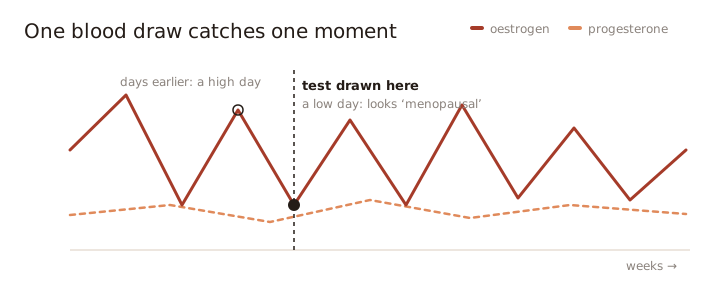
No, not reliably, if you are over 45 and have typical symptoms. During perimenopause your oestrogen (estrogen) and progesterone do not decline in a neat line. They fluctuate up and down, sometimes within the same week.
A blood test captures one moment. Draw it on a high day and the numbers look fine, draw it on a low day and they look menopausal, and neither result changes what you are feeling or what would help. There is no single hormone number that defines perimenopause or sets a treatment.
This is why NICE advises against using FSH and other hormone tests to diagnose perimenopause in women over 45 with typical symptoms. The symptoms and your cycle history tell the story more accurately than the lab does.
Why your doctor says "your bloods are normal" and you still feel awful
This is one of the most common and most frustrating experiences women describe: every report comes back normal, and yet nothing feels normal. Usually one of two things has happened.
First, a result within the normal range does not always mean there is no problem. Reference ranges are based on results from healthy populations, and a result that falls within those limits does not necessarily rule out a health condition.
Second, the right test may not have been done in the first place. For example, you may be feeling constantly tired, but your haemoglobin level is normal. What that test doesn't tell you is whether your iron stores are low. You can have iron deficiency even without anaemia, and a ferritin test may help identify it.
So if your reports are normal but your symptoms persist, it may be worth discussing both the results and the tests that were ordered with your doctor. Sometimes, finding an answer means looking a little closer.
What a blood test is actually good for: ruling out the mimics
Several conditions can cause symptoms that look like perimenopause. Fatigue, brain fog, low mood and changes in weight may have more than one explanation.
For Indian women, there are a few additional things worth considering. Thyroid disorders, anaemia and nutritional deficiencies deserve attention, particularly when symptoms overlap. A study across 8 Indian cities found hypothyroidism in ~16% of women. Vegetarian diets can also increase the risk of vitamin B12 deficiency.
Blood tests can help identify some of these conditions, particularly when your symptoms or medical history suggest another cause.
| What it feels like | Could also be | Marker to check |
|---|---|---|
| Exhaustion, brain fog, feeling cold | Underactive thyroid | TSH; free T4 and anti-TPO when indicated |
| Fatigue, breathlessness, hair fall | Iron deficiency/anaemia | Ferritin, complete blood count (CBC) with haemoglobin |
| Low energy, low mood, tingling | Vitamin B12 deficiency | Vitamin B12 levels, homocysteine |
| Bone pain, muscle weakness | Vitamin D deficiency | Vitamin D levels |
| Weight gain, increased thirst or frequent urination | Early insulin resistance | HbA1c, fasting glucose |
Cholesterol is worth checking too, even if you feel perfectly fine. A lipid profile can help identify high cholesterol and assess your heart health as you move through this phase.
Age is also a factor. The Indian Menopause Society's 2026 guidelines put the average age of natural menopause in India at around 46.6 years, although it varies considerably. This context is useful when considering symptoms and changes in your periods.
These symptoms do not automatically mean you need every test on this list. Your doctor can help decide which investigations are relevant based on your symptoms, medical history, and risk factors.
The opposite trap: testing too much
If under-testing leaves you dismissed, over-testing leaves you buried. Plenty of Indian labs sell full-body packages of 80 to 120 tests for a few thousand rupees. They sound thorough, but they create their own problem.
A huge panel gives you pages of numbers, often with little explanation. Some results may fall just outside the normal range purely by chance, causing unnecessary worry. It measures dozens of things that do not explain how you feel, while often still missing the ones that do.
More tests don't necessarily mean better answers. What helps is a focused set of tests chosen for your symptoms and age, with results interpreted by someone who understands what they mean. The aim is to get answers, not just a spreadsheet full of numbers.
When hormone levels do matter
Hormone tests can be useful if you're under 45 and your periods have become irregular or stopped. They can also help when your symptoms suggest another hormonal condition.
A missed period in your forties doesn't always mean perimenopause. Pregnancy is still possible while your periods are becoming irregular, so a pregnancy test may sometimes be the first thing to check.
| What you might notice | What your doctor may check |
|---|---|
| You're between 40 and 44, and your periods have become irregular or stopped | An FSH blood test may help check for early menopause. |
| You're under 40, and your periods have become irregular or stopped | An FSH test can help check whether your ovaries are working as expected. The test may need to be repeated. |
| Your periods are irregular and you've also noticed excess facial hair or acne | Testosterone and SHBG tests may help investigate PCOS (polycystic ovary syndrome), or the modern name Polyendocrine Metabolic Ovarian Syndrome (PMOS) |
| Your periods have stopped or become very irregular and you notice unexpected milky discharge from your breasts | A prolactin blood test may help identify a hormonal cause. |
Be careful: if you're taking hormonal contraceptives, interpreting hormone tests becomes trickier. Some contraceptives change your bleeding pattern and affect hormone levels, so an FSH result may not give you a reliable answer.
If you're under 45 and noticing these changes, or your symptoms seem unusual, speak to your doctor rather than relying on a home hormone test.
How to use your results
A test is only as good as what you do with it. The point is to turn a vague, dismissed feeling into something specific and believable.
Bring your blood reports to your doctor along with a note of your symptoms, when they started and any changes in your periods. Looking at these together can help your doctor decide whether further investigation is needed.
This is the thinking behind Yellow's blood panel. It focuses on conditions that can cause symptoms similar to perimenopause, including thyroid disorders, iron deficiency and vitamin deficiencies. It avoids routine hormone testing in women over 45 and helps you understand what your results mean in the context of your symptoms.
You can see how it works at yellowforhormones.com. If your symptoms turn out to point at the hormone shift, our guide on thyroid or perimenopause helps you tell the two apart. For the individual tests, see low iron or perimenopause, the AMH test and menopause, and which blood tests are actually worth doing over 40.
Frequently Asked Questions
Can a blood test confirm I am in perimenopause?
Not reliably if you are over 45 with typical symptoms. Your hormones swing too much for one reading to mean anything, so guidelines recommend diagnosing perimenopause from symptoms and cycle history. A blood test is more useful for ruling out other causes of the same symptoms.
Why are my blood tests normal when I feel terrible?
Usually the test measured the wrong thing (a hormone snapshot) or too little (a basic panel that skipped iron, B12, vitamin D and thyroid markers). "Normal range" is also wide, so you can be inside it and still feel unwell. Ask for a fuller, symptom-led panel.
What hormone tests do I actually need in my 40s?
If you are over 45 and have typical perimenopause symptoms, you usually do not need hormone blood tests to confirm that you are in this phase. What helps more is checking the mimics: TSH for the thyroid, a blood count and ferritin, and blood sugar. Free T4, anti-TPO, vitamin B12 and vitamin D are added when your symptoms or risk factors call for them. Hormone levels like FSH matter mainly under 45 or when early menopause is suspected.
Is an FSH test useful for perimenopause?
Mostly not, over 45. FSH rises and falls with the same fluctuations that cause your symptoms, so a single value can be misleading. It has a real role in checking for early or premature menopause in younger women.
Which blood tests should an Indian woman prioritise?
Ferritin first, because 57% of Indian women are anaemic and low iron mimics hormone symptoms. Then TSH for the thyroid, and HbA1c or fasting glucose. Your doctor may add free T4, anti-TPO, vitamin B12 or vitamin D if your symptoms or risk factors suggest them. These catch the most common and most treatable causes of midlife fatigue and fog.
Can I just do a home hormone test kit?
A home hormone kit gives you a number, not a read, and for perimenopause over 45 that number cannot confirm the diagnosis. If you are going to test, a panel that also covers the treatable mimics and interprets the results against your symptoms is far more useful than a hormone value on its own.
Further Reading
- Meeta M, Anuradha M, Ashraf AB, et al. Clinical practice guidelines for menopause: an executive summary and recommendations: Indian Menopause Society 2026. J Midlife Health. 2026;17(suppl 1):S12-S116.
- Spencer C, Currie H. Hormone blood tests in the menopause transition. Women's Health Concern, British Menopause Society; 2026.
- American College of Obstetricians and Gynecologists. Do I need to have testing of my hormone levels during perimenopause? ACOG; 2025.
- Santoro N. Perimenopause: from research to practice. J Womens Health (Larchmt). 2016;25(4):332-339.
- National Library of Medicine. How to understand your lab results. MedlinePlus.
- Snook J, Bhala N, Beales ILP, et al. British Society of Gastroenterology guidelines for the management of iron deficiency anaemia in adults. Gut. 2021;70(11):2030-2051.
- Ministry of Health and Family Welfare, Government of India. Steps taken under Anaemia Mukt Bharat strategy. Press Information Bureau; 5 August 2022.
- Unnikrishnan AG, Kalra S, Sahay RK, Bantwal G, John M, Tewari N. Prevalence of hypothyroidism in adults: an epidemiological study in eight cities of India. Indian J Endocrinol Metab. 2013;17(4):647-652.
- American Thyroid Association. Thyroid function tests.
- Devalia V, Hamilton MS, Molloy AM; British Committee for Standards in Haematology. Guidelines for the diagnosis and treatment of cobalamin and folate disorders. Br J Haematol. 2014;166(4):496-513.
- US Preventive Services Task Force. Vitamin D deficiency in adults: screening. Published 13 April 2021.
- Sacks DB, Arnold M, Bakris GL, et al. Guidelines and recommendations for laboratory analysis in the diagnosis and management of diabetes mellitus. Diabetes Care. 2023;46(10):e151-e199.
- Practice Committee of the American Society for Reproductive Medicine. Current evaluation of amenorrhea: a committee opinion. American Society for Reproductive Medicine; 2024.
- Teede HJ, Tay CT, Laven JJE, et al. Recommendations from the 2023 international evidence-based guideline for the assessment and management of polycystic ovary syndrome. J Clin Endocrinol Metab. 2023;108(10):2447-2469.
- Royal College of Obstetricians and Gynaecologists. RCOG recommends against using over-the-counter menopause tests. Published 10 June 2022.
- American College of Obstetricians and Gynecologists. Abnormal uterine bleeding. ACOG; last reviewed August 2025.