
Bulky Uterus and Fibroids on Your Scan: What the Report Actually Means
By Yellow Editorial · Last updated 18 November 2026

The short answer: "bulky uterus" on a scan report means your uterus measures larger than average. It is a description, not a diagnosis, and after 40 it is common and usually harmless. The usual causes are fibroids (non-cancerous muscle growths), adenomyosis (lining tissue growing into the muscle wall) or having had children. Fibroids are very common: by age 50, most women have at least one. A mildly bulky uterus with no symptoms usually needs only a follow-up scan. Heavy periods, pain, pressure or low iron are the reasons to see a gynaecologist.
What does "bulky uterus" mean on an ultrasound report?
It means the uterus is larger than the reference size the sonographer works from. That is all the phrase tells you on its own. It does not say why, and it does not mean something is wrong.
A typical adult uterus is roughly 7 to 8 cm long, 4 to 5 cm wide and 3 to 4 cm deep, about the size of a fist, though it is normally a little larger in women who have had children. "Mildly bulky" often describes a uterus only slightly above this range. Your report should list the measurements, so you can see whether "bulky" means a few millimetres or a lot.
Look at the line after the word "bulky." It usually names a cause, such as "multiple fibroids," "intramural fibroid," "features suggestive of adenomyosis," or "no focal lesion." That line is what to discuss with your doctor.
What causes a bulky uterus after 40?
There are a handful of common causes, and most are benign.
| Cause | What it is | Typical signs |
|---|---|---|
| Fibroids (leiomyomas) | Firm, non-cancerous growths of uterine muscle | Often none; heavy periods, pressure, frequent urination |
| Adenomyosis | Lining tissue growing into the muscle wall, making it thick and spongy | Painful, heavy periods; a uniformly enlarged, tender uterus |
| Previous pregnancies | The uterus stays a little larger after childbirth | None; a normal finding |
| Perimenopause hormone swings | Higher oestrogen (estrogen) phases can enlarge fibroids and thicken the lining | Irregular, sometimes heavier periods |
| Rarely, cancer | Endometrial cancer or, very rarely, a uterine sarcoma | Bleeding after menopause, a fast-growing mass |
Fibroids and adenomyosis often appear together, and both respond to oestrogen. In perimenopause, oestrogen can rise sharply in some months. So fibroids can grow and periods can get heavier in the years before menopause. Most fibroids then shrink once periods stop.
What are the different types of fibroids?
Fibroids are named by where they are in the uterus, and where a fibroid is matters more than its size. A small fibroid inside the cavity can cause more bleeding than a large one on the outside.
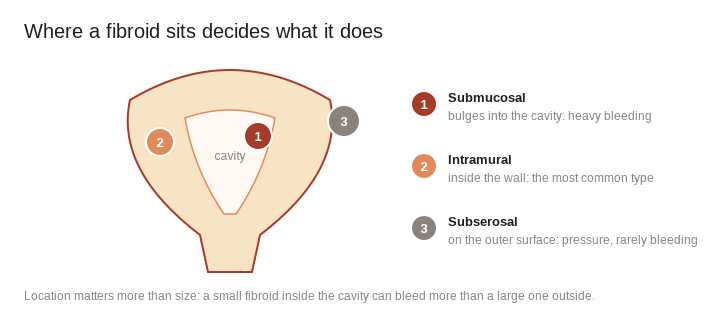
Submucosal fibroids are just under the lining and bulge into the cavity of the uterus. They are the type most linked to heavy and prolonged bleeding, even when small. They are also the type most often removable through the cervix, without any cut on the abdomen (hysteroscopic removal).
Intramural fibroids grow within the muscle wall. They are the most common type. Small ones usually cause no symptoms; larger ones can enlarge the uterus and make periods heavier and more painful.
Subserosal fibroids grow on the outer surface. They rarely affect bleeding, but larger ones can press on the bladder (needing to urinate often) or bowel (constipation, a feeling of fullness). A pedunculated fibroid is one attached by a stalk, either inside or outside.
Many reports in India also use the FIGO numbering system, from type 0 (entirely inside the cavity) to type 7 (hanging off the outside on a stalk). The lower the number, the closer it is to the lining and the more likely it is to affect bleeding.
Are fibroids dangerous? Can they turn into cancer?
For almost all women, no. Fibroids are benign (not cancer), and most women have them at some point. A large US ultrasound study found that by age 50, nearly 70% of white women and over 80% of Black women had fibroids, and many never knew. Data from India is more limited, but fibroids are among the most common reasons women here see a gynaecologist.
A fibroid does not "turn into" cancer in the usual sense. There is a rare, separate cancer of uterine muscle called leiomyosarcoma, which can look like a fibroid on a scan. It is uncommon. The signs that raise concern are a mass that grows quickly, especially one that grows after menopause, when fibroids usually shrink.
The more common harm from fibroids is heavy bleeding. Losing a lot of blood every month lowers your iron. Many women with fibroids feel tired, breathless and unable to concentrate because of anaemia that has not been tested for.
When does a bulky uterus or fibroid need treatment?
Treatment depends on symptoms, not on the scan alone. A fibroid that causes no trouble usually needs no treatment, just a follow-up scan to check it is stable, often at 6 to 12 months.
See a gynaecologist if you have any of these:
- Periods that soak through a pad or tampon every one to two hours, or last more than seven days
- Clots larger than a coin, or flooding through clothes or bedding
- Bleeding between periods or after sex
- Any bleeding at all after menopause (12 months without a period)
- Pelvic pain, pressure, a swollen lower belly, or needing to urinate often
- Tiredness, breathlessness or hair fall that could be iron deficiency
If bleeding is heavy, ask for a ferritin test as well as a haemoglobin. Our guide to the ferritin test explains why haemoglobin alone often misses low iron stores.
What are the treatment options for fibroids?
Options range from tablets to procedures. The right one depends on your symptoms, the type and size of the fibroids, how close you are to menopause, and what you want. These are the main options to discuss with your doctor, not a recommendation for any of them.
| Option | What it does | Often considered when |
|---|---|---|
| Watchful waiting | Follow-up scans, no treatment | No symptoms, or close to menopause |
| Non-hormonal tablets (tranexamic acid, anti-inflammatories) | Reduce bleeding and pain during periods | Heavy periods, fibroids not distorting the cavity |
| Hormonal options, including a hormonal coil (LNG-IUS) | Thin the lining and reduce bleeding | Heavy bleeding, small fibroids, cavity not distorted |
| Short-term hormone-blocking medicines | Shrink fibroids temporarily | Before surgery, or bridging to menopause |
| Hysteroscopic myomectomy | Removes a submucosal fibroid through the cervix | Fibroid inside the cavity causing bleeding |
| Myomectomy (laparoscopic or open) | Removes fibroids, keeps the uterus | Large or symptomatic fibroids, wish to keep the uterus |
| Uterine artery embolisation | Blocks blood supply so fibroids shrink | Wish to avoid surgery |
| Hysterectomy | Removes the uterus | Severe symptoms, other options failed or unsuitable |
The UK's NICE guideline on heavy menstrual bleeding (NG88) recommends that women are offered information about all suitable options, including ones that keep the uterus, before a decision is made.
Is hysterectomy the only real fix?
No, and this is worth knowing in India. National survey data (NFHS-5) shows about 3.3% of Indian women aged 15 to 49 have already had a hysterectomy. Rates are near 9% in Andhra Pradesh and 8% in Telangana, and most were done in private hospitals. Concern that many were unnecessary led the Ministry of Health and Family Welfare to issue Guidelines to Prevent Unnecessary Hysterectomies in 2022.
Hysterectomy is the right choice for some women, and many with severe symptoms feel much better after it. But it is major surgery, and if your ovaries are removed at the same time, it brings on menopause immediately. If it is suggested for a mildly bulky uterus or for fibroids without symptoms, it is entirely reasonable to ask what else is possible and to seek a second opinion.
Questions worth taking to your appointment:
- What is making my uterus bulky, and where exactly are the fibroids?
- Are these fibroids likely to explain my symptoms?
- What happens if I wait, given my age and how close I may be to menopause?
- What options keep my uterus, and why are they or are they not suitable for me?
- Will my ovaries be kept if I have surgery?
What happens to fibroids at menopause?
Most fibroids shrink after menopause, because oestrogen and progesterone levels fall. For a woman in her late forties with manageable symptoms, treating the symptoms and waiting for menopause is often a reasonable plan. The average age of menopause in India is about 46.
Two caveats. Menopausal hormone therapy (HRT) can keep fibroids from shrinking fully, so tell your doctor about fibroids if you are considering it. And as noted above, a fibroid that grows after menopause, or any bleeding after menopause, should always be checked. Our guide to endometrial thickness explains what the lining measurement on the same scan report means.
Where Yellow fits
A scan report is the start of a conversation with your doctor. Yellow's membership helps you understand what your scan and blood results mean, checks your iron and thyroid (heavy periods and an underactive thyroid often occur together; see thyroid or perimenopause), and helps you go into your appointment knowing what to ask. You can see how it works at yellowforhormones.com.
Frequently Asked Questions
What does bulky uterus mean on an ultrasound report?
It means the uterus measures larger than the average reference size. It is a description, not a diagnosis. Common causes are fibroids, adenomyosis or previous pregnancies, and most are benign. Look at the line after "bulky" on your report, which usually names the cause, and discuss that with your doctor.
Is a mildly bulky uterus dangerous?
Usually not. A mildly bulky uterus with no symptoms is very common after 40 and often needs only a follow-up scan. It becomes important if you also have heavy or prolonged bleeding, bleeding between periods, pelvic pressure, or any bleeding after menopause. Those symptoms need a proper review.
Which type of fibroid causes heavy bleeding?
Submucosal fibroids, which bulge into the cavity of the uterus, are most linked to heavy bleeding, even when small. Intramural fibroids in the wall can also make periods heavier if large. Subserosal fibroids on the outside rarely affect bleeding but can press on the bladder or bowel.
Can fibroids go away without surgery?
Many do not need surgery at all. Fibroids that cause no symptoms can simply be monitored, and most fibroids shrink naturally after menopause as hormone levels fall. Tablets, a hormonal coil or non-surgical procedures can control symptoms in the meantime. Surgery is one option among several.
Is hysterectomy necessary for a bulky uterus?
Not usually. A bulky uterus on its own is not a reason for hysterectomy. Treatment depends on symptoms and the cause. India's health ministry issued guidelines in 2022 to prevent unnecessary hysterectomies, so if surgery is suggested without symptoms, it is reasonable to ask about alternatives and get a second opinion.
Do fibroids shrink after menopause?
Yes, most do, because they depend on oestrogen and progesterone, which fall after your last period. Menopausal hormone therapy can slow that shrinkage. A fibroid that grows after menopause, or any bleeding after menopause, should always be checked by a doctor.
Further Reading
- Baird DD, Dunson DB, Hill MC, Cousins D, Schectman JM. High cumulative incidence of uterine leiomyoma in black and white women: ultrasound evidence. American Journal of Obstetrics and Gynecology, 2003;188(1):100-107.
- National Institute for Health and Care Excellence (NICE). Heavy menstrual bleeding: assessment and management (NG88), updated 2021.
- Kumari P, Kundu J. Prevalence, socio-demographic determinants, and self-reported reasons for hysterectomy and choice of hospitalization in India. BMC Women's Health, 2022;22:514 (NFHS-5 analysis).
- Ministry of Health and Family Welfare, Government of India. Guidelines to Prevent Unnecessary Hysterectomies, 2022.
- Munro MG, Critchley HOD, Fraser IS; FIGO Menstrual Disorders Committee. The two FIGO systems for normal and abnormal uterine bleeding symptoms and classification of causes of abnormal uterine bleeding in the reproductive years: 2018 revisions. International Journal of Gynecology and Obstetrics, 2018;143(3):393-408.