
Endometrial Thickness: Normal Size by Age, Before and After Menopause
By Yellow Editorial · Last updated 18 November 2026
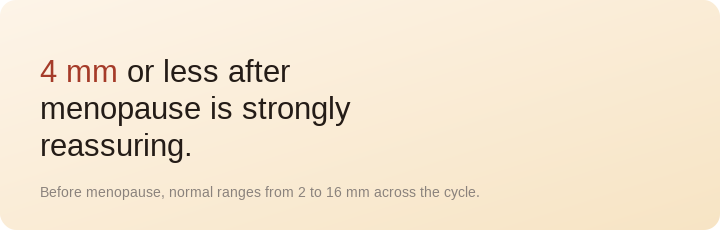
The short answer: a normal endometrial thickness depends on your cycle and whether you have been through menopause. While you have periods, the lining ranges from about 2 to 4 mm just after a period to about 16 mm before the next one. After menopause, if you have any bleeding, a lining of 4 mm or less rules out endometrial cancer in over 99% of cases, according to the American College of Obstetricians and Gynecologists (ACOG). A thicker lining is not a diagnosis; it usually means the next step is a small sample of the lining (a biopsy).
What is the endometrium, and why is it measured?
The endometrium is the inner lining of the uterus. Each cycle, oestrogen (estrogen) makes it grow and thicken. After ovulation, progesterone keeps it stable. When hormone levels fall, it sheds as your period.
On a transvaginal ultrasound, the sonographer measures it as the "endometrial thickness" or "ET," usually in millimetres. The number matters because a lining that keeps growing without enough progesterone is the main cause of endometrial hyperplasia (an overgrowth) and, less often, endometrial cancer. The scan is a quick, painless way to decide who needs further tests.
What is the normal endometrial thickness before menopause?
Before menopause, the lining changes throughout the month, so a "normal" number depends entirely on the day of your cycle.
| Cycle phase | Roughly which days | Typical thickness |
|---|---|---|
| During or just after a period | Days 1 to 5 | 2 to 4 mm |
| Growth phase (proliferative) | Days 6 to 14 | 5 to 7 mm, rising to about 11 mm |
| Around ovulation | About day 14 | Up to about 11 mm, often a "triple line" look |
| After ovulation (secretory) | Days 15 to 28 | 7 to 16 mm |
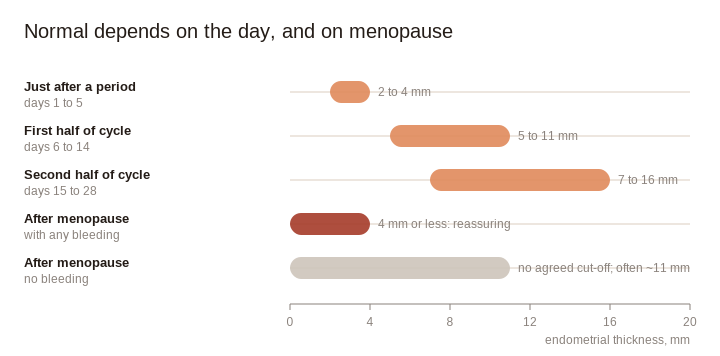
This is why a 12 mm reading can be normal on day 22 but worth checking on day 5. If your report does not say what day of your cycle the scan was done, write it down yourself. Your doctor may ask for the scan just after a period, when the lining is at its thinnest.
Why can the lining get thick in perimenopause?
In perimenopause, ovulation becomes irregular. Some months you ovulate, some you do not. In a month without ovulation, your ovaries still make oestrogen but little or no progesterone, so the lining keeps building with nothing to stabilise it.
This leads to a common perimenopause pattern: a thicker lining, then a heavy, irregular or long bleed when it sheds. A thick reading in your forties with irregular or heavy periods is usually caused by this. It is common and usually benign. But hyperplasia can also develop this way, so ongoing irregular or heavy bleeding should be checked by a doctor.
Other things that raise the chance of a thick lining include higher body weight (fat tissue makes oestrogen), PCOS, diabetes, taking tamoxifen, and endometrial polyps. Fibroids can also distort the measurement; our guide to bulky uterus and fibroids explains those findings on the same report.
What endometrial thickness is normal after menopause?
After menopause the lining should be thin, because the ovaries are no longer making much oestrogen. What counts as "too thick" depends on one question: are you bleeding?
| Situation after menopause | What the measurement means |
|---|---|
| Bleeding, lining 4 mm or less | Reassuring; cancer is very unlikely (less than 1 in 100) |
| Bleeding, lining over 4 mm | Needs further assessment, usually a biopsy or hysteroscopy |
| No bleeding, lining thin | Normal |
| No bleeding, lining thicker (often over about 11 mm) | No agreed cut-off; discussed case by case, considering your risk factors |
| On HRT or tamoxifen | Usual cut-offs are less reliable; tell the sonographer what you take |
Any bleeding after menopause, even a single episode of spotting, should be checked, whatever the thickness. Bleeding after menopause is the main early warning sign of endometrial cancer, and endometrial cancer found early is very treatable.
If you are not bleeding and a thicker lining is found by chance, there is no agreed cut-off. One study suggested that in women without bleeding, a lining over about 11 mm carries a similar risk to a lining over 5 mm in women who are bleeding. Many specialists use that as a guide, along with your risk factors.
What does a thick endometrium mean? Is it cancer?
Most of the time, no. A thick lining has several possible explanations, and cancer is the least common of them.
- Normal cycle timing: the scan was done in the second half of the cycle.
- Perimenopausal anovulation: months without ovulation building the lining up, as above.
- Polyps: small benign growths of the lining, very common in the forties and fifties.
- Endometrial hyperplasia: an overgrowth of the lining. This comes in two kinds, and the difference matters a great deal.
- Endometrial cancer: less common, and most often found because of bleeding after menopause.
Hyperplasia without atypia is the milder kind. UK guidance from the Royal College of Obstetricians and Gynaecologists (RCOG) puts its risk of turning into cancer at less than 5% over 20 years. Most cases settle, often with progestogen treatment, either as tablets or a hormonal coil (LNG-IUS).
Atypical hyperplasia has abnormal-looking cells and is treated more seriously, because it can occur alongside an early cancer or progress to one. The same guidance says women with atypical hyperplasia are usually offered a hysterectomy. Other options exist for women who want to keep their fertility or cannot have surgery.
The only way to know which of these is present is to test a sample of the tissue. The scan shows whether a sample is needed, not what it will show.
What happens after a thick endometrium result?
The next step is usually one of these, and none of them is major surgery:
- A repeat scan timed just after a period, if the first scan was done mid-cycle.
- An endometrial biopsy (pipelle): a thin tube passed through the cervix takes a small sample. It is done in a clinic, takes a few minutes, and feels like a strong period cramp.
- A hysteroscopy: a thin camera looks inside the uterus, and polyps can often be removed at the same time.
Questions worth asking:
- Was the scan timed correctly for my cycle?
- Given my age and symptoms, does this thickness need a biopsy, or a repeat scan first?
- Could this be a polyp?
- If it is hyperplasia, is it with or without atypia, and what are my options?
Where Yellow fits
A result like "ET 14 mm" can be worrying when nobody explains it. Yellow's membership explains results like this in plain language and helps you prepare the next question for your doctor, alongside the blood tests that matter in midlife, such as iron and thyroid. If irregular or heavy bleeding led to the scan, our guide to hormone tests in perimenopause explains why blood tests rarely confirm perimenopause but can rule out conditions with similar symptoms. You can see how it works at yellowforhormones.com.
Frequently Asked Questions
What is the normal endometrial thickness in mm?
Before menopause it depends on your cycle: about 2 to 4 mm just after a period, 5 to 11 mm in the first half, and up to about 16 mm before the next period. After menopause the lining should be thin; with any bleeding, 4 mm or less is considered reassuring.
What endometrial thickness is dangerous after menopause?
No thickness is automatically dangerous, but after menopause with bleeding, a lining over 4 mm needs further assessment, usually a biopsy. Without bleeding there is no agreed cut-off; many specialists consider a lining over about 11 mm worth discussing. Any bleeding after menopause should be checked regardless of thickness.
Is a 12 mm endometrium normal?
It can be. Before menopause, 12 mm is normal in the second half of your cycle, after ovulation, but would be unusually thick just after a period. After menopause, 12 mm is thicker than expected and is worth discussing with your doctor, especially if you have any bleeding.
Does a thick endometrium mean cancer?
Usually not. The most common causes are normal cycle timing, months without ovulation in perimenopause, and benign polyps. Endometrial hyperplasia and cancer are less common. The scan only shows whether a closer look is needed; a small tissue sample (biopsy) is what tells you the cause.
What causes a thick endometrium in perimenopause?
Irregular ovulation. In months when you do not ovulate, your ovaries make oestrogen but little progesterone, so the lining keeps building. That often leads to heavy or irregular bleeding. Higher body weight, PCOS, diabetes and polyps can add to it. Persistent irregular bleeding should be assessed.
How is a thick endometrium treated?
It depends on the cause. A thick lining from cycle timing needs no treatment. Polyps can be removed during a hysteroscopy. Hyperplasia without atypia is often treated with progestogens, as tablets or a hormonal coil. Atypical hyperplasia usually leads to a discussion about hysterectomy. Your doctor will guide this after a biopsy.
Further Reading
- American College of Obstetricians and Gynecologists (ACOG). Committee Opinion No. 734: The Role of Transvaginal Ultrasonography in Evaluating the Endometrium of Women With Postmenopausal Bleeding. Obstetrics and Gynecology, 2018;131(5):e124-e129.
- Royal College of Obstetricians and Gynaecologists and British Society for Gynaecological Endoscopy. Management of Endometrial Hyperplasia (Green-top Guideline No. 67), 2016.
- Smith-Bindman R, Weiss E, Feldstein V. How thick is too thick? When endometrial thickness should prompt biopsy in postmenopausal women without vaginal bleeding. Ultrasound in Obstetrics and Gynecology, 2004;24(5):558-565.
- National Institute for Health and Care Excellence (NICE). Heavy menstrual bleeding: assessment and management (NG88), updated 2021.
- National Health Service (NHS UK). Womb (uterus) cancer: symptoms, reviewed 2024.