
Thyroid Test Results Explained: TSH, T3 and T4 Normal Ranges for Women

Medically reviewed by Dr Lakshmi Vaswani, MBBS, DPB (Pathology), MBA
By Yellow Editorial · Last updated 22 November 2026

The short answer: for most adults, a normal TSH level is roughly between 0.4 and 4.0 mIU/L, although the range can vary between labs. Typical ranges are about 0.8 to 1.8 ng/dL for free T4 and 2.3 to 4.2 pg/mL for free T3. A high TSH usually suggests an underactive thyroid (hypothyroidism), while a low TSH may indicate an overactive thyroid (hyperthyroidism). T3 and T4 tests help your doctor understand how well your thyroid is functioning. Your results need to be interpreted together, along with your symptoms, medical history and the reference ranges on your lab report.
What does a thyroid profile test measure?
A thyroid profile typically includes TSH, T3 and T4, although the tests included can vary between laboratories. Some measure free T3 and free T4, while others measure total hormone levels. Your doctor may also recommend testing for thyroid antibodies.
Free T3 and free T4 are the forms of thyroid hormones that are not bound to proteins in the blood and are available for the body to use.
- TSH (thyroid-stimulating hormone) is made by the pituitary gland in the brain. It tells your thyroid to work harder. It is the most sensitive single test of thyroid function.
- T4 (thyroxine) is the main hormone the thyroid makes.
- T3 (triiodothyronine) is the more active hormone, mostly made from T4 in other tissues.
- Anti-TPO antibodies are proteins made by the immune system that may indicate autoimmune thyroid disease, particularly Hashimoto's thyroiditis, a common cause of hypothyroidism.
What are the normal ranges for TSH, T3 and T4?
Reference ranges vary between labs and testing machines, so always use the range printed on your own report. These are typical adult ranges as a guide:
| Test | Typical adult reference range | Notes |
|---|---|---|
| TSH | about 0.4 to 4.0 mIU/L (some labs up to 4.5 or 5.5) | Same for women and men; the upper limit drifts up with age |
| Free T4 (FT4) | about 0.8 to 1.8 ng/dL (10 to 23 pmol/L) | Preferred over total T4 |
| Total T4 | about 5 to 12 µg/dL | Raised by pregnancy and oral oestrogen (estrogen) |
| Free T3 (FT3) | about 2.3 to 4.2 pg/mL | Most useful when an overactive thyroid is suspected |
| Total T3 | about 80 to 200 ng/dL | Also affected by binding proteins |
| Anti-TPO | Lab-specific; a "positive" flag is more significant | Points to autoimmune thyroid disease |
There is no separate TSH reference range for women outside pregnancy. During pregnancy, thyroid hormone levels change, and doctors use pregnancy-specific reference ranges where available.
Two other factors can affect your results:
- Age: TSH levels tend to rise naturally with age. A mildly raised result in an older woman may therefore need a different interpretation than the same result in someone younger.
- Oral oestrogen: the combined contraceptive pill and oral oestrogen therapy can increase the proteins that carry thyroid hormones in the blood. This can raise total T3 and T4 levels without necessarily indicating an overactive thyroid.
How do I read my thyroid results together?
TSH and free T4 are usually interpreted together. Different combinations can point to different thyroid conditions.
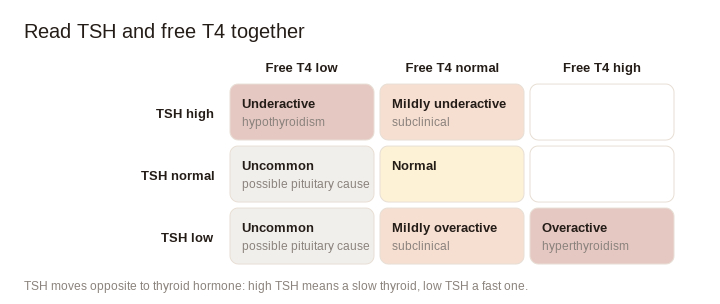
| TSH | Free T4 | What it usually suggests |
|---|---|---|
| Normal | Normal | Thyroid working normally |
| High | Low | Underactive thyroid (overt hypothyroidism) |
| High | Normal | Subclinical (mild) hypothyroidism |
| Low | High | Overactive thyroid (hyperthyroidism) |
| Low | Normal | Subclinical hyperthyroidism; check T3 too |
| Low or normal | Low | May indicate a problem with the pituitary gland, a small gland in the brain that controls the thyroid, or another health condition. Further tests may be needed. |
- Low TSH with normal free T4: this doesn't always mean the thyroid is overactive. A T3 test can help clarify the result.
- Low or normal TSH with low free T4: this is an unusual combination. It may suggest a problem with the gland in the brain that controls the thyroid, or it may be linked to another illness. Further tests may be needed.
- If you're taking levothyroxine: your doctor will usually check your TSH to see whether your dose is right. In some less common thyroid conditions, free T4 is a better guide.
What does a high TSH mean?
Common symptoms of an underactive thyroid include tiredness, feeling cold, weight gain, constipation, dry skin, hair thinning, low mood, difficulty concentrating and heavier or irregular periods. Many of these overlap with perimenopause, making it difficult to tell the difference from symptoms alone. Our guide to thyroid or perimenopause explains this further.
A mildly raised TSH isn't always a sign of a lasting thyroid problem. Levels can rise temporarily after an illness, during recovery from thyroid inflammation, or simply vary between tests.
An anti-TPO antibody test can help your doctor understand whether an autoimmune thyroid condition may be responsible. Women with both raised TSH and positive thyroid antibodies are more likely to develop an underactive thyroid over time. A long-term study found that around 4 in 100 women with both findings developed hypothyroidism each year.
An underactive thyroid is common in India. In a study of adults in eight Indian cities, about 1 in 10 had hypothyroidism, and about a third of them did not know until they were tested.
When does a high TSH need treatment?
If your TSH is high and your free T4 is low, your doctor will usually prescribe levothyroxine, a medicine that replaces the thyroid hormone your body isn't making enough of.
If your TSH is only mildly raised and your free T4 is normal, you may not need treatment straight away. The UK's NICE guideline (NG145) recommends the following approach:
- Repeat the test: your doctor may suggest another TSH test after about three months to see whether the level remains high.
- TSH of 10 mIU/L or higher: if the level remains this high on two tests taken three months apart, your doctor may recommend treatment.
- TSH above normal but below 10 mIU/L: if you're under 65 and have symptoms of an underactive thyroid, your doctor may suggest trying levothyroxine for six months to see whether you feel better, provided the raised TSH has been confirmed on repeat testing.
Your age, symptoms, overall health and plans for pregnancy will also influence whether treatment is right for you.
What TSH level is dangerously high?
There is no single TSH level that is considered dangerous. A very high TSH, particularly when free T4 is low, suggests a significantly underactive thyroid that needs medical attention. But how you're feeling is just as important as the number on your report.
In rare cases, severe, untreated hypothyroidism can lead to a life-threatening condition called myxoedema coma. Warning signs include extreme drowsiness, confusion, unusually low body temperature, a very slow heartbeat or slow breathing.
If someone develops these symptoms, seek emergency medical care immediately.
What does a low TSH mean?
A low TSH often suggests an overactive thyroid. If you're already taking levothyroxine, it may mean your dose is too high. Your doctor may check your T3 and free T4 levels to understand what's causing the low result.
Common symptoms include a racing or pounding heart, anxiety, shaky hands, feeling unusually hot, sweating, weight loss despite eating normally, frequent bowel movements and lighter or irregular periods. Some of these symptoms, particularly palpitations, anxiety and sweating, can also occur during perimenopause.
An overactive thyroid that goes untreated for a long time can weaken bones and increase the risk of an irregular heartbeat, called atrial fibrillation. These are important concerns for women approaching or going through menopause, when bone health and heart health already need attention. If your TSH remains low, speak to your doctor about further testing.
How can I get an accurate thyroid test?
A few simple steps make the result more reliable:
- Stop biotin first. Biotin (vitamin B7), common in hair, skin and nail supplements, can interfere with many lab tests and make thyroid results look falsely abnormal. The US FDA has warned about this. Ask your doctor or lab how long to pause it; many advise at least two to three days.
- Test at a similar time each time. TSH is naturally higher in the early morning, so a consistent time makes repeat results comparable.
- If you take levothyroxine, have blood drawn before your morning dose unless told otherwise.
- Avoid testing during an acute illness if you can; serious illness can temporarily disturb thyroid results.
- Fasting is not usually needed for a thyroid test alone, although your lab may ask for it if other tests are done at the same time.
In India, a TSH test usually costs a few hundred rupees and a full T3, T4 and TSH profile a little more, with prices varying by city and lab.
Where Yellow fits
A thyroid profile is cheap and common, but on its own it often leaves women with a number and no explanation. Yellow's blood panel reads thyroid function properly, with TSH, free T4 and anti-TPO, alongside the conditions that look like it in midlife, from low iron to vitamin B12 and vitamin D, and returns a plain read of what is actually going on. For the full midlife set, see our guide to blood tests for women over 40. You can see how it works at yellowforhormones.com. Yellow’s blood tests are also offered on their own, as the perimenopause panel.
Frequently Asked Questions
What is the normal TSH level for a woman?
For most adult women who are not pregnant, a normal TSH is roughly 0.4 to 4.0 mIU/L, though labs vary and some go up to 4.5 or 5.5. There is no separate female range outside pregnancy. TSH tends to run slightly higher with age, so always read your result against your lab's printed range.
What is the normal range for T3, T4 and TSH?
Typical adult ranges are: TSH about 0.4 to 4.0 mIU/L, free T4 about 0.8 to 1.8 ng/dL, and free T3 about 2.3 to 4.2 pg/mL. Total T4 and total T3 have different ranges. Each lab sets its own range, so use the one printed on your report.
What does a high TSH with normal T4 mean?
It usually means subclinical, or mild, hypothyroidism. It is common and often settles without treatment. Guidelines suggest repeating the test after about three months, ideally with an anti-TPO antibody test, before you and your doctor decide on treatment.
What TSH level requires treatment?
A high TSH with a low free T4 is usually treated. For mild cases, the UK's NICE guideline suggests treatment may be considered if TSH is 10 mIU/L or higher on two tests three months apart. If you are under 65, have symptoms and your TSH is above the normal range on repeat testing, your doctor may suggest a six-month trial of treatment. Your doctor will also consider your symptoms and medical history.
Can a thyroid problem cause irregular periods?
Yes. Both an underactive and an overactive thyroid can disturb periods, making them heavier, lighter, more frequent or irregular. Because perimenopause does the same, a thyroid test is one of the first checks worth doing when periods change in your forties.
Do I need to fast for a thyroid test?
Usually not. A thyroid test alone does not require fasting, although your lab may ask if other tests are done at the same time. More important is to stop biotin supplements a few days before, test at a consistent time, and take levothyroxine after the blood draw, not before.
Further Reading
- National Institute for Health and Care Excellence (NICE). Thyroid disease: assessment and management (NG145), 2019.
- Unnikrishnan AG, Kalra S, Sahay RK, Bantwal G, John M, Tewari N. Prevalence of hypothyroidism in adults: An epidemiological study in eight cities of India. Indian Journal of Endocrinology and Metabolism, 2013;17(4):647-652.
- Vanderpump MPJ, Tunbridge WMG, French JM et al. The incidence of thyroid disorders in the community: a twenty-year follow-up of the Whickham Survey. Clinical Endocrinology, 1995;43(1):55-68.
- Hollowell JG, Staehling NW, Flanders WD et al. Serum TSH, T4, and thyroid antibodies in the United States population (1988 to 1994): National Health and Nutrition Examination Survey (NHANES III). Journal of Clinical Endocrinology and Metabolism, 2002;87(2):489-499.
- U.S. Food and Drug Administration. Biotin (Vitamin B7): Safety Communication, May Interfere with Lab Tests, updated 2019, archived copy (the FDA has since taken the page down).