
Vitamin B12 Test for Women: How to Read Your Result
By Yellow Editorial · Last updated 22 November 2026
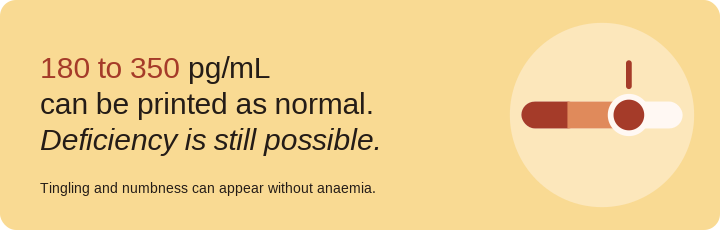
The short answer: the vitamin B12 test is a blood test that measures the B12 in your blood, given here in pg/mL. Under the UK's 2024 NICE guideline, a total B12 below 180 pg/mL confirms deficiency, 180 to 350 pg/mL is an unclear result where deficiency is still possible, and above 350 pg/mL makes deficiency unlikely. The US National Institutes of Health says most laboratories draw their own line for a low result at 200 or 250 pg/mL, so a result marked normal can still fall in the unclear band. Tingling in the hands and feet, tiredness and memory trouble are common signs, and they can appear without anaemia. The number is a starting point for a conversation with your doctor, not a diagnosis.
What does the vitamin B12 test measure?
The standard test measures total vitamin B12 in the blood, also written as serum cobalamin. Total B12 includes two forms: the form your body can take up and use, and a form it cannot use. This is one reason a total B12 result does not always match how you feel.
Three other tests exist, and a doctor may add one when the first result is unclear:
- Active B12 (holotranscobalamin) measures only the usable form. NICE accepts either total or active B12 as the first test. Its committee considers active B12 more accurate, and it costs more.
- Methylmalonic acid (MMA) is a substance that rises in the blood when B12 is short. NICE suggests considering it for people who have symptoms and an unclear first result. It also rises when the kidneys are not working well.
- Homocysteine also rises when B12 is short. It is less specific, because low folate, reduced kidney function and an underactive thyroid raise it too.
No single test settles the question. NICE says there is no "gold standard" test for B12 deficiency, so a result is read together with symptoms and risk factors.
What is a normal vitamin B12 level?
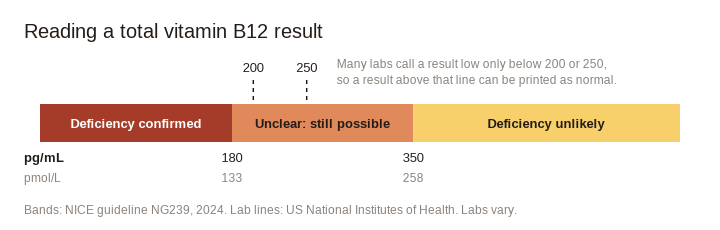
There is no single agreed normal range, and the sources draw the line in different places. The clearest current guide is the table in NICE's 2024 guideline, which sets three bands for total B12 and for active B12.
| What NICE calls it | Total B12 | Active B12 |
|---|---|---|
| Confirmed deficiency | Below 180 pg/mL (133 pmol/L) | Below 25 pmol/L |
| Unclear result, deficiency possible | 180 to 350 pg/mL (133 to 258 pmol/L) | 25 to 70 pmol/L |
| Deficiency unlikely | Above 350 pg/mL (258 pmol/L) | Above 70 pmol/L |
NICE writes total B12 in nanograms per litre. That is the same number as pg/mL, the unit this guide and both Indian studies below use.
Other bodies use other lines:
- The US National Institutes of Health says most laboratories treat a result below 200 or 250 pg/mL as low. It also notes that experts suggest an MMA test when the result is between 150 and 399 pg/mL.
- The British Society for Haematology's 2014 guideline uses 200 pg/mL, or the laboratory's own range, when deficiency is strongly suspected. It also says exact cut-off points cannot be fixed, because laboratories use different methods.
- MedlinePlus, a US government health site, gives normal values as 299 to 1,054 pg/mL and calls a result below 299 pg/mL a possible sign of deficiency.
- NICE says a laboratory with its own validated thresholds may use those. It also says its committee set the bands from experience, because the evidence did not point to exact numbers.
Converting units: to turn pg/mL into pmol/L, multiply by 0.738. So 200 pg/mL is 148 pmol/L, and 300 pg/mL is 221 pmol/L.
Why can a "normal" B12 result still be a problem?
A result inside the range printed on your report can still sit in the band where deficiency is possible. The printed range differs from one laboratory to another. Take a laboratory that treats only results below 200 pg/mL as low, one of the two lines the NIH says most laboratories use. A result of 218 pg/mL is above that line, and it is also inside NICE's unclear band of 180 to 350.
The guidelines are plain about this:
- NICE says a person with an unclear result "could still have a deficiency".
- The NHS says some people have symptoms and seem to have normal levels, and some have low levels with no symptoms.
- The British Society for Haematology says people with strong signs of deficiency can have a B12 level inside the reference range.
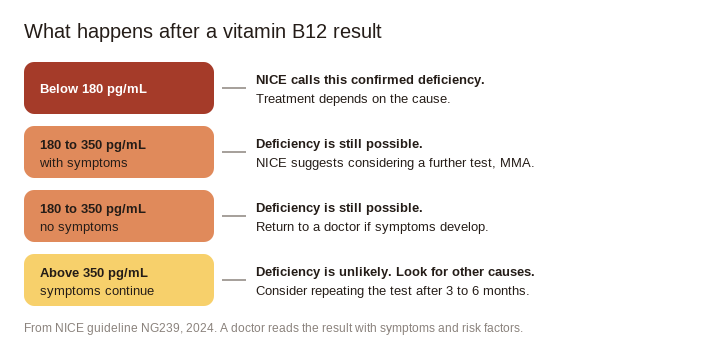
What happens next depends on symptoms. For someone with symptoms and an unclear result, NICE suggests considering an MMA test. For someone with no symptoms, NICE advises returning to a doctor if symptoms develop. And when the result makes deficiency unlikely but symptoms continue, NICE says to look for other causes and to consider repeating the test after 3 to 6 months.
What are the symptoms of low vitamin B12?
The common signs are tiredness, pins and needles, a sore tongue and trouble with memory or concentration. The NHS list includes:
- extreme tiredness and a lack of energy
- pins and needles
- a sore and red tongue, and mouth ulcers
- muscle weakness
- problems with vision
- depression or anxiety
- problems with memory, understanding and judgement
NICE's list adds numbness, balance problems, unexplained fatigue and difficulty concentrating, which it notes is sometimes described as brain fog.
Two points matter for reading these symptoms.
Nerve symptoms can appear without anaemia. B12 deficiency can cause anaemia with unusually large red blood cells. But NICE tells doctors not to rule out deficiency because a blood count looks normal, and the NIH says tingling and numbness can occur without anaemia. So a normal haemoglobin does not clear B12.
Symptoms build slowly and some can last. The body stores B12, and the NHS says those stores can last around 2 to 5 years. Symptoms can take years to appear after intake or absorption drops. The NHS also says that although many symptoms improve with treatment, some problems caused by the condition can be irreversible. This is the reason not to ignore tingling or numbness.
Who is more likely to be low in vitamin B12?
People who eat little or no animal food, and people whose body cannot absorb B12 well, are the two main groups. B12 occurs naturally only in animal foods, and absorbing it depends on the stomach and the small bowel.
NICE and the NIH list these risk factors:
- A vegetarian or vegan diet. The NIH says both vegans and vegetarians have a higher risk, because natural sources are limited to animal foods.
- Metformin, a common diabetes medicine, which may reduce B12 absorption and lower blood levels.
- Acid-reducing medicines: proton pump inhibitors and H2 blockers.
- Autoimmune gastritis, also called pernicious anaemia, where the immune system attacks the stomach cells that make B12 absorption possible. The NIH says it is more common in women.
- Stomach or bowel surgery, including many weight-loss operations.
- Coeliac disease or another autoimmune condition, such as thyroid disease or type 1 diabetes.
- A family history of B12 deficiency or an autoimmune condition.
Do not stop a prescribed medicine because it is on this list. Ask your doctor whether your B12 should be checked.
NICE adds a caution for vegetarians: diet may not be the cause, or the only cause, of a low result. A vegetarian woman with low B12 can also have an absorption problem.
How common is low vitamin B12 in India?
Low B12 is common in the Indian studies described here, but the national figures are for children and adolescents, not adults. The Comprehensive National Nutrition Survey of 2016 to 2018 measured B12 in people aged 1 to 19 across the country. In it, 31% of adolescents aged 10 to 19 were deficient, using a cut-off of 203 pg/mL. Among adolescents, the figure ranged from 2.3% in Kerala to 47.6% in Gujarat.
The adult study used here covers one town and one clinic, so it does not describe Indian women as a whole. It is a 2019 study of health records from north India. Among 267 people who attended health check-up camps in one town in Haryana, 47% had a B12 below 200 pg/mL. Among patients of a Delhi endocrine clinic in the same study, the figure was between 18% and 38%, depending on the patient group. Across the whole study, women had a higher median B12 than men: 286 pg/mL against 244 pg/mL. The records came from people who had a blood test at a camp or a clinic, so the people in it were not chosen at random.
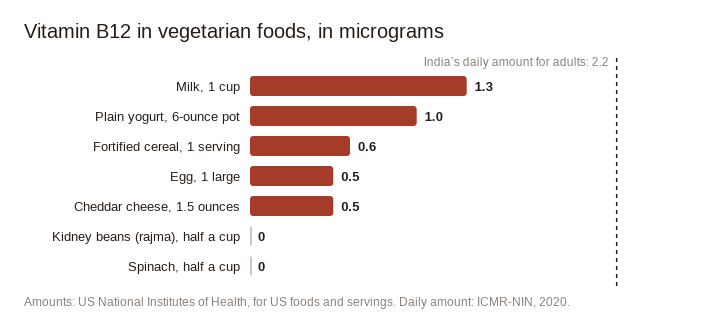
Diet is part of the reason. India's own recommended amount for adults is 2.2 micrograms a day, set by ICMR-NIN in 2020. For a vegetarian, the natural sources are dairy foods and, for those who eat them, eggs. The NIH lists about 1.3 micrograms in a cup of milk, 1.0 in a 6-ounce pot of plain yogurt and 0.5 in one egg. Plant foods do not naturally contain B12, so dal, vegetables and grains do not add to the total unless a food has been fortified. Check the label for added B12.
Do I need to fast for a vitamin B12 test, and do supplements affect it?
The NICE and British Society for Haematology guidelines do not mention fasting before a B12 test. One US government source, MedlinePlus, advises not eating or drinking for 6 to 8 hours before it. Follow the instruction your lab gives when you book. If B12 is part of a larger package, another test in the package may need fasting.
Supplements matter more than food here:
- Tell your doctor what you already take. NICE says tablets, injections and patches bought without a prescription can raise a B12 result without fully treating a deficiency. A normal result while taking B12 is harder to interpret.
- Test before treatment starts. NICE says blood should be taken before B12 replacement begins. It also says treatment influences the test result.
- The combined contraceptive pill can lower total B12 without causing a deficiency, according to NICE. NICE adds that a low result can still mean a deficiency, so a doctor reads that result with care.
B12 is often tested with folate. The NHS explains why: most symptoms of the two deficiencies are the same, and treating low folate alone can hide a B12 deficiency while it continues to affect the nerves.
What if my vitamin B12 is high?
A high result in someone taking B12 tablets or injections can reflect the supplement. NICE notes that these can raise blood levels. The NIH says no upper intake limit has been set for B12, because of its low potential for harm.
A high result in someone who takes no B12 is different. MedlinePlus says a raised level is uncommon and lists liver disease and some blood disorders among the conditions that can cause it. Show that result to a doctor.
How is low vitamin B12 treated?
Treatment depends on the cause, and a doctor decides it. The NHS says most people are treated with tablets or injections that replace the vitamin. Under NICE, tablets are considered when diet is the cause. Injections are offered for life when autoimmune gastritis is the cause, or after an operation that removes the whole stomach or the whole last section of the small bowel. For other absorption problems, such as coeliac disease, NICE says to offer B12 replacement and to consider injections instead of tablets.
NICE tells people what to expect: symptoms can start to improve within 2 weeks, it may take up to 3 months, and it can take much longer for them to go completely. It also warns that some supplements sold in shops do not contain enough B12, or the right type, to treat a deficiency.
Where Yellow fits
Tiredness, tingling, low mood and trouble concentrating have several possible causes, and NICE says these symptoms are not exclusive to B12 deficiency. Low iron and an underactive thyroid can produce some of the same complaints. Our guides to the ferritin test, thyroid test results and the vitamin D test cover those, and blood tests for women over 40 explains how to choose tests by symptom.
Yellow's blood panel reads vitamin B12 and folate together with iron stores, thyroid and vitamin D, and returns a plain explanation of the results with questions to take to your doctor. The same tests are offered on their own as the perimenopause panel.
Frequently Asked Questions
Is a B12 level of 218 pg/mL low?
It is in the unclear band. NICE's 2024 guideline treats a total B12 between 180 and 350 pg/mL as a result where deficiency is still possible, even when the lab's printed range calls it normal. If you have symptoms such as tingling or tiredness, ask your doctor whether a further test is needed.
Can low vitamin B12 cause tingling in the hands and feet?
Yes. Pins and needles and numbness are on both the NHS and NICE lists of B12 deficiency signs. The NIH says these nerve symptoms can occur without anaemia, so a normal haemoglobin does not rule B12 out. Tingling has other causes too, so see a doctor instead of guessing.
Do I need to fast before a vitamin B12 test?
The NICE and British Society for Haematology guidelines do not mention fasting. MedlinePlus, a US government source, advises 6 to 8 hours without food or drink. Follow your lab's instruction. If B12 is booked with tests that need fasting, the lab may ask you to fast.
I am vegetarian. Will I be low in B12?
Not always, but the risk is higher. B12 occurs naturally only in animal foods, so milk, curd and eggs are the natural sources in a vegetarian diet. NICE also says diet may not be the only cause of a low result, so a doctor may still check how well you absorb B12.
Should I take B12 tablets or injections?
That depends on why your B12 is low, and your doctor decides it. Under NICE, tablets are considered when diet is the cause. Lifelong injections are offered when autoimmune gastritis is the cause, and injections may be considered when symptoms could worsen quickly. Have the blood test before starting either.
Does metformin lower vitamin B12?
It can. The NIH says metformin might reduce B12 absorption and significantly lower blood levels, and NICE lists it as a risk factor for deficiency. Do not stop metformin because of this. Ask the doctor who prescribes it whether your B12 should be checked, especially if you have tingling or numbness.
How much does a vitamin B12 test cost in India?
On 20 November 2026, eight labs and lab-booking sites in India listed a vitamin B12 test at ₹489 to ₹1,579. The price changes by city and with the offer running that day. Vitamin B12 and folate are both in Yellow's perimenopause panel, which has 22 tests for ₹4,999.
Further Reading
- National Institute for Health and Care Excellence (NICE). Vitamin B12 deficiency in over 16s: diagnosis and management. NICE guideline NG239, published 6 March 2024.
- National Institutes of Health, Office of Dietary Supplements. Vitamin B12: Fact Sheet for Health Professionals. Updated 2 July 2025.
- NHS. Vitamin B12 or folate deficiency anaemia. Page last reviewed 20 February 2023.
- Shalini T, Pullakhandam R, Ghosh S, Kulkarni B, Rajkumar H, Sachdev HS, Kurpad AV, Reddy GB. Prevalence of Vitamin B12 and Folate Deficiencies in Indian Children and Adolescents. Nutrients, 2023;15(13):3026.
- Singla R, Garg A, Surana V, Aggarwal S, Gupta G, Singla S. Vitamin B12 Deficiency is Endemic in Indian Population: A Perspective from North India. Indian Journal of Endocrinology and Metabolism, 2019;23(2):211-214.