
Vitamin D Test for Women: How to Read Your 25-OH Vitamin D Result
By Yellow Editorial · Last updated 24 November 2026

The short answer: the vitamin D test measures 25-hydroxyvitamin D, written 25(OH)D, the form that shows how much vitamin D your body has stored. The "vitamin D3 test" most Indian labs sell is usually this same test, reporting total 25(OH)D. Results come in ng/mL or nmol/L (multiply ng/mL by 2.5 to get nmol/L). Under the widely used Endocrine Society 2011 cut-offs, below 20 ng/mL is deficient, 21 to 29 ng/mL is insufficient, and 30 ng/mL or above is sufficient. The US Institute of Medicine instead treats 20 ng/mL as enough for most people, and in 2024 the Endocrine Society stopped endorsing fixed cut-offs at all. Low vitamin D is very common in India despite the sunshine, and it matters more in midlife because falling oestrogen (estrogen) speeds up bone loss around menopause. The number is a starting point for a conversation with your doctor, not a diagnosis.
What does the vitamin D test actually measure?
The vitamin D test measures 25(OH)D, the main circulating form of vitamin D and the best single marker of your vitamin D status. Whether vitamin D comes from sunlight on your skin, from food or from a supplement, the liver converts it into 25(OH)D. That form stays in the blood for weeks; the Endocrine Society's 2011 guideline puts its circulating half-life at two to three weeks, so it reflects your recent supply rather than what you ate yesterday.
There is a second form, 1,25-dihydroxyvitamin D, which is the active hormone. It is not a good test of whether you are low. Its level is tightly controlled by the body and can look normal, or even high, when stores are depleted. The 2011 guideline specifically recommends against using it to check vitamin D status; it is reserved for a few specific calcium and kidney conditions.
A few practical points about the report:
- "Vitamin D3 test" usually means total 25(OH)D. Some labs list D2 and D3 separately. In India, most people's vitamin D is D3, so the total is the number that matters. - "Vitamin D and B12 test" packages simply run both tests on one blood sample. They are separate results and should be read separately. - Different labs use different methods. The NIH Office of Dietary Supplements notes that results can read falsely low or high depending on the assay and the lab, so compare repeat results from the same lab where you can.
What is a normal vitamin D level?
Start with your own report. The range printed next to your result is the first thing to read the number against. Beyond that, a normal vitamin D level depends on which expert body you follow, which is why two doctors can read the same number differently. The US Institute of Medicine (IOM, now the National Academies) uses a lower bar for "enough" than the Endocrine Society did in 2011. The bands below are what each body says, not what your laboratory says.
| 25(OH)D in ng/mL | In nmol/L | Endocrine Society 2011 | Institute of Medicine 2011 |
|---|---|---|---|
| Below 12 | Below 30 | Deficient | At risk of deficiency |
| 12 to under 20 | 30 to under 50 | Deficient | Possibly inadequate for some people |
| 20 to 29 | 50 to 72.5 | Insufficient (defined as 21 to 29) | Adequate for most people |
| 30 to 100 | 75 to 250 | Sufficient | Adequate; no added benefit shown above 20 |
| Above 50 | Above 125 | Within "sufficient" | Possible adverse effects |
| Above 100 | Above 250 | Above the safe upper limit used for treatment | Possible adverse effects |
| Above 150 | Above 375 | Level at which toxicity becomes a concern | Possible adverse effects |
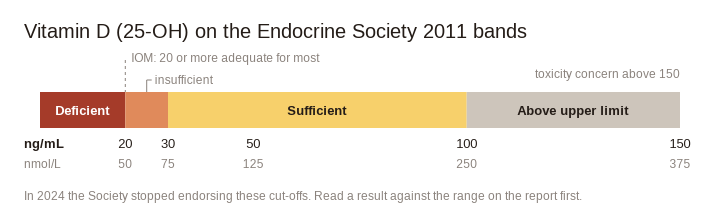
Converting units: 1 ng/mL equals 2.5 nmol/L, so 20 ng/mL is 50 nmol/L and 30 ng/mL is 75 nmol/L.
Why the bodies disagree: the IOM committee, reporting in 2011 (Ross et al.), concluded that a level of 20 ng/mL meets the bone-health needs of at least 97.5% of people, and that higher levels were not consistently linked to more benefit. The Endocrine Society's 2011 guideline (Holick et al.) set 30 ng/mL as the target, mainly for people being treated for deficiency.
What changed in 2024: the Endocrine Society's newer guideline (Demay et al., 2024) moved away from its own 2011 numbers. It no longer endorses specific 25(OH)D levels to define sufficiency, insufficiency or deficiency, because clinical trials have not shown which level delivers which benefit. It also suggests against routine vitamin D screening in healthy adults. That guideline does not cover people with a medical reason to test, such as malabsorption, low calcium or conditions that alter how the body handles vitamin D.
India's 2025 expert group consensus on vitamin D, developed by 41 endocrinologists from across India, defines deficiency as below 20 ng/mL (50 nmol/L). It says a value of 20 ng/mL or below reflects a strong need to initiate vitamin D replacement (Kalra et al., 2025). What your own result means, and whether anything needs to change, is a question for your doctor.
What is the difference between deficiency and insufficiency?
Deficiency means your level is low enough to harm bone; insufficiency means it is lower than some experts consider ideal but not clearly harmful on its own. Below about 12 ng/mL (30 nmol/L), the risk of osteomalacia (soft, painful bones in adults) rises, according to the NIH Office of Dietary Supplements. Between 12 and 20 ng/mL, levels may be inadequate for bone health in some people.
"Insufficient," the 21 to 29 ng/mL band, is the label that causes the most confusion. It comes from the Endocrine Society's 2011 bands. Under the IOM framework, the same result is adequate for most people. If your report flags you as insufficient, it is a reason to ask your doctor how they read it in your context, not a sign that something is wrong.
Why is vitamin D deficiency so common in India?
Vitamin D deficiency is very common in India despite abundant sunshine. A review of Indian studies (Aparna et al., 2018) found prevalence ranging from 40% to 99%, with most studies reporting 80% to 90%, across all age groups. Cut-offs and lab methods differ between those studies, so treat the range as a sign of how widespread low levels are rather than a precise national figure.
The reasons usually cited include:
- Little skin exposed to the sun, through clothing, indoor work and long commutes. - Darker skin, which needs more sun to make the same amount of vitamin D. - Air pollution, which reduces the ultraviolet light reaching the ground in many cities. - Diet, since few foods are naturally rich in vitamin D and vegetarian diets miss the main sources (oily fish, egg yolk). - Weight, as vitamin D is stored in fat, and higher body weight is linked to lower blood levels.
Does low vitamin D cause symptoms?
Often, low vitamin D causes no symptoms at all, which is why it is usually found on a blood test rather than suspected. When symptoms do appear, they tend to be vague: bone pain or aching, muscle weakness, tiredness and, in more severe cases, difficulty climbing stairs or getting up from a chair. Those are also common midlife complaints with many other causes.
This is where women get stuck. Fatigue and aches in your forties can come from low vitamin D, low iron, an underactive thyroid or perimenopause itself, and several can be present at once. Our guide to the ferritin test explains the iron side, and the hormonal imbalance test guide covers what else is worth checking. A normal vitamin D result does not rule out other causes.
Why does vitamin D matter more around menopause?
Vitamin D matters more in midlife because the years around menopause are when bone loss speeds up. Oestrogen (estrogen) helps protect bone, and as it falls, bone is broken down faster than it is rebuilt. The Bone Health and Osteoporosis Foundation in the US notes that women can lose up to 20% of their bone density in the five to seven years after menopause. Our guide to low estrogen symptoms explains the wider picture.
Vitamin D's main job is helping you absorb calcium from food. When vitamin D is low, the body absorbs less calcium, and to keep blood calcium steady it releases parathyroid hormone, which draws calcium out of bone. Low vitamin D on top of falling oestrogen is a double pressure on the skeleton, which is why bone health is the strongest, best-supported reason to know your level in midlife.
Keep it in perspective. Vitamin D is one part of bone health, alongside calcium intake, weight-bearing exercise, muscle strength, and for some women a bone density (DEXA) scan. And the evidence that vitamin D prevents conditions beyond bone, such as heart disease or cancer, is much weaker; the IOM committee found it inconsistent and insufficient to set requirements.
Can vitamin D be too high?
Yes, but vitamin D toxicity is rare, and it almost always comes from taking very high doses of supplements, not from sun or food. The Endocrine Society's 2011 guideline describes toxicity as rare, caused by ingesting excessively high amounts, and notes that most studies suggest blood levels need to be above 150 ng/mL (375 nmol/L) before there is concern. It used 100 ng/mL (250 nmol/L) as an upper limit to keep a safety margin. The IOM is more cautious, noting possible adverse effects above 50 ng/mL (125 nmol/L).
Too much vitamin D raises blood calcium, which can cause nausea, thirst, frequent urination, confusion and kidney problems. High-dose weekly sachets and injections are widely available in India without a clear plan for follow-up, so two questions are worth taking to your doctor: how long should a high-dose course run, and when should the test be repeated? It also helps to tell your doctor about every vitamin D product you already take, including multivitamins and calcium tablets that contain it.
How do I get a vitamin D test, and how much does it cost?
A vitamin D test is a simple blood draw from the arm, and you do not usually need to fast for it. It can be done at any time of day. If you are having other tests on the same sample, such as a lipid profile or fasting glucose, the lab may ask you to fast for those.
In India, eight labs and lab-booking sites listed a vitamin D (25-OH) test at ₹399 to ₹2,149 on 20 November 2026. The price changes by city, by lab and with the offer running that day. Home sample collection is widely available.
A few points help you get a result you can use:
- Tell your doctor what you already take, including multivitamins, calcium-with-D tablets and any weekly or monthly high-dose vitamin D. - Retest at the right interval. Because 25(OH)D changes slowly, doctors commonly retest about three months after starting or changing supplementation, not after a week or two. - Read it with the rest of your panel. Calcium, and sometimes parathyroid hormone, help your doctor understand what a low vitamin D result means for your bones. Our guide to blood tests for women over 40 covers the full midlife set.
Any decision about whether to supplement, and how much, belongs with your doctor. The right approach depends on your level, your diet, your bone health, your weight and your other medicines.
Where Yellow fits
A vitamin D result on its own often arrives as a red flag with no explanation, and the "deficient" or "insufficient" label depends on which set of cut-offs your lab happens to print. Yellow's blood panel reads vitamin D alongside the other markers that shape how midlife feels, from ferritin and vitamin B12 to a full thyroid read, and returns a plain explanation of what your numbers mean together, with questions to take to your doctor. You can see how it works at yellowforhormones.com. Yellow’s blood tests are also offered on their own, as the perimenopause panel.
Frequently Asked Questions
What is the normal range for a vitamin D test?
Start with the range printed next to your own result. The NIH notes that a vitamin D result can read falsely low or falsely high depending on the assay and the laboratory. The guideline bands do not agree with each other. On Endocrine Society 2011 bands, below 20 ng/mL is deficient, 21 to 29 is insufficient and 30 to 100 is sufficient. The US Institute of Medicine considers 20 ng/mL (50 nmol/L) or above adequate for most people. In 2024 the Endocrine Society stopped endorsing fixed cut-offs.
Is the vitamin D3 test the same as the 25-OH vitamin D test?
Usually, yes. Most Indian labs selling a "vitamin D3 test" measure total 25-hydroxyvitamin D, the standard marker of vitamin D status. Some labs report D2 and D3 separately. The active form, 1,25-dihydroxyvitamin D, is a different test and is not used to check whether you are deficient.
How do I convert vitamin D from nmol/L to ng/mL?
Divide nmol/L by 2.5 to get ng/mL, or multiply ng/mL by 2.5 to get nmol/L. For example, 50 nmol/L equals 20 ng/mL, and 75 nmol/L equals 30 ng/mL. Check which unit your report uses before comparing it with ranges you read online.
Do I need to fast before a vitamin D test?
No, a vitamin D test does not usually need fasting and can be done at any time of day. If other tests such as fasting glucose or a lipid profile are being run on the same sample, your lab may ask you to fast for those. Confirm with the lab when you book.
How long after starting vitamin D should I retest?
Many doctors retest about three months after starting or changing supplementation. 25(OH)D has a half-life of two to three weeks, so levels take time to settle and an earlier test can mislead. Retesting with the same lab makes the two results easier to compare.
Can low vitamin D cause bone loss after menopause?
Low vitamin D reduces how much calcium you absorb, and the body then draws calcium from bone. After menopause, falling oestrogen already speeds up bone loss, so low vitamin D adds to the pressure. Your doctor may look at vitamin D, calcium and a bone density scan together.
How much does a vitamin D test cost in India?
On 20 November 2026, eight labs and lab-booking sites in India listed a vitamin D (25-OH) test at ₹399 to ₹2,149. A vitamin B12 test, often booked with it, was ₹489 to ₹1,579 on the same day. The price changes by city and with the offer running that day. Both tests are in Yellow's perimenopause panel, which has 22 tests for ₹4,999.
Further Reading
- Holick MF, Binkley NC, Bischoff-Ferrari HA, Gordon CM, Hanley DA, Heaney RP, Murad MH, Weaver CM. Evaluation, Treatment, and Prevention of Vitamin D Deficiency: an Endocrine Society Clinical Practice Guideline. Journal of Clinical Endocrinology and Metabolism, 2011;96(7):1911-1930.
- Demay MB, Pittas AG, Bikle DD et al. Vitamin D for the Prevention of Disease: An Endocrine Society Clinical Practice Guideline. Journal of Clinical Endocrinology and Metabolism, 2024;109(8):1907-1947.
- Ross AC, Manson JE, Abrams SA et al. The 2011 Report on Dietary Reference Intakes for Calcium and Vitamin D from the Institute of Medicine: What Clinicians Need to Know. Journal of Clinical Endocrinology and Metabolism, 2011;96(1):53-58.
- National Institutes of Health, Office of Dietary Supplements. Vitamin D: Fact Sheet for Health Professionals.
- Aparna P, Muthathal S, Nongkynrih B, Gupta SK. Vitamin D deficiency in India. Journal of Family Medicine and Primary Care, 2018;7(2):324-330.
- Kalra S, Zargar AH, Das AK, et al. Prevention and Treatment of Vitamin D Deficiency in India: An Expert Group Consensus. Indian Journal of Endocrinology and Metabolism, 2025;29(1):13-26.