
Perimenopause and Menopause Blood Test Packages in India: What They Include, What They Miss
By Yellow Editorial · Last updated 8 November 2026
The short answer: no blood test package can tell you that you are in perimenopause if you are 45 or over; doctors decide that from your symptoms and your periods. What a good package can do is rule out the common, treatable conditions that feel the same, like low iron, thyroid problems and low B12 or vitamin D. We read 14 packages from six national lab brands in India on 8 November 2026. The general full body checkups covered the basics well, but none listed ferritin (your iron stores) or thyroid antibodies, and none read the results against your symptoms. The two menopause packages leaned on hormone tests that guidelines do not use to identify menopause from 45 onwards. If you already have a package booked, the gap worth raising with your doctor is iron: India's menopause guideline puts screening for anaemia and its nutritional causes in the baseline menopause workup and in the periodic health check after 40.
If you have had "normal" reports and still do not feel like yourself, you are not imagining it. One woman told us exactly this: "I don't feel like myself, and every report says normal." Often the report was normal for what it tested. It just did not test the right things, or nobody read it against how she feels.
We read 14 blood test packages from six national lab brands in India on 8 November 2026 and compared them with Yellow's own test. How we compared is at the end of this guide.
Is there one blood test that tells you if you are in menopause?
No. For women aged 45 or over with symptoms, the UK's national guideline, NICE NG23 "Menopause: identification and management", says perimenopause is identified from symptoms and changes in your periods, without laboratory tests. It also advises against using AMH, oestradiol and several other tests to identify it at that age.
The reason is that hormone levels, FSH in particular, go up and down during perimenopause, as NICE's quality standard on menopause puts it, so one normal result does not rule perimenopause out. Hormone tests still have a place. NICE says an FSH test can be considered for women aged 40 to 45 with symptoms, including a change in their periods, and for women under 40 when menopause is suspected. Other tests, such as a blood count or thyroid tests, may still be needed if a doctor suspects another cause of the symptoms.
This matters in India. NICE notes that people from some ethnic minority backgrounds, and people with some lifelong conditions, may reach menopause younger. India's menopause guideline puts the mean age at natural menopause here at 46.6 years, about 4 to 5 years earlier than the roughly 51 years it gives for Caucasian women, and it asks for that to be read as a population average rather than an exact figure (Indian Menopause Society, 2026). The same guideline puts early menopause, which it defines as 40 to 45, at 8 to 16 per cent of Indian women, and premature ovarian insufficiency at 1.5 to 3 per cent. That is the same 40 to 45 band in which NICE says an FSH test can be considered. Our guide on hormone tests for perimenopause covers when they help.
So the real job of a blood test in your late 30s, 40s and 50s is different. India's menopause guideline tells doctors that before aches and physical symptoms are put down to menopause, other causes should be excluded, and it names vitamin D deficiency, anaemia, thyroid disease, autoimmune disorders and osteoarthritis (Indian Menopause Society, 2026). That is what a blood test is for at this age, alongside the risks that rise after menopause.
What does a full body checkup actually include?
A general full body checkup in India is built around the basics, and it does them well. Here is what the seven general packages we read listed, next to the five women's packages and the two menopause packages.
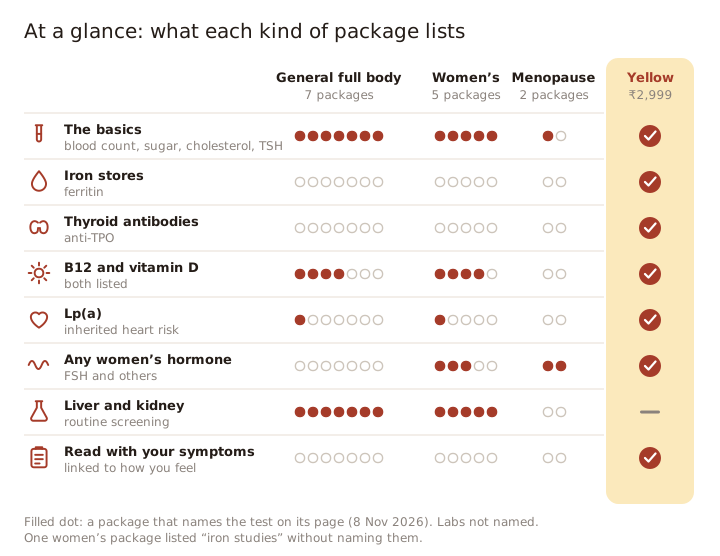
The full count, marker by marker:
| What it checks | General full body (7 packages) | Women's full body (5) | Menopause packages (2) | Yellow's blood test |
|---|---|---|---|---|
| Blood count (CBC) | 7 of 7 | 5 of 5 | 1 of 2 | Yes |
| Blood sugar (fasting glucose) | 7 of 7 | 4 of 5 | 0 of 2 | Yes |
| HbA1c (3-month sugar) | 5 of 7 | 5 of 5 | 1 of 2 | Yes |
| Cholesterol (lipid profile) | 7 of 7 | 5 of 5 | 2 of 2 | Yes |
| Thyroid (TSH) | 7 of 7 | 5 of 5 | 2 of 2 | Yes |
| Free T4 | 0 of 7 | 1 of 5 | 1 of 2 | Yes |
| Thyroid antibodies (anti-TPO) | 0 of 7 | 0 of 5 | 0 of 2 | Yes |
| Serum iron | 4 of 7 | 5 of 5 | 0 of 2 | No, ferritin instead |
| Ferritin (iron stores) | 0 of 7 | 0 of 5* | 0 of 2 | Yes |
| Vitamin B12 | 4 of 7 | 4 of 5 | 0 of 2 | Yes |
| Vitamin D | 4 of 7 | 5 of 5 | 1 of 2 | Yes |
| Lp(a) (inherited heart risk) | 1 of 7 | 1 of 5 | 0 of 2 | Yes |
| FSH | 0 of 7 | 3 of 5 | 2 of 2 | Yes |
| LH | 0 of 7 | 3 of 5 | 1 of 2 | Yes |
| Oestradiol and AMH | 0 of 7 | 0 of 5 | 2 of 2 | Yes |
| Liver and kidney tests | 7 of 7 | 5 of 5 | 0 of 2 | No |
| Urine routine | 6 of 7 | 3 of 5 | 0 of 2 | No |
| Results read against your symptoms | 0 of 7 | 0 of 5 | 0 of 2 | Yes |
Counts are tests named on each package page on 8 November 2026. One general package had cut-down liver, kidney and lipid panels; we counted them as included. Where a page listed only "T4" without saying free, we did not count it as free T4. One general package included a free doctor consultation; no page said the results would be read against your symptoms. *One women's package listed "iron studies" without naming the tests, so ferritin may be in it.
Two things stand out. Full body checkups are strong on routine screening: liver, kidney, urine, sugar and cholesterol. That is useful, and it is something Yellow's test does not cover. And the tests most likely to explain how a woman in midlife feels, ferritin and thyroid antibodies, were missing from every package we read.
What do most packages leave out?
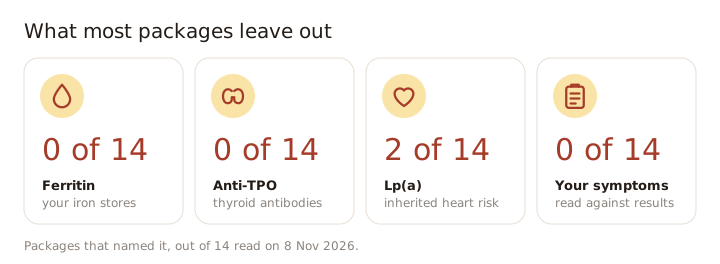
Ferritin. Most packages test serum iron. Ferritin is the standard test for your iron stores: the World Health Organization recommends ferritin as the marker of iron stores for diagnosing iron deficiency (WHO, 2020). Iron deficiency occurs both with and without anaemia, so a normal blood count does not rule it out (Breymann et al, 2013). That matters in India, where 57% of women aged 15 to 49 were anaemic in 2019-21 (NFHS-5, Ministry of Health and Family Welfare, 2022). Heavy periods make low iron more likely, and they are common in the years before menopause: in a large US study, about 1 in 3 women had three or more spells of heavy bleeding lasting three days or longer (Paramsothy et al, 2014). More in our ferritin and iron guide.
Thyroid antibodies. TSH is in every package, and that is the right first test. Anti-TPO antibodies are an established marker of autoimmune thyroid disease. A study across eight Indian cities found hypothyroidism in 15.86% of women, about 1 in 6, and in 10.95% of all the adults it tested; anti-TPO antibodies turned up in 21.85%, about twice that overall rate (Unnikrishnan et al, 2013). India's menopause guideline says the first thyroid test should be TSH, and names a positive thyroid peroxidase antibody among the findings that change what a doctor does about a raised TSH (Indian Menopause Society, 2026). See thyroid or perimenopause.
Lp(a). Lipoprotein(a) is an inherited heart risk that a routine cholesterol test does not show. The European Atherosclerosis Society advises measuring it at least once in adulthood (Kronenberg et al, 2022). One general package of the seven listed it.
Your symptoms. None of the 14 package pages said the results would be read against how you feel. One general package included a free doctor consultation, but otherwise you get numbers with reference ranges. A result just inside the range can still matter if you are exhausted and your periods are heavy. Numbers without your story are only half an answer.
What do menopause packages test, and is it useful?
The two menopause packages we read centred on FSH, oestradiol and AMH, with cholesterol and TSH. One added LH, vitamin D, a blood count and HbA1c; the other had none of these. Neither listed ferritin, B12 or thyroid antibodies.
For a woman aged 45 or over, these hormone results rarely change what happens next, because the diagnosis rests on symptoms (NICE NG23). AMH is a good example. Pooling 2,596 women from several cohorts, it added almost nothing to age alone in predicting when menopause would arrive, and the estimate for any one woman grew less accurate the earlier her menopause turned out to be. It was, though, much better than age alone at picking out which women were heading for menopause at 45 or under (Depmann et al, 2018). Our AMH test guide explains more. Hormone tests can be useful when you are younger than 45, when periods have stopped early, or when a doctor suspects another hormone condition.
The women's full body packages that added hormones added FSH, LH and prolactin. None of them added oestradiol, and none listed ferritin or thyroid antibodies.
Why "90 tests" does not mean 90 checks
Package names in India often promise 80, 90 or 100 tests. The number counts every line printed on the report.
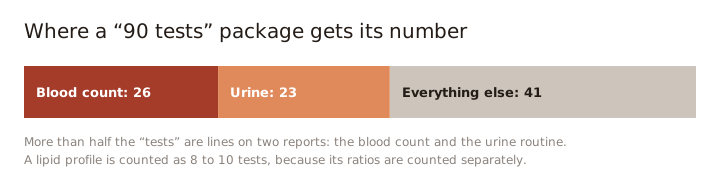
In the packages we read, the blood count alone was listed as 20 to 31 tests, and the urine routine as 17 to 24, including items like colour and volume. In four of the general packages, those two panels made up more than half of the headline number. A lipid profile was counted as 8 to 10 tests because the ratios are counted separately.
None of this is wrong, but it means the number tells you little. Compare packages by the markers that answer your question, not by the count. Our guide to blood tests for women over 40 covers which ones matter at this age.
What would it cost to test these one by one?
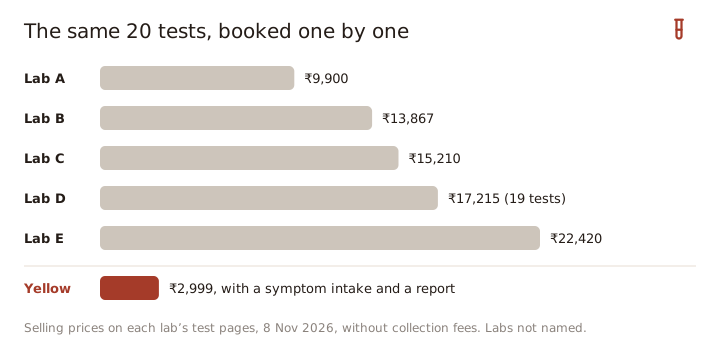
If you built a panel like Yellow's yourself, the same 20 tests booked one at a time, the selling prices on 8 November 2026 added up to:
| Large lab (not named) | 20 tests, one by one |
|---|---|
| Lab A | ₹9,900 |
| Lab B | ₹13,867 |
| Lab C | ₹15,210 |
| Lab D | ₹17,215 (19 tests; one not sold) |
| Lab E | ₹22,420 |
Prices are the selling price on each test page, in Bangalore where the lab shows city prices and on the default page where it does not, without home collection fees. Lab A's total includes a discount its site applies automatically on two tests; without it, the total is ₹10,750. Prices change often and differ by city. At most labs the costliest single tests were SHBG, AMH and anti-TPO. At every lab the cheapest were fasting glucose and calcium.
That is why packages exist: buying tests one at a time costs more. The question is whether the package you buy contains the tests that answer your question.
I have already booked a package. What should I add?
You do not need to start again. Look at the test list and check for these:
- Ferritin, if it is not there. It was missing from every package we read, and India's menopause guideline puts screening for anaemia and its nutritional causes in the baseline menopause workup and the periodic health check after 40 (Indian Menopause Society, 2026).
- HbA1c, if the package only has fasting glucose. The same guideline names fasting glucose or a non-fasting HbA1c as the preferred screening tests.
- Vitamin B12 and vitamin D, if they are missing. A 2021 review that pooled Indian studies found about half of adults low in B12 and about 6 in 10 low in vitamin D (Venkatesh et al, 2021), and India's menopause guideline lists vitamin D deficiency among the causes to exclude before symptoms are put down to menopause.
- Anti-TPO, if your doctor is looking at a raised TSH. India's menopause guideline names a positive thyroid peroxidase antibody among the findings that change what happens next.
- Lp(a), once. The European Atherosclerosis Society advises measuring it at least once in adulthood (Kronenberg et al, 2022).
India's menopause guideline says FSH, oestradiol and AMH are not recommended for diagnosing natural menopause, so from 45 onwards a hormone test added to a package rarely changes what happens next (Indian Menopause Society, 2026). The same guideline carries a table of tests done only on indication, and it names women who have already had a hysterectomy as an indication for FSH and oestradiol, which we cover in perimenopause after a hysterectomy. Whether a hormone test would change anything for you is a question for your doctor.
When should I take the test, and how often?
If your panel includes fasting glucose or a lipid profile, labs usually ask you to fast overnight, so book a morning slot. Ferritin and FSH taken on their own do not need fasting. Tell the lab about any supplements, because biotin can give wrong results on some thyroid tests.
If hormone tests are part of the panel and you still have periods, ask your doctor or the lab which day of your cycle to give the sample. If you take the combined pill or a high-dose progestogen, NICE advises against using FSH to identify menopause, so mention it.
How often depends on what you find. For diabetes, India's menopause guideline names fasting glucose or a non-fasting HbA1c as the screening tests, and advises repeating them every three years if the result is normal, or every one to three years if it falls in the prediabetes band (Indian Menopause Society, 2026). Anything low or borderline should be repeated when your doctor suggests.
Which kind of test suits you?
There is no single best package. It depends on what you want the test to answer.
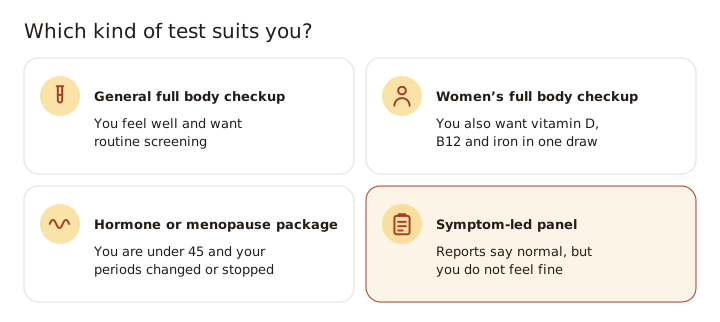
- A general full body checkup suits you if you feel well and want routine screening: blood count, sugar, cholesterol, liver, kidney and TSH.
- A women's full body checkup suits you if you also want vitamin D, B12 and iron in the same draw. Check whether it lists ferritin, because the five we read did not name it.
- A hormone or menopause package suits you mainly if you are under 45 and your periods have changed or stopped, and your doctor wants an FSH result. From 45 onwards, it rarely changes what happens next (NICE NG23).
- A symptom-led panel suits you if your reports have been normal but you do not feel fine, and you want the results read against your symptoms. Yellow's test is one. You can also ask your doctor to add ferritin and anti-TPO to a standard package.
Where does Yellow's blood test fit?
Yellow sells a blood test for women in perimenopause and menopause, so read this section knowing that. It costs ₹2,999 and the sample is collected at home by a national lab. Before the test you fill in a detailed intake of your history and symptoms, scored on the Menopause Rating Scale. The panel has 20 tests, which the page counts as more than 30 biomarkers, and it covers the gaps above: ferritin, thyroid with free T4 and anti-TPO, B12 and vitamin D, HbA1c with glucose and fasting insulin, cholesterol with Lp(a), calcium, and seven hormones read alongside your cycle. Your report links each result to the symptom it may explain and tells you what to ask your doctor.
What it does not do: it has no liver, kidney or urine tests, so it does not replace a routine full body checkup if you need those. Fasting insulin is not used to screen for diabetes; guidelines use glucose and HbA1c, and fasting insulin on its own does not diagnose anything. And like any blood test, it cannot diagnose perimenopause on its own. It is a report, not a diagnosis. You can see the full list on the blood test page.
How we compared
On 8 November 2026 we read the published test lists of 14 packages from six national lab brands in India (one of them on a reseller's page): seven general full body checkups (₹997 to ₹2,599), five women's full body checkups (₹2,529 to ₹3,279) and two packages sold for menopause or perimenopause (₹2,684 and ₹3,499). We counted a test only if it was named on the package page. Prices are the selling price shown on the page, in the city the page showed. We do not name the labs, because contents and prices change often and differ by city. Yellow sells its own blood test, so we say plainly below where it is stronger and where it is not.
Frequently Asked Questions
Which blood test is best for menopause?
No single test confirms menopause or perimenopause from age 45. Both NICE and India's menopause guideline say doctors decide that from symptoms and periods, not from a hormone test. India's guideline tells doctors to exclude other causes first, naming vitamin D deficiency, anaemia, thyroid disease, autoimmune disorders and osteoarthritis, and it puts screening for anaemia and its nutritional causes in the baseline workup after 40. It keeps hormone tests for defined situations, among them premature ovarian insufficiency, an uncertain menstrual history, and women who have already had a hysterectomy.
Is a full body checkup enough after 40?
It covers routine health well: blood count, sugar, cholesterol, liver, kidney and thyroid (TSH). In the 14 packages we read in November 2026, none listed ferritin or thyroid antibodies, and none read results against symptoms. If you are tired, foggy or your periods are changing, ask to add ferritin and talk to your doctor about what else fits your symptoms.
How much does a menopause blood test cost in India?
The two menopause packages we read cost ₹2,684 and ₹3,499 in November 2026. Women's full body packages cost ₹2,529 to ₹3,279 and general ones ₹997 to ₹2,599. Prices change often and differ by city and offer. Booking the same 20 tests as Yellow's panel one by one cost ₹9,900 to ₹22,420 across five large labs.
My reports are normal but I don't feel fine. What should I test?
Check what the report included. Many packages test serum iron but not ferritin, and TSH but not thyroid antibodies, so low iron stores or autoimmune thyroid trouble can be missed. Also check for B12 and vitamin D. Then take the report and a list of your symptoms to a doctor, so the results are read together with how you feel.
When in my cycle should I take the blood test?
For most tests, such as ferritin, thyroid, vitamin D, B12 and HbA1c, the day of your cycle does not matter. If FSH, LH or oestradiol are included and you still have periods, ask your doctor or the lab which day to give the sample. Fast overnight if your panel includes fasting glucose or cholesterol, and mention any biotin supplement.
How many times do I need to take the test?
Usually once, unless something comes back low or borderline. Then repeat only what your doctor asks for, such as ferritin after treatment or a borderline thyroid result. If sugar tests are normal, diabetes guidelines suggest repeating them at least every three years. Hormones go up and down during perimenopause, so one hormone result is a snapshot, not a verdict.
Further Reading
- National Institute for Health and Care Excellence. Menopause: identification and management. NICE guideline NG23. Published 12 November 2015, last updated 15 April 2026.
- Unnikrishnan AG, Kalra S, Sahay RK, Bantwal G, John M, Tewari N. Prevalence of hypothyroidism in adults: an epidemiological study in eight cities of India. Indian J Endocrinol Metab. 2013;17(4):647-652.
- Ministry of Health and Family Welfare, Government of India. Steps taken under Anaemia Mukt Bharat (AMB) strategy. Press Information Bureau; 2 August 2022.
- Venkatesh U, Sharma A, Ananthan VA, Subbiah P, Durga R; CSIR Summer Research Training Team. Micronutrient's deficiency in India: a systematic review and meta-analysis. J Nutr Sci. 2021;10:e110.
- Kronenberg F, Mora S, Stroes ESG, et al. Lipoprotein(a) in atherosclerotic cardiovascular disease and aortic stenosis: a European Atherosclerosis Society consensus statement. Eur Heart J. 2022;43(39):3925-3946.
- Meeta M, Anuradha M, Ashraf AB, et al. Clinical practice guidelines for menopause: an executive summary and recommendations: Indian Menopause Society 2026. J Midlife Health. 2026;17(Suppl 1):S12-S116.
- World Health Organization. WHO guideline on use of ferritin concentrations to assess iron status in individuals and populations. Geneva: World Health Organization; 2020.