
Cortisol Test for Women: What It Shows, Normal Ranges, and the Truth About Adrenal Fatigue
By Yellow Editorial · Last updated 24 November 2026
The short answer: a cortisol test is designed to find two real but uncommon adrenal conditions: too much cortisol (Cushing's syndrome) and too little (adrenal insufficiency, including Addison's disease). It is not a measure of how stressed or tired you are. Cortisol follows a strong daily rhythm, highest in the early morning and lowest around midnight, so the time of the sample matters as much as the number. A typical 8am serum cortisol range is about 5 to 25 µg/dL (138 to 690 nmol/L), but labs differ, so use the range on your report. Oral oestrogen (estrogen), including the combined pill, raises total cortisol and can skew results. "Adrenal fatigue" is not a recognised medical diagnosis; a 2016 systematic review found no evidence that it exists. If you are exhausted in your forties, poor sleep from perimenopause, low iron, thyroid problems and low mood are far more likely causes, and each has its own test.
What does a cortisol test measure?
A cortisol test measures cortisol, a steroid hormone made by the adrenal glands above the kidneys. Cortisol helps control blood sugar, blood pressure, the immune response and how the body copes with illness or injury.
The pituitary gland in the brain tells the adrenals how much to make, using a signal called ACTH (adrenocorticotropic hormone). When cortisol rises, ACTH falls. That is why doctors sometimes measure ACTH too: the pair shows whether a problem starts in the adrenals or the pituitary.
Cortisol can be measured in three kinds of sample:
- Blood (serum cortisol). The most common test in India, usually drawn in the morning. - Saliva. Most usefully collected late at night; reflects free, active cortisol. - Urine. Usually a 24-hour collection, showing the free cortisol made across a day.
Most blood tests measure total cortisol, which includes cortisol bound to a carrier protein called cortisol-binding globulin (CBG). That detail matters for women who take oestrogen, as explained below.
Why does the time of a cortisol test matter so much?
Timing matters because cortisol is not a steady level: it rises sharply in the hours before and just after waking, peaks in the early morning, then falls through the day to its lowest point around midnight. A cortisol of 8 µg/dL could be low at 8am and high at midnight. The number means nothing without the time.
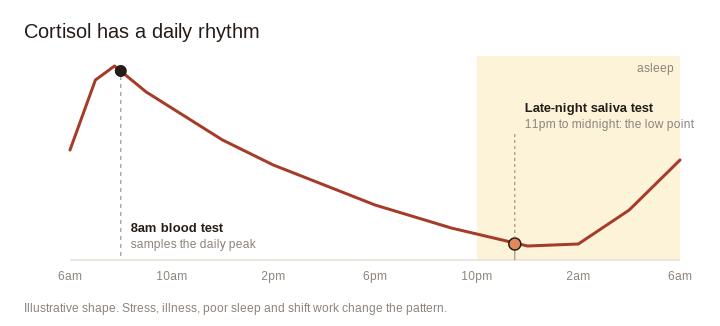
A morning blood test catches cortisol at its expected peak, so a low result hints the adrenals may not be making enough. A late-night saliva test catches it at its expected low, so a high result hints something is making too much. The US Endocrine Society's guideline on diagnosing Cushing's syndrome (Nieman et al., 2008) asks for late-night saliva to be collected between 11pm and midnight on two separate evenings for exactly this reason.
Stress, intense exercise, a bad night and acute illness can all push cortisol up temporarily. That is normal physiology, not disease, and it is one reason a single random cortisol result rarely settles anything.
Which cortisol test answers which question?
The right cortisol test depends on whether your doctor is looking for too much cortisol or too little, because the two questions use different tests.
| The question | Test commonly used | How it works |
|---|---|---|
| Could cortisol be too high (Cushing's)? | Late-night salivary cortisol | Saliva collected 11pm to midnight on two nights; cortisol should be at its lowest |
| Could cortisol be too high? | 24-hour urine free cortisol | All urine collected over 24 hours, usually on at least two occasions |
| Could cortisol be too high? | 1 mg overnight dexamethasone suppression test | A steroid tablet taken at night should switch cortisol off by the next morning's blood test |
| Could cortisol be too low (adrenal insufficiency)? | 8am serum cortisol, often with ACTH | Blood drawn at the time cortisol should be at its peak |
| Is it confirmed to be too low? | ACTH (Synacthen) stimulation test, which the 2016 guideline calls the gold standard for primary adrenal insufficiency but not for secondary | Blood taken before and 30 to 60 minutes after an injection of synthetic ACTH, to see if the adrenals respond |
The Endocrine Society guideline recommends starting with one high-accuracy test when Cushing's is suspected, then confirming any abnormal result with a second test under an endocrinologist (Nieman et al., 2008). For adrenal insufficiency, its 2016 guideline calls the ACTH (Synacthen) stimulation test the diagnostic gold standard for primary adrenal insufficiency, where the adrenal glands fail, but not for secondary adrenal insufficiency, where the problem lies in the pituitary (Bornstein et al., 2016).
What is a normal cortisol level?
A normal 8am serum cortisol is typically about 5 to 25 µg/dL (138 to 690 nmol/L), according to the US National Library of Medicine's MedlinePlus, but ranges vary with the lab, the testing machine and the time of the sample. Always read your result against the range printed on your own report.
| Test | Typical reference or cut-off | Notes |
|---|---|---|
| Serum cortisol, 8am | about 5 to 25 µg/dL (138 to 690 nmol/L) | Much lower by late afternoon; labs vary |
| 24-hour urine free cortisol (women) | under about 45 µg per 24 hours (124 nmol per 24 hours) | Assay-specific; may need repeating |
| Late-night salivary cortisol | above about 145 ng/dL (4 nmol/L) suggests excess | Lab and assay ranges differ |
| Serum cortisol after 1 mg dexamethasone | above 1.8 µg/dL (50 nmol/L) is abnormal | Cortisol should be suppressed |
| Peak cortisol after Synacthen | below about 500 nmol/L (18 µg/dL) suggests insufficiency | Cut-off depends on the assay used |
| Morning cortisol with ACTH, if Synacthen is not available | 140 nmol/L (5 µg/dL) or under is suggestive of insufficiency | A preliminary pointer, not a confirmation |
Sources: MedlinePlus for the first two rows; Nieman et al. (2008) for rows three and four; Bornstein et al. (2016) for the last two.
Units differ between labs: some Indian reports use µg/dL (also written mcg/dL), others nmol/L; 1 µg/dL is roughly 27.6 nmol/L. And a result just outside the printed range is not, on its own, a diagnosis.
Can the pill or HRT affect a cortisol test?
Yes. Oestrogen raises the level of cortisol-binding globulin, the protein that carries cortisol in the blood, so women taking oestrogen by mouth often have a higher total serum cortisol even when their active cortisol is normal. The Endocrine Society guideline notes that the overnight dexamethasone suppression test gives a false-positive result in about 50% of women taking the oral contraceptive pill, and suggests that, where possible, oestrogen-containing medicines are stopped for six weeks before that test (Nieman et al., 2008).
Whether that suits you is your doctor's decision. What you can do is tell them about every medicine you take, including the pill, HRT, steroid creams, inhalers or tablets, and supplements. Steroid medicines are the most common cause of abnormal cortisol results, and long-term steroid use is the most common cause of Cushing's syndrome, according to the NHS.
What conditions does a cortisol test diagnose?
A cortisol test helps diagnose two groups of real adrenal conditions, both far less common than everyday tiredness.
Too much cortisol: Cushing's syndrome. The NHS lists weight gain around the tummy, upper back and neck with thinner arms and legs, a round red face, easy bruising, stretch marks, muscle weakness in the thighs and upper arms, mood changes, irregular or absent periods and excess hair growth. Some of these overlap with midlife changes, which is why doctors look for the distinctive combination rather than any single sign.
Too little cortisol: adrenal insufficiency. In Addison's disease the adrenal glands themselves fail; in secondary adrenal insufficiency the pituitary stops sending enough ACTH. The NHS lists profound tiredness, patches of darker skin, poor appetite and weight loss, nausea, salt craving, dizziness on standing and muscle weakness. An adrenal crisis, with severe dizziness, vomiting, confusion or collapse, is a medical emergency.
Adrenal insufficiency can be life-threatening and is easy to miss early, which is exactly why it deserves a proper, correctly timed test rather than a guess.
Is "adrenal fatigue" real?
No. "Adrenal fatigue" is not a recognised medical diagnosis. The idea, popularised online and in some clinics, is that years of stress wear the adrenal glands out so they make too little cortisol, causing tiredness, cravings and brain fog. The Endocrine Society states that no scientific proof supports adrenal fatigue as a true medical condition, and that there is no test that can detect it.
In 2016, Brazilian endocrinologists Flavio Cadegiani and Claudio Kater published a systematic review of 58 studies in BMC Endocrine Disorders. They found the results were almost systematically conflicting, whatever cortisol method was used, and concluded there was no substantiation that adrenal fatigue is an actual medical condition.
This matters. The symptoms blamed on adrenal fatigue are real, and pinning them on a condition that does not exist can leave the actual cause unfound. The Endocrine Society also warns that supplements sold as adrenal support may contain hormones or untested ingredients; taking adrenal hormones you do not need can make your own adrenal glands stop working.
Are home and saliva cortisol tests worth it?
It depends on who ordered the test and why. A late-night saliva test ordered by a doctor to check for Cushing's syndrome is a validated, guideline-backed test. Saliva and dried-urine "adrenal stress" panels sold directly online, often taking four samples across a day and promising to map your stress or diagnose adrenal fatigue, are a different thing.
The Endocrine Society notes that blood and saliva tests marketed for adrenal fatigue are not grounded in solid evidence and may give inaccurate results. Cortisol swings with sleep, waking time, stress and exercise, so a one-day home curve can look "abnormal" in a healthy woman. If a kit result worries you, take it to a doctor, who will repeat any test that matters under proper conditions.
Does perimenopause affect cortisol?
The honest answer is that perimenopause and cortisol interact, but cortisol is rarely the explanation for how you feel. Night sweats and hot flushes break up sleep; broken sleep and ongoing stress can nudge cortisol patterns; and stress itself can make hot flushes and poor sleep feel worse. That loop is real, but it is not a disease, and there is no cortisol test for perimenopause.
When a woman in her forties says she is exhausted, the causes worth checking first are usually:
- Sleep disruption from night sweats, waking at 3am or 4am, or a sleep problem such as sleep apnoea. - Low iron stores. Heavy perimenopausal periods drain iron long before haemoglobin falls. Our ferritin test guide explains why. - Thyroid problems, which mimic perimenopause closely. See how to read thyroid test results. - Low vitamin B12 or vitamin D, both common in India. - Low mood, anxiety or burnout, which are real and treatable.
If stress or low mood has become hard to carry, please do not wait for a hormone appointment. In India you can call Tele-MANAS, the government's free mental health line, on 14416, any time.
For the wider picture of what is and is not worth testing, see our guide to hormonal imbalance tests for women.
Where Yellow fits
A cortisol test answers a narrow medical question, and on its own it rarely explains midlife exhaustion. Yellow's blood panel looks at the things that most often do, from ferritin and thyroid function to vitamin B12 and vitamin D, and returns a plain read of what your results actually suggest, including when something deserves a specialist's attention. For the full midlife set, see our guide to blood tests for women over 40. You can see how it works at yellowforhormones.com. Yellow’s blood tests are also offered on their own, as the perimenopause panel.
Frequently Asked Questions
What is a normal cortisol level for a woman?
A typical 8am serum cortisol is about 5 to 25 µg/dL (138 to 690 nmol/L), and it is much lower by evening. There is no separate female range, but oestrogen taken by mouth can raise total cortisol. Ranges differ between labs, so read your result against the one printed on your report.
What is the best time for a cortisol blood test?
For most purposes, early morning, usually around 8am, when cortisol should be at its daily peak. A low result at that time is more meaningful. Some tests are deliberately timed differently, such as late-night saliva between 11pm and midnight. Follow the timing your doctor or lab gives you exactly.
Do I need to fast for a cortisol test?
Fasting is not usually required for a serum cortisol test, though your lab may ask if other tests are drawn at the same time. More important is resting beforehand, avoiding hard exercise, and telling the lab about steroid medicines, the pill or HRT. For a saliva test, avoid eating, drinking or brushing for 30 minutes first.
Can stress cause high cortisol on a test?
Yes, temporarily. Physical or emotional stress, a poor night's sleep, illness and intense exercise can all raise cortisol on the day. That is a normal response, not Cushing's syndrome. This is why doctors confirm a high result with a second, different test before drawing any conclusion.
Can I test my cortisol levels at home?
Home saliva kits exist, and a late-night saliva test is a valid test when a doctor orders it for suspected Cushing's syndrome. Kits sold to measure stress or diagnose adrenal fatigue are not supported by evidence, according to the Endocrine Society. Results can be misleading, so discuss any worrying result with a doctor.
Is adrenal fatigue a real diagnosis?
No. The Endocrine Society says there is no scientific proof that adrenal fatigue exists and no test that can detect it, and a 2016 systematic review reached the same conclusion. Real adrenal insufficiency does exist, and is diagnosed with proper cortisol testing such as the Synacthen test.
How much does a cortisol test cost in India?
On 20 November 2026, eight labs and lab-booking sites in India listed a serum cortisol test at ₹481 to ₹919. Most of those pages name a morning sample. The price changes by city and with the offer running that day.
Further Reading
- Nieman LK, Biller BMK, Findling JW, Newell-Price J, Savage MO, Stewart PM, Montori VM. The Diagnosis of Cushing's Syndrome: An Endocrine Society Clinical Practice Guideline. Journal of Clinical Endocrinology and Metabolism, 2008;93(5):1526-1540.
- Bornstein SR, Allolio B, Arlt W et al. Diagnosis and Treatment of Primary Adrenal Insufficiency: An Endocrine Society Clinical Practice Guideline. Journal of Clinical Endocrinology and Metabolism, 2016;101(2):364-389.
- Cadegiani FA, Kater CE. Adrenal fatigue does not exist: a systematic review. BMC Endocrine Disorders, 2016;16(1):48.
- Endocrine Society. Adrenal Fatigue, patient information.
- MedlinePlus, US National Library of Medicine. Cortisol blood test.