
Testosterone Test for Women: How to Read Your Result
By Yellow Editorial · Last updated 23 November 2026
The short answer: the testosterone test is a blood test that measures testosterone, a hormone women make in smaller amounts than men. The guidelines used here give no normal range for women, and laboratories differ. The MedlinePlus medical encyclopedia, on a US government health site, lists 8.4 to 48.1 ng/dL for women aged 17 to 50, and three NHS hospital laboratories print upper limits of 1.4 to 2.0 nmol/L, depending on age. Doctors order the test mostly for signs of a high level, such as excess hair, acne or irregular periods, and PCOS is the most common cause. The 2019 global consensus statement on testosterone for women says a blood level should not be used to diagnose low sexual desire. The number starts a conversation with your doctor.
What does the testosterone test measure?
The test measures the amount of testosterone in a sample of your blood. Women make testosterone in the ovaries and the adrenal glands, and tissues such as fat and skin make more from other hormones.
Most testosterone in the blood is bound to proteins, mainly sex hormone-binding globulin (SHBG) and albumin. The rest is unbound, or free.
- Total testosterone. Bound and free together. MedlinePlus calls this the most common type of test.
- Free testosterone. The unbound part only.
- SHBG. The protein that binds testosterone.
- Free androgen index. Total testosterone divided by SHBG, multiplied by 100, the formula one Mumbai study prints. The 2023 international PCOS guideline accepts it as an estimate of free testosterone. The guidelines used here give it no normal range.
MedlinePlus says a testosterone test alone cannot diagnose any health condition.
What is a normal testosterone level for a woman?
There is no single agreed range. The guidelines used here give no number, and the sources that do print one are in the table below.
| Source | Range for women as printed | Method stated |
|---|---|---|
| MedlinePlus medical encyclopedia | 8.4 to 48.1 ng/dL (0.3 to 1.7 nmol/L) for ages 17 to 50. 2.9 to 40.1 ng/dL (0.1 to 1.4 nmol/L) over 50 | Not stated |
| A study of 161 healthy women aged 18 to 49 with regular cycles | 15 to 46 ng/dL for a 30-year-old woman | Immunoassay, morning samples |
| A German study of 985 women aged 20 to 80 | 0.35 to 1.97 nmol/L | Mass spectrometry |
| Three NHS hospital laboratories in the UK | Up to 2.0 nmol/L at one. At the other two, up to 1.7 and 1.67 nmol/L for women up to 49, and 1.4 and 1.42 nmol/L from 50 | Immunoassay at one, with raised results confirmed by mass spectrometry |
| A national Indian study: its own cut-off for a raised level, not a reference range | 0.88 ng/mL or higher | Immunoassay |
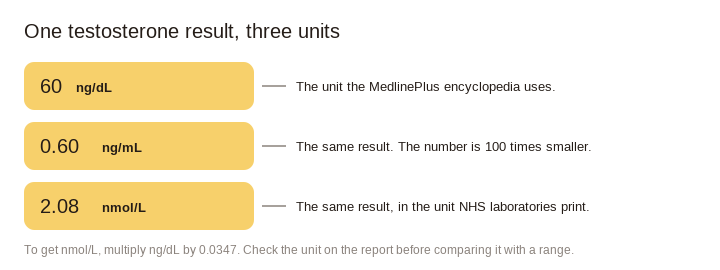
Check the unit before you compare numbers. These sources use ng/dL, ng/mL and nmol/L. A millilitre is one hundredth of a decilitre, so the same result is 100 times smaller in ng/mL than in ng/dL: 0.88 ng/mL is 88 ng/dL. To get nmol/L, multiply ng/dL by 0.0347. The Indian study prints this factor, and the paired figures in the MedlinePlus row fit it.
The 2023 international PCOS guideline says reference ranges vary widely between methods and laboratories, and that many come from groups highly likely to include women with PCOS. Read your number against the range and the unit printed on your own report.
How reliable is the testosterone test at women's levels?
The guidelines say direct immunoassays are less accurate at the low levels found in women than mass spectrometry. The Endocrine Society's hirsutism guideline says the automated assays in most hospital laboratories are generally not suitable for women.
The 2019 global consensus statement says direct assays for total and free testosterone are highly unreliable in the female range, and that mass spectrometry measures total testosterone with high accuracy. The 2023 international PCOS guideline says laboratories should use mass spectrometry over direct immunoassays. The consensus statement adds that a direct assay is appropriate where mass spectrometry is not available, to exclude a high level.
The Endocrine Society's hirsutism guideline says a direct test for free testosterone is unreliable, and that the most reliable methods calculate it from total testosterone and SHBG. It recommends against saliva tests.
What raises testosterone in women?
PCOS, polycystic ovary syndrome, is the most common cause. The Endocrine Society's hirsutism guideline says 70% to 80% of women with hirsutism have it. The NHS website now calls it polyendocrine metabolic ovarian syndrome (PMOS), and says PMOS used to be called PCOS.
The 2023 international PCOS guideline diagnoses PCOS when two of three features are present and other causes are excluded:
- signs of high androgens, seen on the body or measured in the blood
- irregular ovulation
- polycystic ovaries on ultrasound, or an anti-Müllerian hormone (AMH) blood test in place of the ultrasound
A raised blood level and visible signs count as the same feature. The guideline says the blood test is of greatest value when visible signs are minimal or absent. It gives no testosterone number and leaves the cut-off to each laboratory. The Endocrine Society's hirsutism guideline says PCOS can be diagnosed in a woman with regular periods, hirsutism, polycystic ovaries and a normal testosterone level.
When a level is markedly above the laboratory's range, the 2023 guideline says other causes should be considered: growths of the ovary or adrenal gland, congenital adrenal hyperplasia, Cushing's syndrome, ovarian hyperthecosis after menopause, medicines and severe insulin resistance. The Endocrine Society's hirsutism guideline puts androgen-secreting tumours at about 0.2% of women with high androgens.
What are the signs of high testosterone, and which need prompt assessment?
MedlinePlus lists these signs of a high level in women:
- abnormal hair growth on the body or face
- hair loss on the head
- acne
- irregular periods or no periods
- difficulty getting pregnant
- voice changes
The Endocrine Society's hirsutism guideline says the hair score does not correlate well with the androgen level. The 2023 international PCOS guideline says hair loss and acne without hirsutism are relatively weak predictors of a raised level. Our guide to the signs of hormonal imbalance covers these alongside others.
Some signs need prompt assessment. The NHS says to ask for an urgent appointment if new thick, dark hair suddenly starts growing on the face and body, the voice is getting lower or the muscles are getting bigger. The Endocrine Society's hirsutism guideline says rapid development or virilisation, such as a deepening voice or increasing muscularity, points to a greater likelihood of an androgen-secreting tumour. The 2023 guideline says some tumours cause only mild to moderate rises. The Endocrine Society's guideline says the level predicts a tumour poorly, although one in the adult male range is suggestive. Neither gives a number.
Can a test show low testosterone?
A report can show a low number, but the sources do not accept it as a diagnosis.
- The 2019 global consensus statement says no cut-off blood level separates women with and without sexual dysfunction, and that total testosterone should not be used to diagnose low sexual desire, which it calls hypoactive sexual desire disorder (HSDD).
- NICE, in its menopause guideline, says to consider testosterone for low sexual desire associated with menopause if HRT alone is not effective. Its recommendations say nothing about measuring a level.
- The British Menopause Society says testosterone should not be replaced just because levels are low. It uses the test before treatment, as a baseline, and then for monitoring.
The sources do not link a low level to tiredness, low mood or poor concentration. The Endocrine Society's 2014 guideline on androgen therapy says data correlating androgen levels with specific symptoms are unavailable. The consensus statement found no effect of testosterone treatment on general wellbeing or depressed mood in postmenopausal women. The British Menopause Society says trials have not shown benefits for cognition, mood or energy, and adds that some individuals report improvement.
How is the test done, and do time of day, cycle day and fasting matter?
The test is a blood sample, and the sources differ or are silent on timing and fasting.
| Question | What the sources say |
|---|---|
| Time of day | MedlinePlus says the sample is taken in the morning, between 7 and 10, when levels are typically highest. The line is not specific to women. The Endocrine Society's hirsutism guideline standardises for early morning. The 2023 PCOS recommendations are silent |
| Day of the cycle | The Endocrine Society's hirsutism guideline standardises for days 4 to 10. The 2023 PCOS recommendations and MedlinePlus name no day |
| Fasting | MedlinePlus says that in certain cases you may need to fast for several hours. No guideline used here asks for fasting |
| The combined contraceptive pill | The 2023 PCOS guideline says it is very difficult to assess androgens reliably in women on the combined pill, because the pill raises SHBG and reduces androgen production |
Do not stop the pill or any other medicine before a test. Tell the doctor who orders the test what you take, and ask the prescribing doctor how to read a result taken while you are on it.
What happens after a high testosterone result?
The guidelines name other blood tests to find the cause, sometimes a scan, and treatment that depends on the cause.
- Other blood tests. To exclude other causes, the 2023 international PCOS guideline names TSH, prolactin, FSH and 17-hydroxyprogesterone, the test for congenital adrenal hyperplasia. Our guides to thyroid test results, the prolactin test and the FSH and LH test explain three of them.
- Ultrasound. The 2023 guideline says an ovarian ultrasound is not necessary to diagnose PCOS when irregular cycles and high androgens are both present.
- Treatment. The 2023 guideline names the combined oral contraceptive pill as the first-line medicine for irregular periods and high androgens in PCOS. The Endocrine Society's hirsutism guideline says it takes about 6 months to detect the effect of hormonal treatment on hair.
- Weight and diet. The Endocrine Society's hirsutism guideline recommends lifestyle changes for women with hirsutism and obesity. It cites a pooled analysis of four studies in which these lowered testosterone in women with PCOS and obesity, and says the effect on hair is not clinically significant. The NHS says losing weight if you are overweight can help control hormone levels.
Our guide on which doctor to see for a hormonal imbalance covers who manages this.
What do the sources say about testosterone and menopause?
Testosterone falls with age, and the sources differ on what menopause itself adds. The 2019 global consensus statement says testosterone declines during the reproductive years. The Endocrine Society's 2014 guideline on androgen therapy says most prospective studies have not shown significant changes in testosterone across menopause, and that one study following women through the menopausal transition found a small decrease. The British Menopause Society says the decline appears to be at least partly due to loss of ovarian function.
The consensus statement says the only evidence-based use of testosterone treatment in women is for postmenopausal women diagnosed with HSDD after a formal assessment. The 2023 international PCOS guideline says high androgens persist after menopause in women with PCOS.
No Indian data on testosterone at menopause were found for this guide.
How common is PCOS in India?
No Indian figure was found for how many women have a raised testosterone result. The figures below are for PCOS, and they change with the diagnostic criteria used.
- In a study of 8,993 women aged 18 to 40 across eight Indian states, PCOS was found in 7.2% by the NIH 1990 criteria, 19.6% by the Rotterdam 2003 criteria and 13.6% by the AE-PCOS criteria.
- In a community study in one part of Mumbai, 22.5% of 600 girls and women aged 15 to 24 had PCOS by the Rotterdam criteria and 10.7% by the Androgen Excess Society criteria.
- A pooled analysis of 11 Indian studies from 2010 to 2021 put the figure at 11.33%.
The 2023 guideline gives 10% to 13% worldwide.
Where Yellow fits
A testosterone result is read alongside other hormone tests. Our guide to the hormonal imbalance test covers the tests that are ordered together.
Total testosterone and SHBG are in Yellow's blood panel. They are also two of the 22 tests in the perimenopause panel, which includes prolactin, FSH, LH and TSH.
Frequently Asked Questions
Is a testosterone level of 60 high for a woman?
In ng/dL, 60 is above the 48.1 ng/dL upper figure that the MedlinePlus medical encyclopedia lists for women aged 17 to 50, and below the 88 ng/dL line that a national Indian study used to define a raised level. The guidelines used here give no cut-off. Read the number against your own report's range.
Why do my two testosterone reports show different numbers?
Check the units first. One laboratory may print ng/dL and another ng/mL, which makes the same result 100 times smaller. Laboratories also use different methods, and the 2023 international PCOS guideline says reference ranges vary widely between them. Testosterone also changes through the day and across the menstrual cycle.
Does high testosterone mean I have PCOS?
Not by itself. PCOS is the most common cause, but the 2023 international PCOS guideline requires two of three features and the exclusion of other causes. It names TSH, prolactin, FSH and 17-hydroxyprogesterone tests for that. A level markedly above the laboratory's range leads doctors to consider causes other than PCOS.
I have chin hair but my periods are regular. Should I get a testosterone test?
The Endocrine Society's hirsutism guideline suggests testing all women with an abnormal hirsutism score, which a doctor measures. It suggests against testing women with regular periods who have unwanted local hair growth and a normal score. It also says many women have hirsutism without a raised androgen level.
What is the difference between total and free testosterone?
Total testosterone counts all the testosterone in the blood, including the part bound to proteins. Free testosterone is the unbound part only. For PCOS, the 2023 international guideline uses both. The Endocrine Society's hirsutism guideline says a direct test for free testosterone is unreliable and that the most reliable methods calculate it.
Can high testosterone make it harder to get pregnant?
MedlinePlus lists difficulty getting pregnant among the symptoms of high testosterone in women. PCOS is the most common cause of a high level, and the NHS says it can sometimes cause problems getting pregnant, usually because the ovaries do not release an egg each month. The sources here give no testosterone level at which conceiving becomes harder.
How much does a testosterone test cost in India?
On 23 November 2026, eight labs and lab-booking sites in India listed a total testosterone test at ₹469 to ₹989, with a middle price of about ₹685. The price changes by city and with the offer running that day. Total testosterone and SHBG are two of the 22 tests in Yellow's perimenopause panel, which costs ₹4,999.
Further Reading
- Davis SR, Baber R, Panay N, et al. Global Consensus Position Statement on the Use of Testosterone Therapy for Women. Journal of Clinical Endocrinology and Metabolism, 2019;104(10):4660-4666.
- Teede HJ, Tay CT, Laven JJE, et al. Recommendations From the 2023 International Evidence-based Guideline for the Assessment and Management of Polycystic Ovary Syndrome. Journal of Clinical Endocrinology and Metabolism, 2023;108(10):2447-2469.
- Martin KA, Anderson RR, Chang RJ, Ehrmann DA, Lobo RA, Murad MH, Pugeat MM, Rosenfield RL. Evaluation and Treatment of Hirsutism in Premenopausal Women: An Endocrine Society Clinical Practice Guideline. Journal of Clinical Endocrinology and Metabolism, 2018;103(4):1233-1257.
- MedlinePlus, US National Library of Medicine. Testosterone Levels Test. Last updated 5 June 2025.
- Ganie MA, Chowdhury S, Malhotra N, et al. Prevalence, Phenotypes, and Comorbidities of Polycystic Ovary Syndrome Among Indian Women. JAMA Network Open, 2024;7(10):e2440583.