
Prolactin Test for Women: How to Read Your Result
By Yellow Editorial · Last updated 22 November 2026
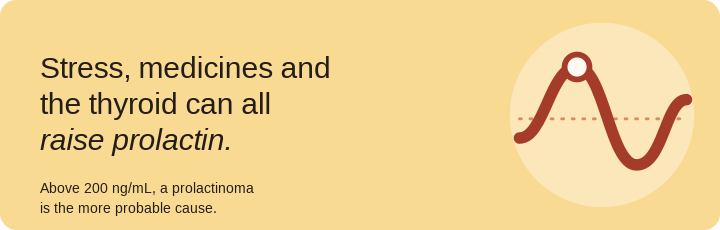
The short answer: the prolactin test is a blood test that measures prolactin, a hormone made by the pituitary gland. For women who are not pregnant, the sources that give a number put the upper limit between 15 and about 26 ng/mL, and 25 is the figure given most often. Each laboratory prints its own range. A small rise can have an ordinary cause, such as stress, a medicine or an underactive thyroid. The Pituitary Society's 2023 statement says that at 200 ng/mL or below, causes other than a prolactinoma should be considered, and that above 200 ng/mL a prolactinoma, a benign tumour of the pituitary gland, is the more probable cause. The number is a starting point for a conversation with your doctor, not a diagnosis.
What does the prolactin test measure?
The test measures the amount of prolactin in a sample of your blood. It is also called the serum prolactin test or the PRL test. Prolactin is made by the pituitary gland, a small gland at the base of the brain. Its main role is to make breast tissue grow during pregnancy and to produce milk after birth. In women who are not pregnant, the level is normally low.
Doctors order the test to find the cause of irregular or absent periods or of infertility, and to diagnose a prolactinoma.
MedlinePlus, a US government health site, says the test cannot show the cause of a high level.
What is a normal prolactin level for a woman?
There is no single agreed range, and the upper limit depends on the laboratory. The sources that give a number for women who are not pregnant are in the table below.
| Source | Upper limit as stated | The same in ng/mL |
|---|---|---|
| The Endocrine Society's 2011 guideline | Generally lower than 25 µg/L | 25 |
| MedlinePlus | Less than 25 ng/mL | 25 |
| Two NHS hospital laboratories in the UK | 496 mU/L and 550 mU/L | About 23.4 and 25.9 |
| Limits and cut-offs in the Indian studies described below | 15, 18 or 25 ng/mL | 15, 18 or 25 |
Check the unit before you compare numbers. The Indian studies in this guide report prolactin in ng/mL, which MedlinePlus prints as the same number as µg/L. The guidelines also use mIU/L, and the two NHS laboratories print mU/L. Both guidelines give the same conversion: 1 µg/L equals 21.2 mIU/L. So 25 ng/mL is 530 mIU/L, 100 ng/mL is 2,120 mIU/L and 200 ng/mL is 4,240 mIU/L. The NHS figures in the table use the same factor.
The Pituitary Society gives no single normal number and works in multiples of each laboratory's own upper limit. Pregnancy changes the range: the Endocrine Society says prolactin rises 10-fold and reaches 150 to 300 ng/mL by term. A low result is rare, and MedlinePlus says it may be a sign of a pituitary disorder.
What can a high prolactin level mean?
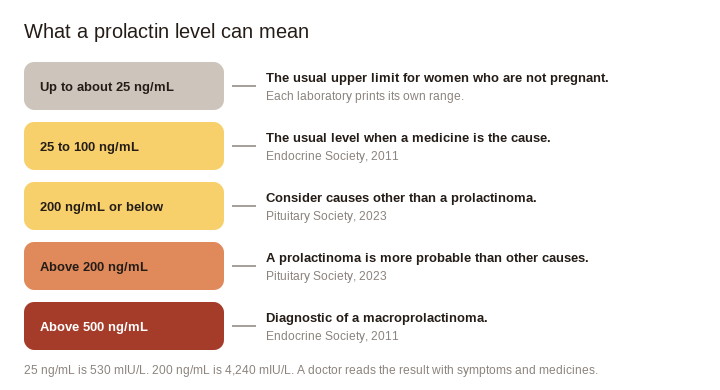
A higher level makes a prolactinoma more likely, but no level settles the cause without other checks. The two main guidelines draw these lines.
| Prolactin level | What the source says | Source |
|---|---|---|
| Above the lab's upper limit, but less than five times it | Repeat the test | Pituitary Society, 2023 |
| 25 to 100 ng/mL | The usual level when a medicine is the cause. A few medicines can take it above 200 ng/mL | Endocrine Society, 2011 |
| 200 ng/mL or below | Consider causes other than a prolactinoma. Check for macroprolactin, at least when the result does not fit the symptoms or the scan | Pituitary Society, 2023 |
| Above 200 ng/mL | A prolactinoma is more probable than other causes | Pituitary Society, 2023 |
| Above 250 ng/mL | Usually indicates a prolactinoma | Endocrine Society, 2011 |
| Above 500 ng/mL | Diagnostic of a macroprolactinoma, a prolactinoma larger than 10 mm | Endocrine Society, 2011 |
The Endocrine Society says a prolactinoma can be found at any prolactin level, including a small rise. So a doctor reads the result together with symptoms, medicines and other tests.
What raises prolactin without any disease?
Pregnancy, breastfeeding, stress, exercise, sleep and sex can all raise prolactin in a healthy body, according to both main guidelines. The Pituitary Society adds high-protein meals and alcohol. The US National Institutes of Health says the rises from physical stress, exercise, a meal and sex are usually small and temporary.
The blood draw itself counts as stress. The Pituitary Society says the stress of the needle can raise prolactin twofold to fourfold, and that the rise lasts less than one hour.
Which medicines raise prolactin?
Medicines that affect dopamine, the brain chemical that holds prolactin down, can raise prolactin, and antipsychotics are the most common cause among them. The Endocrine Society says medicines are the most frequent cause of high prolactin that does not come from a tumour. The Pituitary Society says a raised level occurs in 30 to 75% of people who take antipsychotics.
The guidelines and the US National Institutes of Health list these classes:
- antipsychotics
- medicines for nausea and vomiting
- antidepressants
- some types of blood pressure medicine
- pain relievers that contain opioids
- H2 blockers, medicines that reduce stomach acid
The sources disagree about oestrogen. The Pituitary Society says oestrogens raise prolactin. The Endocrine Society calls the role of oestrogen controversial. The US National Institutes of Health says contraceptive pills that contain oestrogen and hormone replacement therapy have not been found to cause high prolactin.
Do not stop a prescribed medicine because it is on this list. Ask the doctor who prescribes it whether it could explain your result.
Which medical conditions raise prolactin?
A prolactinoma, an underactive thyroid and kidney disease are among the medical causes that the guidelines name.
- Prolactinoma. This is a benign tumour of the pituitary gland that makes prolactin. The Pituitary Society calls it the most common disease-related cause. The US National Institutes of Health says prolactinomas are usually small, less than 1 centimetre across.
- Underactive thyroid. Both guidelines list it as a cause, and both say the rise can be reversed with thyroid hormone treatment. Our guide to thyroid test results explains that test.
- Kidney disease. The kidneys clear prolactin from the blood. The Endocrine Society says about one third of people with kidney disease develop high prolactin.
- Others. The guideline lists include liver cirrhosis, other masses near the pituitary, and injury, surgery or shingles affecting the chest wall. Sometimes no cause is found.
PCOS: the sources do not agree. The Endocrine Society's 2011 guideline and MedlinePlus list polycystic ovary syndrome among the conditions linked to high prolactin. The Pituitary Society's 2023 statement says PCOS by itself is rarely associated with high prolactin, and that a raised level in a woman with PCOS needs further evaluation. A study at one Dutch hospital found high prolactin in 1.1% of 1429 women with PCOS and 3.0% of 299 women without it.
What is macroprolactin?
Macroprolactin is a larger form of prolactin that the test counts. The Pituitary Society calls it biologically inactive and says most people who have it lack the typical symptoms of high prolactin. The Society for Endocrinology says macroprolactin does not cause problems in the body, and that people with it need no further investigation or treatment. The Endocrine Society suggests checking for it when prolactin is high and there are no symptoms.
At one hospital laboratory in New Delhi, 13.7% of 1,229 people with raised prolactin had macroprolactin.
What are the symptoms of high prolactin in women?
The common signs are changes in periods, milky discharge from the breasts and difficulty conceiving. The US National Institutes of Health lists:
- irregular periods or no periods
- infertility
- milky discharge from the breasts
- loss of interest in sex
- pain or discomfort during sex due to vaginal dryness
High prolactin can lower the level of sex hormones. The Society for Endocrinology says the low oestrogen can cause hot flushes.
- There may be no symptoms. The Endocrine Society says high prolactin can remain without symptoms. The Pituitary Society says the absence of milky discharge does not exclude it.
- Headaches and vision problems are linked to large tumours. The Society for Endocrinology says most prolactinomas are small and the tumour itself does not usually cause specific symptoms.
How is the prolactin test done, and do time of day, fasting and stress matter?
The test is a blood sample from a vein, and the sources differ on timing and fasting.
- Time of day. The Endocrine Society says the sample can be taken at any time of day. MedlinePlus says prolactin changes through the day and the sample is usually scheduled three to four hours after waking.
- Fasting. Neither guideline says fasting is needed. MedlinePlus says you may be asked to fast for several hours.
- Stress. The Endocrine Society says the sample should be taken without excessive stress from the needle. If stress is suspected, the Pituitary Society recommends sampling through a cannula, a small tube placed in a vein.
- Day of the cycle. No guideline used here asks for a particular day.
Follow the instruction your lab gives when you book.
What happens after a high prolactin result?
The guidelines call for a repeat test, a search for other causes, and a pituitary scan when no other cause is evident. They do not set these out as a fixed sequence.
- Repeat the test. The Pituitary Society says a level less than five times the upper limit should be measured again.
- Rule out pregnancy. The same statement says pregnancy should not be overlooked.
- Review medicines with the doctor who prescribes them.
- Check for an underactive thyroid and kidney disease. The Endocrine Society recommends excluding both when high prolactin causes symptoms.
- Check for macroprolactin where it applies.
- MRI of the pituitary. The Pituitary Society recommends an MRI when high prolactin is confirmed and no other cause is evident.
Neither guideline gives a prolactin number below which an MRI is not needed.
Not every prolactinoma is treated. The Endocrine Society recommends a class of medicines called dopamine agonists for a prolactinoma that causes symptoms. The Pituitary Society adds that for some prolactinomas, surgery should be discussed alongside medicine as a first choice. Our guide on which doctor to see for a hormonal imbalance covers who manages this.
What do the sources say about prolactin and menopause?
The Pituitary Society says menopause is associated with a natural fall in prolactin. It reports that prolactin returned to normal in 45% of untreated women with a small prolactinoma who entered menopause. That figure comes from a study at one UK hospital in which 11 women became menopausal.
The US National Institutes of Health says women who no longer have periods lack that clear sign, which may delay a diagnosis.
The sources used here say nothing about prolactin levels during perimenopause. They do say that new irregular or absent periods are a reason to measure prolactin. Our guide to the hormonal imbalance test covers the tests ordered alongside it.
How common is high prolactin in India?
No national or community figure for Indian women was found for this guide. The three studies described here each come from one hospital or medical college, and all are of women with infertility.
- In a study of 160 women with infertility referred to one Delhi medical college, 41% had high prolactin, against a laboratory range of 2 to 25 ng/mL. So did 15% of 80 fertile hospital employees in the comparison group.
- In a study of 394 women at the infertility clinic of one north Indian teaching hospital, 18.3% had prolactin above 25 ng/mL.
- In a study of 100 women with infertility at one outpatient department, 46% had prolactin above 15 ng/mL, a lower cut-off than the other two.
Where Yellow fits
Irregular periods have several possible causes, and prolactin is one of them. Our guides to thyroid test results and the FSH and LH test cover two others, and blood tests for women over 40 explains how to choose tests by symptom.
Prolactin is one of the 22 tests in Yellow's blood panel, which also includes TSH, FSH and LH, and returns a plain explanation of the results with questions to take to your doctor. The same tests are offered on their own as the perimenopause panel.
Frequently Asked Questions
My prolactin level is 36. Is that high?
First check the unit. In ng/mL, 36 is above the 25 ng/mL upper limit that the Endocrine Society and MedlinePlus give for women who are not pregnant. The Pituitary Society says a level less than five times the upper limit should be repeated. Stress, medicines and an underactive thyroid are among the causes the guidelines list.
Does high prolactin mean I have a brain tumour?
Not by itself. Stress, pregnancy, medicines, an underactive thyroid and kidney disease can all raise prolactin. A prolactinoma is a benign tumour of the pituitary gland, and the US National Institutes of Health says it is usually less than 1 centimetre across. The Pituitary Society says a prolactinoma becomes the more probable cause above 200 ng/mL.
Do I need an MRI for high prolactin?
The Pituitary Society recommends an MRI when high prolactin is confirmed and no other cause is evident. The guidelines also name a repeat test, a pregnancy check, a review of medicines and checks for an underactive thyroid and kidney disease. Neither main guideline gives a prolactin number below which an MRI is not needed.
Do I need to fast before a prolactin test, and what time should I go?
The sources differ. The Endocrine Society says the sample can be taken at any time of day, and neither main guideline asks for fasting. MedlinePlus says the sample is usually taken three to four hours after waking and that you may be asked to fast. Follow your lab's instruction.
Can stress raise prolactin?
Yes. Both main guidelines list stress as a cause of a raised level. The Pituitary Society says the stress of the blood draw alone can raise prolactin twofold to fourfold for less than one hour. If stress is suspected, it recommends sampling through a cannula, a small tube placed in a vein.
Can I get pregnant with high prolactin?
MedlinePlus says high prolactin can affect how the ovaries work and can cause menstrual problems and infertility. The answer depends on the cause, which your doctor needs to find first. When a prolactinoma is the cause, the US National Institutes of Health says dopamine agonist medicines are very effective in restoring fertility.
How much does a prolactin test cost in India?
On 22 November 2026, eight labs and lab-booking sites in India listed a prolactin test at ₹419 to ₹789, with a middle price of about ₹570. The price changes by city and with the offer running that day. Prolactin is one of the 22 tests in Yellow's perimenopause panel, which costs ₹4,999.
Further Reading
- Melmed S, Casanueva FF, Hoffman AR, Kleinberg DL, Montori VM, Schlechte JA, Wass JAH. Diagnosis and Treatment of Hyperprolactinemia: An Endocrine Society Clinical Practice Guideline. Journal of Clinical Endocrinology and Metabolism, 2011;96(2):273-288.
- Petersenn S, Fleseriu M, Casanueva FF, et al. Diagnosis and management of prolactin-secreting pituitary adenomas: a Pituitary Society international Consensus Statement. Nature Reviews Endocrinology, 2023;19(12):722-740.
- MedlinePlus, US National Library of Medicine. Prolactin Levels. Last updated 3 January 2024.
- National Institute of Diabetes and Digestive and Kidney Diseases. Prolactinoma. Last reviewed September 2019.
- Goswami B, Patel S, Chatterjee M, Koner BC, Saxena A. Correlation of Prolactin and Thyroid Hormone Concentration with Menstrual Patterns in Infertile Women. Journal of Reproduction and Infertility, 2009;10(3):207-212.