
Estrogen Test for Women: How to Read Your Estradiol (E2) Result
By Yellow Editorial · Last updated 24 November 2026
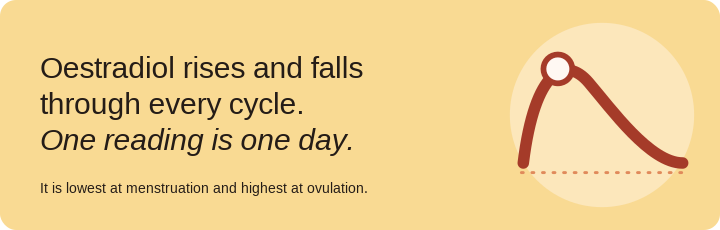
The short answer: an estrogen (oestrogen) test measures one or more oestrogens. The E2 test is a blood test for estradiol (oestradiol), the main oestrogen in women of childbearing age who are not pregnant. The level changes through each menstrual cycle and from one cycle to the next, so one reading says little by itself. NICE, the UK's guideline body, says not to use oestradiol to identify perimenopause or menopause in people aged 45 or over. The sources name uses for the test when periods stop before 40, in fertility care, and when a doctor suspects a pituitary problem or an oestrogen-producing tumour. Each laboratory prints its own range. Discuss the number with your doctor. It is not a diagnosis.
What does the estrogen test measure?
An oestrogen test measures the level of oestrogens in a sample of blood, urine or saliva, and the E2 test measures oestradiol in blood. MedlinePlus, a US government health site, says three types of oestrogen are commonly tested.
- Oestrone (E1) is the only oestrogen that women continue to make after menopause.
- Oestradiol (E2) is the main oestrogen in women of childbearing age who are not pregnant.
- Oestriol (E3) rises during pregnancy and is made in the placenta.
What is a normal estradiol level for a woman?
There is no single agreed range, because the limits depend on the laboratory, the method and the phase of the cycle. The table shows what each source prints.
| Source | Follicular phase (first half of the cycle) | Mid-cycle | Luteal phase (second half) | After menopause |
|---|---|---|---|---|
| MedlinePlus (pg/mL) | 30 to 400 before menopause, not split by phase | 0 to 30 | ||
| An NHS laboratory service in north-west London (pmol/L) | 200 to 500, early follicular | 500 to 1500 | 250 to 1000 | Below 100 |
| An NHS hospital laboratory in Newcastle (pmol/L) | 0 to 854 | 151 to 1461 | 82 to 1251 | 0 to 180 |
| An NHS hospital laboratory in York (pmol/L) | Below 854 | 151 to 1461 | 82 to 1251 | 505 or below |
| One hospital laboratory in New Delhi (pmol/L) | Below 141 |
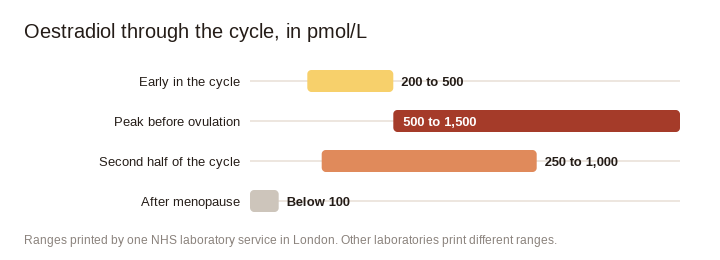
Check the unit before you compare numbers. A report may give oestradiol in pg/mL or in pmol/L. A study at the New Delhi hospital states the conversion it used: pg/mL multiplied by 3.67 gives pmol/L. By that factor, 100 pmol/L is 27.2 pg/mL, 180 pmol/L is 49.0 pg/mL and 505 pmol/L is 137.6 pg/mL.
The three NHS laboratories put the upper limit after menopause at 100, 180 and 505 pmol/L. The Endocrine Society's 2013 position statement says that when the same sample is measured at a different laboratory or on a different instrument, more often than not it does not return the same result.
No study of reference ranges by cycle phase in Indian women was found for this guide. Read your result against the range on your own report.
Why can one estradiol reading mislead?
One reading can mislead because oestradiol changes through the cycle, from one cycle to the next, and in the years around the final period.
- Within one cycle. The Society for Endocrinology, a UK professional body, says the level is lowest at menstruation, which usually occurs on days 1 to 5, and highest at ovulation, around days 12 to 14. A study that took blood daily from 30 healthy women set reference limits from 31 pmol/L in the early follicular phase to 2864 pmol/L at the mid-cycle LH peak.
- Between cycles. The authors of a laboratory study of reference values write, as background, that oestradiol can vary widely between cycles for the same woman.
- Before the final period. The staging workshop for reproductive ageing, held in 2011, describes cycles in the late menopausal transition as having "extreme fluctuations in hormonal levels", and mentions high oestradiol levels at that stage.
Writing about women who have had a hysterectomy or endometrial ablation, the staging workshop says a single sample for FSH and oestradiol may be ambiguous or misleading.
Can an estrogen test show perimenopause or menopause?
The sources disagree: NICE says not to use oestradiol for this in people aged 45 or over, while MedlinePlus lists perimenopause among the reasons for the test. The guideline positions are below, in each guideline's own age groups.
| Group, as the guideline defines it | What the guideline says | Source |
|---|---|---|
| Aged 45 or over, otherwise healthy, with menopause-associated symptoms | Identify perimenopause and menopause without laboratory tests. Perimenopause: hot flushes and sweats that have recently started and any changes in the menstrual cycle. Menopause: no period for at least 12 months while not using hormonal contraception. Do not use oestradiol to identify either | NICE |
| Aged 40 to 45 with symptoms, including a change in the menstrual cycle | Consider an FSH blood test to confirm menopause | NICE |
| Under 40, menopause suspected | Consider FSH. Diagnose premature ovarian insufficiency on symptoms and raised FSH on 2 blood samples taken 4 to 6 weeks apart, not on a single blood test | NICE |
| Natural menopause | Diagnose primarily on clinical history, after 12 months without a period in women aged 45 or over. FSH, oestradiol and anti-Müllerian hormone are not recommended for the diagnosis | Indian Menopause Society, 2026 |
| Under 40, premature ovarian insufficiency | Disordered cycles for at least 4 months and FSH above 25 IU/L. One FSH test is sufficient with the clinical picture, and a second is needed only when the diagnosis is uncertain | A 2024 guideline from ESHRE and three partner organisations |
The Indian Menopause Society's 2026 guideline says blood markers are preferably restricted to special situations, such as premature ovarian insufficiency, an uncertain menstrual history and fertility counselling. It also states that FSH above 35 to 40 IU/L and oestradiol below 20 pg/mL are diagnostic of menopause, a statement it grades C, against A for its statement that these markers are not recommended.
The 2024 guideline on premature ovarian insufficiency, from ESHRE, two other societies and a research centre, differs from NICE on the number of FSH tests. It does not recommend making the diagnosis on oestradiol, and adds that a low oestradiol with a raised FSH gives additional confirmation.
The NHS laboratory service in north-west London says oestradiol is rarely useful in the diagnosis of menopause.
Our guides on whether this is perimenopause, hormone tests in perimenopause and the FSH and LH test cover the symptoms and the other tests.
When is an estradiol test useful?
The sources name these uses and disagree on one.
- Periods that stop before 40. The north-west London laboratory says the test may be helpful when premature ovarian failure is suspected.
- Absent or irregular periods. The Newcastle laboratory says oestradiol often forms part of the evaluation of absent periods, painful periods and infertility, read with FSH and LH.
- Fertility assessment. The American Society for Reproductive Medicine says an early-cycle oestradiol level should not be used alone to screen for diminished ovarian reserve. It says the test has value only as an aid to interpreting a normal FSH result.
- IVF and ovulation induction. The Endocrine Society's statement and MedlinePlus describe the test as a way to monitor treatment. The 2025 update of ESHRE's guideline on ovarian stimulation says adding oestradiol measurements to ultrasound monitoring is probably not recommended.
- A suspected oestrogen-producing tumour of the ovary, and early or late puberty. MedlinePlus lists both.
Monitoring hormone therapy: the sources disagree. MedlinePlus lists monitoring hormone therapy for menopause as a use of the test. The North American Menopause Society's 2022 position statement, in its section on compounded hormones, says blood hormone testing is rarely needed. The north-west London laboratory does not recommend the test for monitoring oral HRT. Ask the doctor who prescribes your treatment.
How accurate is the estradiol test at low levels?
It is less accurate at low levels, according to the Endocrine Society's 2013 position statement, which says most commercial tests cannot accurately measure oestradiol in women after menopause, at levels below 20 pg/mL. It says methods based on mass spectrometry appear suitable for addressing some of these shortcomings, though they may have difficulty below 5 pg/mL.
The statement says modern tests are well suited to diagnosing and managing infertility, and adds that imprecision and differences between methods remain a problem. No later update was found for this guide.
How is the estradiol test done, and do cycle day, fasting and time of day matter?
The test is a blood sample from a vein in the arm, and the sources say little about timing.
- Day of the cycle. No source used here gives a cycle day for a general check. In a fertility assessment, the American Society for Reproductive Medicine describes FSH on day 2, 3 or 4 of the cycle, with oestradiol read alongside it.
- Fasting and time of day. No source used here mentions either.
- Hormonal contraception. The Indian Menopause Society's 2026 guideline says FSH and E2 testing is unreliable during combined hormonal contraception, which suppresses oestradiol.
- Other medicines and supplements. MedlinePlus says certain medicines may affect the result, and its list includes the pill and oestrogen.
- Saliva and urine tests. In its section on compounded hormones, the North American Menopause Society's 2022 statement says saliva and urine hormone testing to set a dose is unreliable and not recommended.
Do not stop a prescribed medicine, the pill or hormone therapy for a test unless the doctor who prescribes it tells you to.
What can low or high estradiol mean?
A low or high result has several possible causes.
Low oestradiol. The Endocrine Society's patient page says the most common reason is menopause or surgical removal of the ovaries. Other sources name premature ovarian insufficiency, a problem with the pituitary gland or hypothalamus, and combined hormonal contraception. Our guide to low oestrogen symptoms covers the symptoms.
High oestradiol. The Society for Endocrinology says it is unusual for women to have too much oestradiol outside hormonal treatments. The NHS laboratory pages name pregnancy, fertility treatment, HRT and an oestrogen-producing tumour of the ovary.
What is "estrogen dominance"?
"Estrogen dominance" is not a diagnosis in any guideline read for this guide. Each guideline, society statement, MedlinePlus page and NHS laboratory page used here was searched for the word "dominance", and none uses it of oestrogen. A web search on 23 November 2026 found no professional society statement that rejects the term by name.
The Endocrine Society's patient page on reproductive hormones says low progesterone can cause too-high levels of oestrogen. The page does not use the word dominance, and it lists no references.
The staging workshop mentions high oestradiol levels in the late menopausal transition, without naming this a condition or giving a test for it.
What is known about menopause in India?
The Indian figures come from surveys that asked women about their periods, and none measured oestradiol.
- In a survey by members of the Indian Menopause Society in 21 cities, the mean age at natural menopause was 46.2 years. The survey interviewed women who accompanied patients to gynaecology clinics, and each woman gave her age at menopause from memory.
- In an analysis of the national family health survey of 2019 to 2021, among women aged 30 to 39, 4.73% in rural areas and 2.55% in urban areas were classed as in menopause. The answers were self-reported, and the count includes women who had a hysterectomy, so it is not a rate of premature ovarian insufficiency.
Where Yellow fits
Our guides to the FSH and LH test and the prolactin test cover two other tests on the same panel.
Oestradiol is in Yellow's blood panel. It is also one of the 22 tests in the perimenopause panel, which includes FSH, LH, progesterone and prolactin.
Frequently Asked Questions
My estradiol level is 45. Is that normal?
First check the unit. In pg/mL, 45 sits inside the 30 to 400 pg/mL range that MedlinePlus gives for women before menopause, and above the 0 to 30 pg/mL it gives after menopause. Each laboratory prints its own range, and the level changes through the cycle, so read the number against your own report.
Which day of the cycle should an estradiol (E2) test be done?
No source used for this guide gives a cycle day for a general check. In a fertility assessment, the American Society for Reproductive Medicine describes FSH measured on day 2, 3 or 4 of the cycle, with oestradiol read alongside it. Ask the doctor who ordered the test which day applies to you.
Do I need to fast before an estrogen test?
None of the sources used for this guide mentions fasting for an oestradiol test, and none gives a time of day for the sample. MedlinePlus, a US government health site, describes the test as a blood sample from a vein in the arm. Follow the instruction your lab gives when you book.
How do I confirm menopause? Can an estrogen test do it?
NICE, the UK's guideline body, says menopause in otherwise healthy people aged 45 or over with symptoms is identified without laboratory tests, after at least 12 months with no period while not using hormonal contraception. It says not to use oestradiol for this. The Indian Menopause Society's 2026 guideline also bases the diagnosis primarily on clinical history.
What does a day 2 or day 3 estradiol result mean for fertility?
The American Society for Reproductive Medicine says this result should not be used alone to screen for diminished ovarian reserve. It helps a doctor interpret a normal FSH result. The society says that when FSH is normal and oestradiol is raised, above 60 to 80 pg/mL, this may indicate ovarian dysfunction from diminished ovarian reserve.
What is estrogen dominance?
It is not a diagnosis in any guideline read for this guide, and a web search found no professional society statement on the term. An Endocrine Society patient page says low progesterone can cause too-high oestrogen, without using the word dominance. The staging workshop for reproductive ageing mentions high oestradiol levels in the late menopausal transition.
How much does an estradiol test cost in India?
On 23 November 2026, eight labs and lab-booking sites in India listed an estradiol (E2) test at ₹351 to ₹1,000, with a middle price of about ₹690. The price changes by city and with the offer running that day. Estradiol is one of the 22 tests in Yellow's perimenopause panel, which costs ₹4,999.
Further Reading
- National Institute for Health and Care Excellence. Menopause: identification and management. NICE guideline NG23. Published 12 November 2015, last updated 15 April 2026.
- Rosner W, Hankinson SE, Sluss PM, Vesper HW, Wierman ME. Challenges to the Measurement of Estradiol: An Endocrine Society Position Statement. Journal of Clinical Endocrinology and Metabolism, 2013;98(4):1376-1387.
- Harlow SD, Gass M, Hall JE, et al. Executive summary of the Stages of Reproductive Aging Workshop + 10: addressing the unfinished agenda of staging reproductive aging. Menopause, 2012;19(4):387-395.
- MedlinePlus, US National Library of Medicine. Estrogen Levels Test. Last updated 30 July 2025.
- Ahuja M. Age of menopause and determinants of menopause age: A PAN India survey by IMS. Journal of Midlife Health, 2016;7(3):126-131.